
IndiaFilings
Expert
Published on: Jul 30, 2026
What is Registered Design?
Registered design is a shape, configuration, pattern or ornament or composition of lines or colour or combination thereof applied to any article whether two dimensional or three dimensional protected under the Designs Act, 2000. Design registration is similar to copyright registration, patent or trademark registration and a type of intellectual property registration - which protects creations of the mind. In this article, we review the basics of registered design in India.
Registered Design
As per the Designs Act, 2000, a ‘Design’ means only the features of shape, configuration, pattern or ornament or composition of lines or colour or combination thereof applied to any article whether two dimensional or three dimensional or in both forms, by any industrial process or means, whether manual, mechanical or chemical, separate or combined, which in the finished article appeal to and are judged solely by the eye, but does not include any mode or principle or construction or any thing which is in substance a mere mechanical device, and does not include any trade mark or copyright. A design registration in India under the Designs Act, 2000 is referred to as a registered design.
Designs that can be Registered
For a design to be registered under the Designs Act, it must satisfy the following six conditions:
- The design should be new or original, not previously published or used in any country before the date of application for registration.
- The design should relate to features of shape, configuration, pattern or ornamentation applied or applicable to an article. Thus, designs of industrial plans, layouts and installations are not registrable under the Act.
- The design should be applied or applicable to any article by any industrial process. Normally, designs of artistic nature like painting, sculptures and the like which are not produced in bulk by any industrial process are excluded from registration under the Act.
- The features of the design in the finished article should appeal to and are judged solely by the eye. This implies that the design must appear and should be visible on the finished article, for which it is meant. Thus, any design in the inside arrangement of a box, money purse or almirah may not be considered for showing such articles in the open state, as those articles are generally put in the market in the closed state.
- Any mode or principle of construction or operation or any thing which is in substance a mere mechanical device, would not be registrable design.
- The design should not include any Trademark or Copyright.
Examples of Registered Designs
A wide variety of items can be registered under the Designs Act in India. Items ranging from cutlery to dress can be registered as a design in India provided its original and not be a mere mechanical contraption.
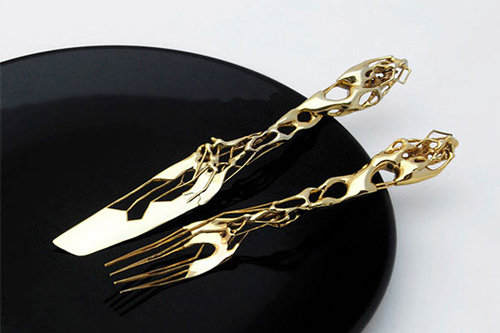 Design Registration Example 1
 Design Registration Example 2
Items that Cannot be Registered as a Design
The following items cannot be registered as a design:
- Books, jackets, calendars, certificates, forms-and other documents, dressmaking patterns, greeting cards, leaflets, maps and plan cards, postcards, stamps, medals.
- Labels, tokens, cards, cartoons. any principle or mode of construction of an article.
- Mere mechanical contrivance.
- Buildings and structures.
- Parts of articles not manufactured and sold separately.
- Variations commonly used in the trade.
- Mere workshop alterations of components of an assembly.
- Mere change in size of article.
- Flags, emblems or signs of any country.
- Layout designs of integrated circuits.
Benefits of Design Registration
All documents pertaining to a registered design are maintained by the Patent Office to put competitors on notice about registration of a design. A registered design provides the creator, exclusive rights over use of the design for a period of ten years, that can be further extended for a period of five years. In case of infringement or piracy of a registered design, the owner of the registered design can seek legal remedy under the Designs Act. Anyone found contravening to the copyright in a design, is liable for every offence to pay a sum not exceeding Rs. 25,000/- to the registered proprietor subject to a maximum of Rs. 50,000/- recoverable as contract debt in respect of any one design. Thus, registering a design provides legal remedy against infringement.
IndiaFilings.com can help you with design search or design registration in India. Talk to an IndiaFilings Business Expert of visit IndiaFilings.com to know more.