IndiaFilings

Expert

Published on: Jun 24, 2026

Share Certificate

Share certificate serves as an important document for shareholders to prove ownership in a company. Share certificate must be issued by a company after incorporation to its shareholders on receipt of money for capital. Further, in case of issue of additional shares or transfer of shares, share certificates are again issued by the company. In this article, we look at the share certificate format in India and procedure for issue of Share Certificate.

Procedure for Issue of Share Certificate

The latest MCA notification with procedure for issue of share certificate is Notification for Amendment in Schedule I of the Companies Act, 2013 -dated 10.04.2018. A copy of the notification is reproduced below for reference. According to the notification, a share certificate should specify the share and the amount of paid-up capital it relates to. Further, the Share Certificate must be signed by a minimum of two Directors of the company or by a Director and a company secretary. The signature fo the Director can be affixed with a

digital signature or printed by means of a machine, equipment or other mechanical means such as engraving in metal or lithography. However, affixing Directors Signature by means of a rubber stamp is not allowed. In case a common seal is placed on the share certificate, it must be affixed in the presence of the person who signed the Share Certificate. However, it is no longer required to affix the common seal of the company and is optional. Know more about procedure for share transfer.

Share Certificate Format

A share certificate format acceptable in India is attached below for reference. In the Share Certificate format provided below, the company name and its registered office address would be printed at the top. The face value of each share, the amount paid-up and the name of the shareholder would also be printed along with the number of shares issued.
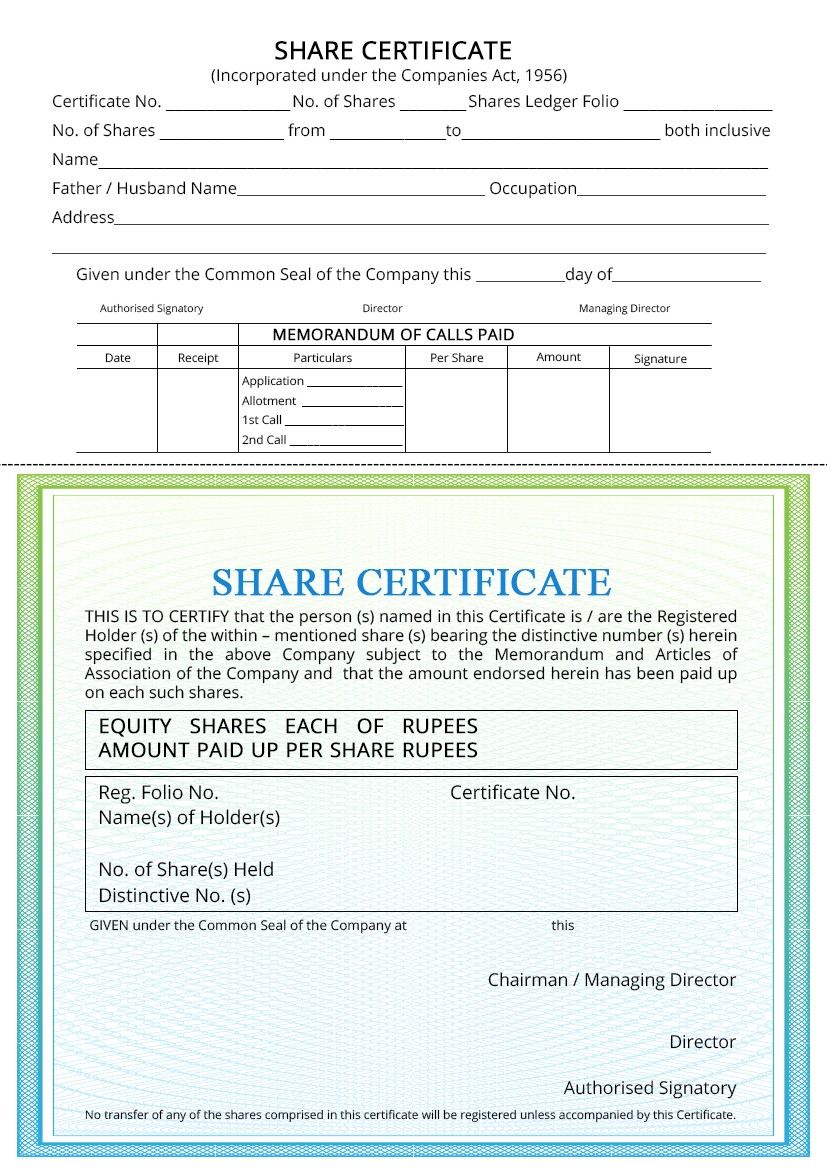
Share Certificate Format Share Certificate Format  
Back to Learn

Frequently Asked Questions

A share certificate is a legal document that serves as proof of ownership of shares in a company. It is an important document for shareholders as it certifies their stake and rights in the company.
The company itself is responsible for issuing share certificates to its shareholders after incorporation and whenever there is an issue of additional shares or transfer of shares.
According to the Companies Act, 2013, a share certificate should specify the number of shares, the amount of paid-up capital it relates to, and it must be signed by at least two directors or a director and a company secretary.
The share certificate must be signed by a minimum of two directors or a director and a company secretary. The signatures can be digital, printed by mechanical means like engraving or lithography, but rubber stamps are not allowed.
No, it is no longer mandatory to affix the company's common seal on the share certificate. It is now optional as per the latest amendments in the Companies Act, 2013.
Yes, a shareholder can request the company to issue a new share certificate in case the existing one is lost, stolen, or damaged. The company may follow specific procedures and charge a fee for issuing a duplicate certificate.
While there is no prescribed format, share certificates typically include the company's name, registered office address, face value of shares, amount paid-up, name of the shareholder, and the number of shares issued.
The ownership of shares is transferred through a process called 'share transfer.' The existing shareholder needs to surrender the share certificate and follow the company's procedures for transferring shares to the new shareholder, who will then receive a new share certificate.
No, a company cannot refuse to issue a share certificate to a shareholder who has paid for the shares. Issuing share certificates is a legal obligation for companies after incorporation and whenever shares are issued or transferred.
Having the share certificate signed by two directors or a director and a company secretary adds authenticity and validity to the document, as these authorized signatories represent the company's management and certify the ownership of shares.