

RENU SURESH
Expert
Published on: Jul 30, 2026
How To Start A Company in India?
Starting a company is one of the most significant decisions any entrepreneur can make. It requires strategic planning, legal structuring, financial foresight, and operational discipline. To help you establish a solid foundation, we have created the most detailed and actionable guide on How To Start A Company from scratch that covers everything from ideation to registration, compliance, and growth. This comprehensive roadmap ensures you don’t just start but thrive as a business owner.
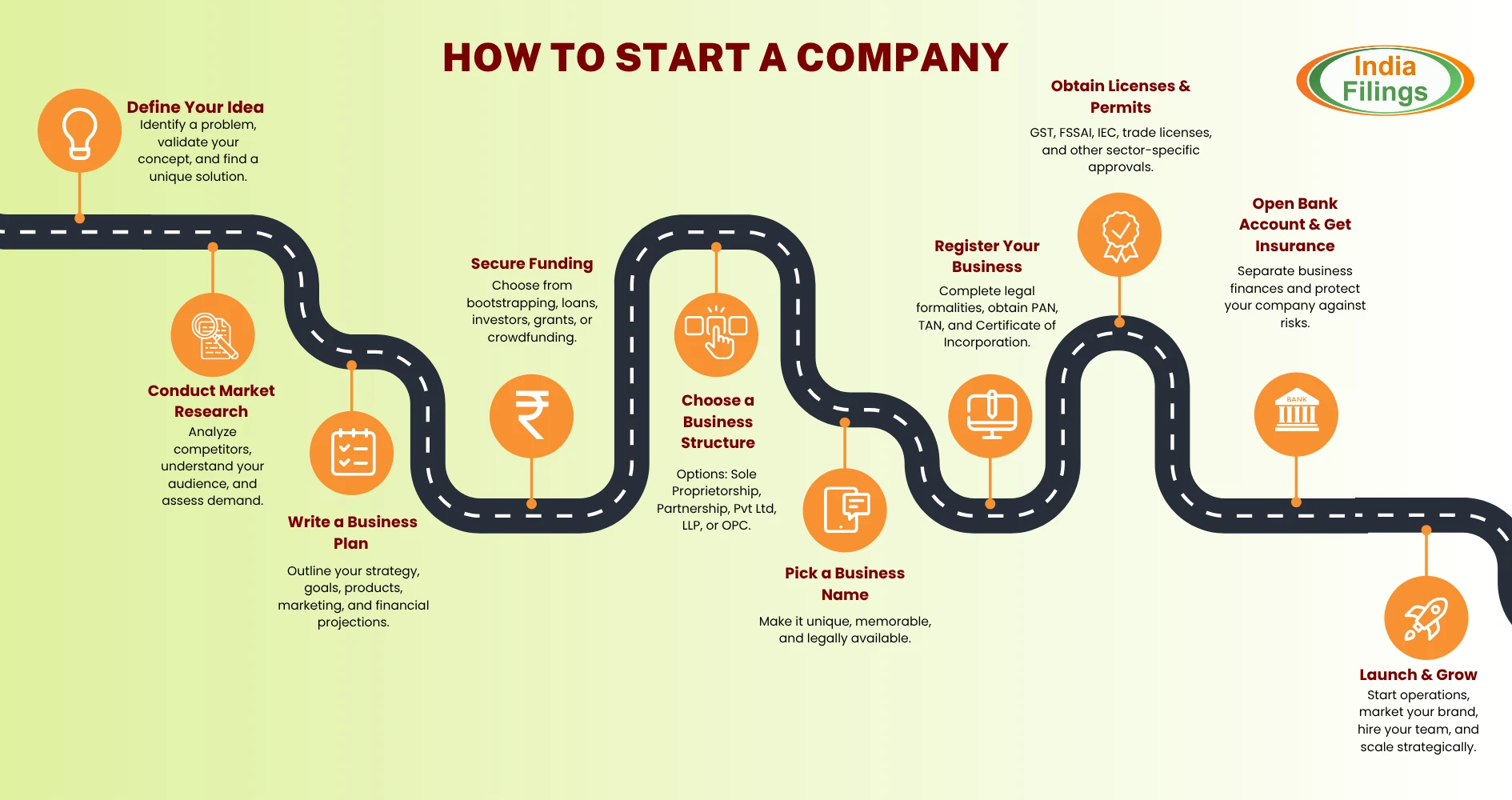
How To Start A Company in India?
Starting a company in India involves several legal, financial, and administrative steps. Here’s a complete step-by-step guide (2025 updated) to help you understand the process clearly:
Step 1. Define and Validate Your Business Idea
Every company begins with an business idea, but not every idea translates into a successful business. Before diving in, validate your concept through careful research and analysis.
- Identify a problem worth solving: The most sustainable businesses are built around solving pressing customer problems.
- Conduct customer interviews and surveys: Understand what potential buyers truly want.
- Check market demand: Use tools like Google Trends, industry reports, and competitor analysis to measure potential.
- Validate willingness to pay: Gauge whether customers are not only interested but ready to spend money.
By validating your idea early, you avoid wasted resources and ensure your company starts with a strong footing.
Click here to learn more about the How to Generate and Validate Business Ideas?
Step 2: Conduct Market Research Thoroughly
Launching without research is like sailing without a compass. Market research ensures that your company enters the market with clarity and competitiveness.
- Primary research: Collect first-hand information through interviews, surveys, and direct observation.
- Secondary research: Leverage industry reports, government publications, and competitor data.
- Market sizing: Estimate the total market size (TAM), serviceable market (SAM), and the share you can realistically capture (SOM).
- SWOT analysis: Document your Strengths, Weaknesses, Opportunities, and Threats.
A thorough research strategy will guide your business plan, product development, and marketing strategy.
Step 3: Write a Comprehensive Business Plan
A business plan acts as the blueprint of your company. It not only clarifies your goals but also attracts investors and stakeholders.
Key components of a strong business plan include:
- Executive Summary: Snapshot of your company vision and objectives.
- Business Description: Define your mission, vision, and the problem you aim to solve.
- Market Analysis: Summarize your industry research and competitive advantage.
- Organization Structure: Detail the team, roles, and legal structure of the company.
- Product/Service Offering: Explain your products or services in depth.
- Marketing and Sales Strategy: Outline how you will attract, convert, and retain customers.
- Funding Requirements: State how much money you need and how it will be used.
- Financial Projections: Include income statements, balance sheets, and cash flow forecasts for 3–5 years
Step 4: Secure Business Funding
Financing is often the most challenging yet crucial step. Your options include:
- Self-funding (Bootstrapping): Using personal savings to retain ownership and control.
- Bank Loans: Suitable for small and medium-sized businesses with strong repayment capacity.
- Angel Investors: Wealthy individuals investing in exchange for equity.
- Venture Capital (VC): Large funds for scalable startups with high growth potential.
- Government Grants and Subsidies: Programs supporting small businesses and startups.
- Crowdfunding: Check for Platforms offering public fundraising.
Each funding method has benefits and drawbacks; the right choice depends on your industry, stage, and scalability goals.
Click here to 11 Ways to Raise Funds for Startups in India
Step 5: Choose the Right Business Location
Your business location has long-term implications on costs, taxes, accessibility, and visibility.
- Brick-and-mortar business: Consider foot traffic, rental costs, customer accessibility, and competition.
- Online business: Focus on digital infrastructure, e-commerce platforms, and hosting reliability.
- Tax-friendly locations: Some states or regions offer tax incentives to encourage new businesses.
Select a location that aligns with your business model and customer base.
Step 6: Choose the Right Business Structure
Choosing the legal structure is critical as it impacts taxation, liability, and compliance. The most common structures include:
- Sole Proprietorship: Simple and low-cost, but the owner is personally liable.
- Partnership: Shared ownership and responsibilities, suitable for small businesses.
- Private Limited Company (Pvt Ltd): Separate legal identity, limited liability, and investor-friendly.
- Limited Liability Partnership (LLP): Hybrid model offering flexibility with limited liability.
- One Person Company (OPC): Ideal for solo entrepreneurs who want limited liability benefits.
- Public Limited Company: Best for large ventures seeking to raise capital from the public.
Recommendation: For most startups, a Private Limited Company is the preferred structure due to credibility, growth potential, and investor acceptance
Step 7: Choose and Protect Your Business Name
A powerful company name strengthens branding and creates recall.
- Ensure it’s unique and memorable.
- Verify domain availability for online presence.
- Check trademark databases to avoid infringement.
- Align it with your brand personality and mission.
Protect your name legally by registering it. Click here to learn about how to register company name.
Step 8: Register Your Company
Company registration formalizes your business and gives it legal recognition. The process involves:
- Obtaining Digital Signature Certificate (DSC) for directors.
- Applying for Director Identification Number (DIN).
- Reserving Company Name with the Ministry of Corporate Affairs (MCA).
- Drafting Incorporation Documents including Memorandum of Association (MOA) and 1
- Filing for Incorporation through the SPICe+ form on the MCA portal.
- Receiving Certificate of Incorporation which provides your Corporate Identity Number (CIN).
- Applying for PAN & TAN to enable tax compliance.
After registration, your company is officially recognized as a legal entity.
Step 9: Obtain Tax IDs and Comply with Tax Regulations
Every business must comply with taxation requirements.
- Permanent Account Number (PAN) – Required for tax filings.
- Tax Deduction and Collection Account Number (TAN) – Mandatory for businesses deducting tax at source.
- Goods and Services Tax (GST) – Required if turnover crosses prescribed thresholds or if operating interstate.
- State-specific registrations – For professional tax or other local levies.
Registering for taxes ensures your company remains compliant and avoids penalties.
Step 10: Obtain Mandatory Licenses and Permits
Depending on your industry, you may require additional licenses and permits to operate legally. Some of the common ones include:
- GST Registration: Mandatory for businesses exceeding the prescribed turnover threshold.
- Professional Tax Registration: Applicable in certain states.
- Shops and Establishment Act License: Required for setting up offices or outlets.
- Trade License: Necessary for commercial operations within municipal limits.
- FSSAI License: Compulsory for businesses in the food sector.
- Import Export Code (IEC): Required for businesses dealing in international trade.
Skipping licenses can result in penalties and legal issues, so ensure compliance from the start.
Step 11: Open a Business Bank Account
Opening a dedicated business bank account separates personal and business finances, ensuring smoother financial management and tax compliance. To open an account, you typically need:
- Certificate of Incorporation
- Memorandum & Articles of Association
- PAN card of the company
- Address proof of the registered office
- Authorised signatories’ documents
A separate account also enhances credibility with clients, investors, and suppliers.
Step 12: Build Your Brand Identity
Branding goes beyond just a logo; it defines how your customers perceive your company. Focus on building a strong identity with:
- Company name and logo: Memorable and relevant to your business.
- Website development: A professional website acts as your digital storefront.
- Social media presence: Consistency across platforms builds trust and visibility.
- Unique Value Proposition (UVP): Clearly articulate why customers should choose you over competitors.Brand tone and voice: Align communication style with your target audience.
A strong brand identity creates lasting recognition and competitive advantage.
Step 13: Protect Your Business with Insurance
Safeguard against risks with the right insurance policies:
- General Liability Insurance – Covers lawsuits and damages.
- Property Insurance – Protects company assets.
- Professional Liability Insurance – For service-based companies.
- Workers’ Compensation Insurance – Covers employee injuries.
- Health Insurance Plans – To retain and protect employees.
Insurance is an investment in business continuity and risk management.
Step 14: Build Your Team and Organisational Structure
As your company grows, recruit the right talent.
- Hire based on skills, culture fit, and experience.
- Define clear roles and responsibilities.
- Implement HR policies covering recruitment, payroll, benefits, and employee welfare.
- Use tools for project management, communication, and productivity.
A motivated workforce drives innovation and scalability.
Step 15: Set Up Accounting and Bookkeeping Systems
Proper financial management is the backbone of a successful company. From day one, establish systems to track income, expenses, and compliance.
- Choose accounting software: Use to simplify record-keeping, accounting & more.
- Hire a professional accountant: Helps in managing tax filings, payroll, and financial audits.
- Maintain compliance records: Regularly update ROC filings, GST returns, and income tax returns.
- Prepare financial statements: Monthly and quarterly reports help track growth and performance.
Maintaining transparent financial records also helps attract investors and avoid legal penalties.
Step 16: Develop Your Product or Service
Whether you are creating a physical product, software, or a service, ensure quality and differentiation. Steps include:
- Prototype development: Create a minimum viable product (MVP) for testing.
- Customer feedback loop: Collect insights from early adopters to refine offerings.
- Supply chain setup: Secure reliable vendors and distributors.
- Quality assurance: Implement standards to maintain consistency.
Iteration and improvement at this stage ensure your offering stands out in the market.
Step 17: Create a Marketing and Sales Strategy
No matter how good your product is, success depends on your ability to attract and retain customers. Develop a strategy that includes:
- Digital Marketing: SEO, content marketing, paid ads, and social media campaigns.
- Offline Marketing: Print media, events, trade shows, and networking.
- Sales Funnel: Define lead generation, conversion, and customer nurturing steps.
- Customer Relationship Management (CRM): Tools like HubSpot or Zoho CRM streamline interactions.
- Pricing strategy: Competitive yet profitable pricing drives adoption.
Effective marketing and sales execution can set your company on a growth trajectory.
Step 18: Scale and Expand Strategically
Once established, focus on sustainable growth. Expansion strategies include:
- Geographic expansion: Entering new cities, regions, or international markets.
- Product diversification: Launching complementary offerings.
- Partnerships and collaborations: Strategic alliances with other companies.
- Automation and technology adoption: Streamlining operations for efficiency.
- Franchising or licensing: Extending brand reach without heavy capital investment.
Scaling smartly ensures that your company grows without compromising quality or culture.
Conclusion: Take the First Step Today
Starting a company is not just about registering a business; it’s about creating a legacy. From refining your business idea and building a strong foundation to ensuring compliance and driving growth, every step matters. The journey may be challenging, but with the right guidance, the process becomes seamless.
IndiaFilings has empowered thousands of entrepreneurs to transform their business ideas into successful ventures. From company registration and tax compliance to legal advisory and growth consultation, we simplify entrepreneurship for you.
Get started with IndiaFilings today and turn your vision into reality.
Related Guides:
How to Start a Pharmaceutical Company in 2025?
Why starting a company is hard?
Is starting a company worth it?
What is the easiest way to start a company?
Definition of a Company in Law