

RENU SURESH
Expert
Published on: Jul 30, 2026
Domestic Company: Definitions, Types, Benefits, Registration, Taxation & Compliance
A Domestic Company is a legal entity incorporated and registered within a country, primarily operating within its national boundaries. In India, domestic companies are governed by the Companies Act, 2013, and are subject to national taxation, compliance, and regulatory frameworks. Domestic companies can take multiple forms, ranging from Private Limited Companies to Sole Proprietorships, Limited Liability Partnerships (LLPs), One Person Companies (OPCs), and Public Limited Companies.
These companies play a crucial role in the economy by creating employment, contributing to tax revenue, and supporting industrial and commercial growth. Their legal structure ensures limited liability protection, financial credibility, and regulatory compliance, making them the preferred choice for local entrepreneurs and investors seeking stability and growth.
What is a Domestic Company?
As mentioned, A Domestic Company is a business entity that operates primarily within its home country and conducts commercial activities in accordance with local laws and regulations. Such companies are subject to domestic taxation, meaning their income is taxed under the country’s corporate tax framework, and they are required to pay duties or fees on imported goods when applicable.
Domestic companies benefit from a simplified operational framework within their home country. Once incorporated, they can easily conduct business in other states or regions of the country where they have filed their articles of incorporation, ensuring legal recognition and smooth operations.
In the context of domestic trade, both the buyer and seller are located within the same country, and all trade agreements are governed by the laws, practices, and commercial customs of that nation. This facilitates regulated, predictable, and compliant business transactions while fostering local economic growth.
Domestic Company Taxation
As per Section 2(22A), A Domestic Company is an Indian company, or any other company, that, for the purpose of taxation under Indian law, has made the necessary arrangements to declare and pay dividends within India, including dividends on preference shares, from its income liable to tax.
This definition ensures that a Domestic Company is recognized for taxation purposes, with a clear obligation to distribute profits locally in compliance with Indian tax regulations.
Key Features of a Domestic Company
Domestic companies possess several distinctive characteristics that differentiate them from foreign entities. These features ensure compliance with national laws, strengthen local governance, and contribute significantly to the country’s economic development. Below are the key features of a Domestic Company:
1. Incorporation Within the Country
A Domestic Company is incorporated and registered under the laws of the country in which it operates. This incorporation subjects the company to the nation’s legal framework, corporate governance norms, and compliance obligations outlined by local authorities.
2. Local Ownership and Control
Most domestic companies are owned, managed, and controlled by residents or citizens of the country. This promotes national ownership, encourages local entrepreneurship, and strengthens domestic economic participation.
3. Domestic Taxation
Domestic companies are liable to pay taxes at the prevailing corporate tax rate applicable within their home country. The rate may vary depending on the company’s legal structure, turnover, and nature of business operations. Tax compliance ensures contribution to the national revenue system and overall fiscal health.
4. Local Business Operations
A defining characteristic of domestic companies is that their primary commercial and operational activities are conducted within the country’s borders. By operating locally, these companies play a crucial role in boosting domestic production, employment, and GDP growth.
5. Regulatory Compliance
Domestic companies must adhere strictly to the regulatory framework and statutory requirements established by local governing bodies. This includes compliance with labor laws, corporate filings, annual returns, environmental norms, and other business regulations to maintain legal standing.
6. Financial Reporting Standards
Domestic companies are required to prepare and present financial statements according to national accounting and reporting standards. This ensures transparency, accountability, and uniformity in financial disclosures, enabling investors and regulators to assess performance effectively.
7. Access to Local Funding
Domestic companies typically enjoy greater access to local banks, financial institutions, and government-backed schemes for raising capital or obtaining credit. With a strong local presence and regulatory recognition, securing business loans or financial assistance becomes easier and faster.
Types of Domestic Companies
Domestic companies are classified based on their ownership structure, liability, and operational framework. Understanding the various types helps entrepreneurs and investors choose the most appropriate structure for their business goals, risk appetite, and compliance needs. Below are the main types of domestic companies commonly registered under national laws such as the Companies Act, 2013 in India.
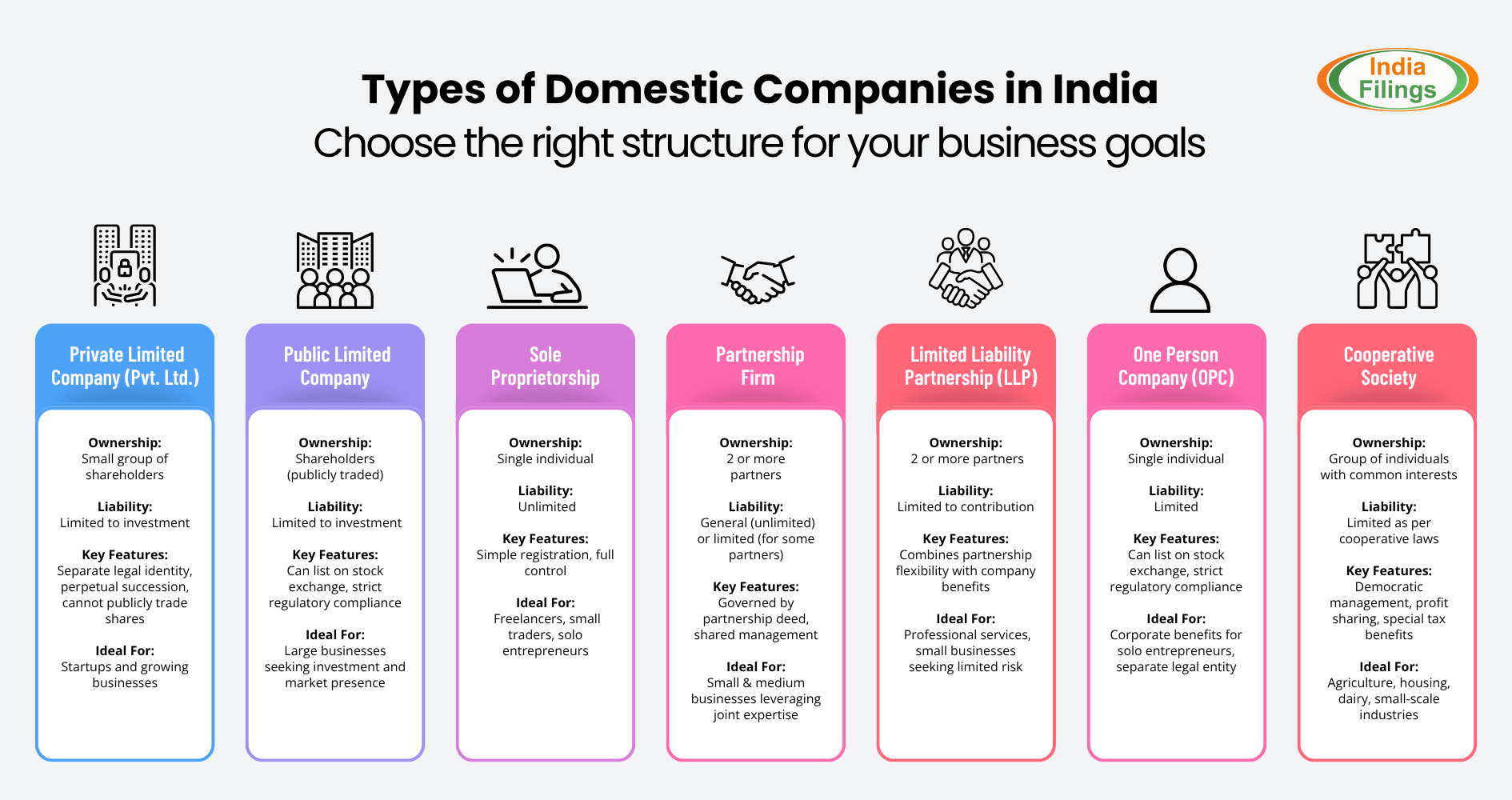
1. Private Limited Company
A Private Limited Company (Pvt. Ltd.) is one of the most preferred forms of business for startups and growing enterprises. It is owned by a small group of shareholders, and the liability of each shareholder is limited to the amount invested in their shares.
Private limited companies cannot publicly trade their shares and must adhere to certain restrictions on share transfer. They offer the advantages of limited liability, separate legal existence, and perpetual succession, making them ideal for small to medium-scale businesses seeking credibility and growth opportunities.
Launch your Private Limited Company with IndiaFilings today and enjoy limited liability, credibility, and growth opportunities!
2. Public Limited Company
A Public Limited Company is a larger corporate entity that offers its shares to the public and can be listed on a stock exchange. Ownership is distributed among shareholders who can freely buy or sell shares in the open market.
These companies must comply with strict regulatory, financial, and disclosure requirements, ensuring transparency for investors. They are suitable for large-scale businesses looking to raise substantial capital through public investment and enhance their market presence.
Start your Public Limited Company with IndiaFilings and raise capital, expand your business, and build a strong market presence!
3. Sole Proprietorship
A Sole Proprietorship is the simplest form of business structure, owned and managed by a single individual. It requires minimal registration and offers complete control to the owner. However, the major drawback is unlimited liability, meaning the owner is personally responsible for all business debts and obligations.
This structure is ideal for small traders, freelancers, and individual entrepreneurs looking for flexibility and ease of operation.
4. Partnership Firm
A Partnership Firm is owned by two or more individuals who agree to share profits, losses, and responsibilities of the business. Partnerships can be general partnerships, where all partners have unlimited liability, or limited partnerships, where some partners enjoy limited liability.
Partnerships are governed by a partnership deed, which outlines each partner’s role, profit-sharing ratio, and responsibilities. This form is suitable for small and medium-sized businesses that rely on joint expertise and shared management.
Register your Partnership Firm with IndiaFilings and streamline profit-sharing, responsibilities, and legal compliance!"
5. Limited Liability Partnership (LLP)
A Limited Liability Partnership (LLP) is a modern hybrid structure that combines the benefits of a partnership and a company. It provides partners with limited liability protection, meaning their personal assets are safeguarded against business debts, while maintaining operational flexibility.LLPs are governed by the Limited Liability Partnership Act, 2008, and are ideal for professional services firms, consultants, and small businesses seeking limited risk and simple compliance.
6. One Person Company (OPC)
The One Person Company (OPC) is a unique business model introduced under the Companies Act, 2013, designed for solo entrepreneurs. It allows a single individual to operate a company with limited liability, without the need for multiple shareholders or directors.
An OPC offers the advantages of a corporate structure—such as separate legal identity, perpetual succession, and better funding prospects—while retaining the simplicity of sole ownership. This structure is perfect for individual professionals and small business owners aiming for scalability.
7. Cooperative Society
A Cooperative Society is a collective organization formed by a group of individuals who voluntarily come together to promote their common economic, social, or cultural interests. Members pool resources and share profits equitably.Cooperative societies are often found in agriculture, housing, dairy, and small-scale industries, functioning on the principle of mutual help and democratic management. They are governed by cooperative laws and enjoy special tax and operational privileges in many jurisdictions.
Choosing the Right Type of Domestic Company
Selecting the right business structure depends on several factors, including capital requirements, ownership preferences, liability concerns, and long-term goals.
For instance, a Private Limited Company may be suitable for startups seeking investment, while an LLP or OPC works better for professionals or solo entrepreneurs looking for flexibility with limited liability.
Advantages of a Domestic Company
Domestic companies offer a variety of benefits that make them an attractive choice for business owners, enhancing operational efficiency, financial stability, and market presence. The key advantages include
1. Ease of Registration
Domestic companies can be registered relatively easily by following local legal and regulatory procedures. This simplifies the incorporation process and allows entrepreneurs to start operations quickly.
2. Tax Benefits
Many governments provide tax incentives, rebates, and deductions to promote domestic business activity. These benefits help reduce the overall tax burden, making domestic companies financially more viable.
3. Business Loan Accessibility
Domestic companies enjoy better access to local financial institutions for securing business loans, as banks and lenders are more familiar with their operations. Looking for quick funds? Check your pre-approved business loan offer with us and get financing instantly.
4. Legal Protection
Operating under national laws, domestic companies are safeguarded against unfair business practices, ensuring protection of their interests, intellectual property, and contracts.
5. Local Government Support
Domestic companies often receive subsidies, grants, and support programs aimed at promoting local industry, innovation, and economic development.
6. Market Familiarity
Being rooted in the local market, domestic companies have a deep understanding of consumer behavior, market trends, and cultural nuances, enabling them to create customer-focused strategies.
7. Employee Retention
Domestic companies can attract and retain talent who prefer working with well-known local businesses, enhancing workforce stability and productivity.
Disadvantages of a Domestic Company
Despite their numerous advantages, domestic companies face certain limitations and challenges that may affect growth and competitiveness:
1. Limited Global Reach
Domestic companies often struggle with international expansion due to limited global recognition, resources, and networks.
2. Tax Liabilities
Depending on the country, domestic companies may face high corporate taxes, impacting profitability. Efficient tax planning becomes crucial to maintain financial health.
3. Compliance Burden
Domestic companies must adhere to multiple statutory and regulatory requirements, including filing annual returns, audits, and labor compliance. This can be time-consuming and costly.
4. Economic Dependency
Domestic companies are heavily influenced by the local economy, making them vulnerable to market fluctuations, economic downturns, and policy changes.
5. Limited Foreign Investment
Attracting foreign investment may be challenging, especially for businesses that require international partnerships for growth and expansion.
6. Operational Restrictions
Local laws and regulations may impose constraints on certain business activities, reducing flexibility in operations and decision-making.
7. Cost Implications
Establishing and maintaining a Domestic Company can involve substantial expenses, including registration fees, compliance costs, and ongoing taxes, which may impact profitability, especially for small businesses.
How to Register a Domestic Company in India
Registering a domestic company in India is a structured process designed to ensure compliance with legal and regulatory requirements. Following the proper steps helps entrepreneurs establish their business efficiently while avoiding legal complications. Below is a detailed guide on how to register a Domestic Company, the required documents, compliance obligations, and a comparison with foreign companies.
1. Choose a Business Structure
The first step is to decide on the most suitable business structure based on your goals, investment, and liability preferences. Options include:
- Private Limited Company
- Public Limited Company
- Limited Liability Partnership (LLP)
- Sole Proprietorship
- One Person Company (OPC)
2. Obtain Digital Signature Certificate (DSC)
Directors must obtain a Digital Signature Certificate (DSC) to electronically sign documents submitted to the Ministry of Corporate Affairs (MCA).
3. Apply for Director Identification Number (DIN)
Every proposed director must have a DIN, which can be obtained through the MCA portal.
4. Name Approval
Submit a name reservation application using the RUN (Reserve Unique Name) service to secure a unique name for your company.
5. Filing Incorporation Documents
Prepare and file the Memorandum of Association (MOA) and 1 along with other required documents, with the Registrar of Companies (RoC).
6. Payment of Registration Fees
Pay the prescribed registration fees through the MCA portal to complete the incorporation process.
7. Obtain Certificate of Incorporation
Upon approval, the Certificate of Incorporation is issued, confirming the legal existence of the Domestic Company.
Documents Required for Registration
Accurate and complete documentation is critical to avoid delays. The essential documents include:
- Identity Proof of Directors: PAN card, passport, or voter ID
- Address Proof of Directors: Utility bills, Aadhaar card, or bank statements
- Registered Office Address Proof: Rental agreement or sale deed with NOC from the property owner
- MOA & AOA: Defining the company’s objectives and internal rules
- Digital Signature Certificate (DSC): Required for online filings
- Director Identification Number (DIN): Proof from MCA portal
- Certificate of Incorporation: Issued after successful registration
Compliance Requirements for Domestic Companies
Domestic companies must comply with various statutory requirements to maintain their legal status and operate smoothly:
- Annual Filings: Submission of financial statements and annual returns to regulatory authorities
- Statutory Audit: Conducting annual audits of financial statements as per legal requirements
- Board Meetings: Holding regular board meetings and maintaining accurate minutes as mandated by the Companies Act
- Income Tax Compliance: Timely payment of corporate taxes and adherence to income tax regulations and filing of income tax returns.
- GST Compliance: Filing Goods and Services Tax (GST) returns if applicable to your business
- Employee Compliance: Maintaining payroll records and complying with labor laws, provident fund, and other employee-related regulations
- Reporting Changes: Informing the RoC about changes in directors, registered office, or capital structure
Domestic Company Tax Rates in India
For assessment years 2025-26 and 2026-27, domestic companies in India are subject to income tax, surcharge, health and education cess, and, in some cases, Minimum Alternate Tax (MAT). The tax structure varies based on turnover, type of company, and special tax provisions opted for.
1. Standard Income Tax Rates
Type of Domestic Company | Assessment Year 2025-26 | Assessment Year 2026-27 |
Total turnover or gross receipts ≤ ₹400 crore | 25% | 25% |
Any other Domestic Company | 30% | 30% |
Domestic companies with total income exceeding ₹1 crore or ₹10 crore are also subject to surcharge as detailed below.
2. Surcharge on Domestic Companies
Surcharge is an additional charge on the income tax based on the total income of the company:
- 7% of income tax if total income exceeds ₹1 crore but does not exceed ₹10 crore.
- 12% of income tax if total income exceeds ₹10 crore.
Marginal Relief:
- If income exceeds ₹1 crore but ≤ ₹10 crore, the total tax and surcharge shall not exceed the tax on ₹1 crore plus the amount exceeding ₹1 crore.
- If income exceeds ₹10 crore, the total tax and surcharge shall not exceed the tax on ₹10 crore plus the amount exceeding ₹10 crore.
3. Health and Education Cess
All domestic companies are required to pay a Health and Education Cess at 4% of income tax plus applicable surcharge. This is mandatory for all companies, irrespective of their turnover or tax regime.
4. Minimum Alternate Tax (MAT)
Domestic companies are liable to pay MAT at 15% of book profit if the tax computed under normal provisions is lower than 15% of the book profit.
- Special MAT rate of 9% applies for companies operating as a unit of an International Financial Services Centre (IFSC) with income solely in convertible foreign exchange.
- Companies opting for Sections 115BAA or 115BAB are exempted from MAT, while those under Section 115BA are not.
5. Special Tax Regimes for Domestic Companies
Section | Applicable Tax Rate | Surcharge | Remarks |
Section 115BA | 25% | As per standard surcharge rules | Companies opting for 115BA are not exempt from MAT |
Section 115BAA | 22% | Flat 10% | Exempt from MAT; must forego certain deductions/exemptions |
Section 115BAB | 15% | Flat 10% | Applies to new manufacturing companies; exempt from MAT; subject to conditions for commencing production |
Health and Education Cess: 4% on income tax plus surcharge applies for all special regimes.
6. Key Takeaways
- Domestic companies with turnover ≤ ₹400 crore enjoy a lower base tax rate of 25%, while larger companies are taxed at 30%.
- Surcharge and cess increase the effective tax rate, but marginal relief ensures fairness for high-income companies.
- Special regimes like 115BAA and 115BAB offer significant tax benefits, especially for new manufacturing companies, but require companies to forego certain exemptions and deductions.
- MAT ensures minimum tax contribution, but exemptions under special sections encourage investment and business growth.
Click here to learn more about the Domestic Company Tax Rates
Domestic Company: Examples
A Domestic Company is a business incorporated and operating primarily within its home country, adhering to local laws, taxation, and regulatory compliance. Examples help illustrate how domestic companies function in practice:
1. Tata Consultancy Services (TCS)
- Type: Public Limited Company
- Country: India
TCS is incorporated in India and primarily conducts its operations under Indian law, paying corporate taxes in India while serving both domestic and international clients.
2. Reliance Industries Limited (RIL)
- Type: Public Limited Company
- Country: India
RIL operates across multiple sectors such as petrochemicals, refining, and telecommunications. Its operations are primarily based in India, making it a classic example of a Domestic Company.
3. Infosys Limited
- Type: Public Limited Company
- Country: India
Infosys, while a global IT services provider, is incorporated in India and adheres to domestic regulatory and taxation requirements, classifying it as a Domestic Company.
4. HDFC Bank
- Type: Private/Public Limited Company (Banking Sector)
- Country: India
HDFC Bank operates within India under Indian banking regulations and taxation laws, serving as an example of a domestic financial services company.
Domestic companies are incorporated locally, follow national regulations, and primarily serve the domestic market, though many may also engage in international business. Their primary obligation is compliance with local laws, taxation, and reporting standards.
Domestic Company vs. Foreign Company
Understanding the differences between domestic and foreign companies is crucial for strategic decision-making:
Aspect | Domestic Company | Foreign Company |
Definition | Incorporated and registered within the home country | Incorporated outside the home country but operating domestically |
Registration | Registered under domestic laws (e.g., Companies Act, 2013) | Registered under foreign laws and subject to Indian regulations |
Ownership & Control | Primarily owned and controlled by local residents | Controlled by foreign entities or investors |
Taxation | Taxed at domestic corporate rates | Taxed on income earned within India |
Legal Compliance | Follows local laws and regulations | Must comply with both foreign and domestic regulations |
Funding Options | Easier access to local business loans and government support | Limited access to local financing; it often relies on foreign investment |
Management & Operations | Managed by local stakeholders | Often managed by foreign nationals or representatives |
Profit Repatriation | Retained or reinvested locally | Profits may be repatriated to the home country |
Annual Reporting | As per domestic accounting standards | As per domestic and foreign standards |
Government Incentives | Eligible for local subsidies and tax benefits | May not qualify for local government incentives |
Click here to know more about Difference Between Domestic Company and Foreign Company
Conclusion
Both domestic and foreign companies play vital roles in the business ecosystem, each offering unique advantages. Domestic companies provide benefits such as local market familiarity, easier regulatory compliance, and access to business loans, making them ideal for entrepreneurs aiming to establish a strong presence in India. Foreign companies, on the other hand, bring global expertise and foreign investment, suited for businesses looking to expand internationally.
Choosing the right structure depends on your operational goals, expansion plans, and compliance readiness. Understanding the legal, financial, and operational implications ensures sustainable growth and regulatory adherence for your enterprise.
Ensure Your Company Stays Compliant with IndiaFilings!
IndiaFilings offers end-to-end support for domestic company registration, compliance management, and expert business advisory services. Get professional assistance today to register your Domestic Company seamlessly, complete all statutory filings on time, and maintain full compliance with Indian corporate regulations.
Contact IndiaFilings now to simplify your business setup and compliance journey.