
Marlin Priya
Expert
Published on: Jul 30, 2026
Karnataka FSSAI Registration and License
The Food Safety and Standards Authority of India is a licensing and registering system that regulates the laws related to food and establishing safety standards. In India, every Food Business Operators (FBO) that manufacture, store, distribute, sell and import food should acquire an FSSAI registration or license depending on the nature and size of the business. FSSAI license is granted as either State License or Central License. The State Authorities are responsible to issue the State FSSAI License in each state. In this article, we look at the procedure and documents required for Karnataka FSSAI Registration and License.
To obtain FSSAI registration or license in India, visit IndiaFilings.comFSSAI Licensing Vs FSSAI Registration
It is necessary that every Food Business Operators should have a FSSAI License to operate. However, FSSAI License is not required for businesses that has an annual turnover below 12 lakhs or if the production capacity falls below 100 kgs per. Such businesses rather requires an FSSAI Registration.
Know more.Documents Required
- Completed Form- B duly signed by the Partner/ Proprietor or Authorized Signatory.
- Name list of Directors / Proprietor / Partner / Executive Members of Society or Trust with full address and contact details (Mandatory for Companies only).
- Food category list desired to be manufactured (For manufacturer only).
- Blueprint/layout of the processing unit displaying the dimensions and allocation of the operation-wise area necessary for manufacturing and processing units.
- Name and list of machinery and equipment along with the number, installed capacity and horsepower used (Mandatory for manufacturing and processing units only).
- Authority letter with the name and address of the person responsible along with alternative responsible person nominated by the manufacturer, a collection of samples, packing and dispatch. (For manufacturers and processors).
- Analysis report of water to be used as an ingredient in food from a recognised / public health laboratory to confirm the portability. (Mandatory for manufacturing and processing units).
- Partnership Deed or MOA & AOA along with Incorporation Certificate and list of Directors with the address.Note: In the case of a company, three pages must be uploaded:
- First Page – Certificate of Incorporation
- Second Page – Food business activity authorisation
- Third Page – List of Directors with respective addresses
- No Objection Certificate & Copy of License from the manufacturer (Mandatory for repackers)
- Pesticide residues report of water if packaged mineral water, units manufacturing packaged drinking water or carbonated water from a recognised health laboratory.
- Certificate provided by the Ministry of Tourism (HRACC). (Mandatory for Hotels).
- Documentary proof of turnover or self-declaration of number of vehicles (Mandatory for Transporters)
- FSSAI Declaration Form
- Copy of certificate obtained under the Coop Act – 1861 / Multi-State Coop Act – 2002 in case of Cooperatives. (If applicable)
- Food Safety Management System Certificate or Plan (if any).
- Source of raw material for meat and meat processing plants.
- In case of milk or milk products processing units, milk source or procurement plan for milk that includes the location of milk collection centres. (if applicable).
- Photo id proof and address proof of Proprietor / Partner / Authorized Signatory issued by the Government (Optional).
- Proof of possession of premises (Sale deed / Rental Agreement / Electricity Bill) (Optional)
- Recall plan wherever applicable, with details of to whom the product is distributed (optional).
- NOC from Municipality or Local Body (optional).
Competent Authority
The Food Safety Officer is the registering authority while the Designated Licensing Officer is the competent authority for the issuance of License.
Fees
| License for Manufacturer/ Miller | Fees Per Year |
| For New License | |
| Hotels up to 4 Star | Rs. 5000 |
| Above 1 MT production per day | Rs. 5000 |
| From 10,001 to 50,000 LPD of milk or 501 MT to 2500 MT of solid milk production per annum | |
| Below 1 MT production per day | Rs. 3000 |
| From 501 MT to 10,000 LPD of milk or 2.5 MT to 500 MT of solid milk production per annum | |
| All Food Service Providers including Restaurants/ Boarding Houses/ Clubs/ Canteens (in Schools, Colleges, Office, Institutions)/ Caterers/ Banquet Halls with food catering arrangements/ Food Vendors/ Dabbawallas and other food business operators. | Rs. 2000 |
| For Renewal of License | Depends on number of years selected. |
| For Modification of License | Fees for modification of license for 1 year will be charged same during modification. |
| For Duplicate of License | 10% of license fees is applicable |
For Registration Certificate:
New Registration Certificate:- Rs.100/- Renewal of Registration Certificate: Rs.100/- Duplicate Copy of Registration Certificate:- 10 percent of the certificate fee.
Note: The fees paid for a license by any applicant is non-refundable under any circumstances.How to Apply?
To apply online for Karnataka FSSAI Registration and License visit the
official website of Food Safety Commissioner, Government of Karnataka. Step 1: Click ‘How to Apply’ option on the homepage of the official website.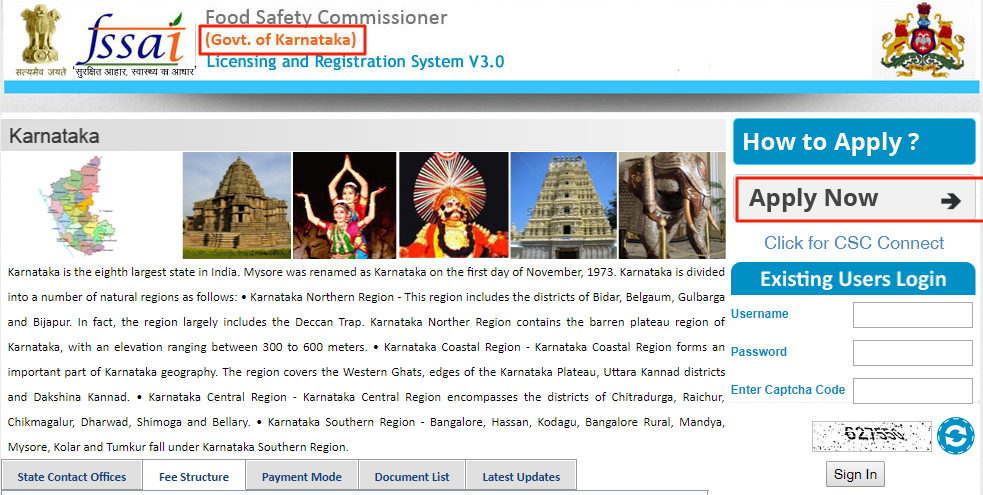 Karnataka FSSAI Registration and License - HomePage
Step 2: The declaration page appears. Click ‘Accept’ to proceed to apply.
Step 3: Select the state where the premise is located, for which the license is applied.
Step 4: Provide required information such as details of the business activities, type of business activity for which the license or the registration is required. Then click Proceed.
Karnataka FSSAI Registration and License - HomePage
Step 2: The declaration page appears. Click ‘Accept’ to proceed to apply.
Step 3: Select the state where the premise is located, for which the license is applied.
Step 4: Provide required information such as details of the business activities, type of business activity for which the license or the registration is required. Then click Proceed.
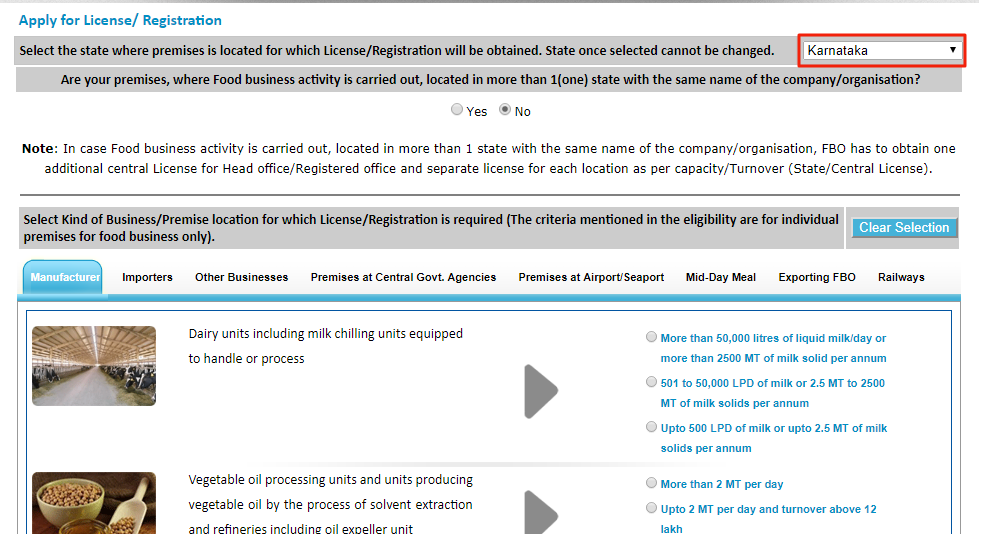 Karnataka FSSAI Registration and License - Apply for License or Registration
Step 5: Clicking on proceed will redirect to the portal that provides access to the application. Click on the link ‘Click to apply’ that redirects to the login page.
Karnataka FSSAI Registration and License - Apply for License or Registration
Step 5: Clicking on proceed will redirect to the portal that provides access to the application. Click on the link ‘Click to apply’ that redirects to the login page.
 Karnataka FSSAI Registration and License - apply for business
Step 6: Enter the credentials to login if an already registered user. In other cases, register as a member to apply.
Karnataka FSSAI Registration and License - apply for business
Step 6: Enter the credentials to login if an already registered user. In other cases, register as a member to apply.
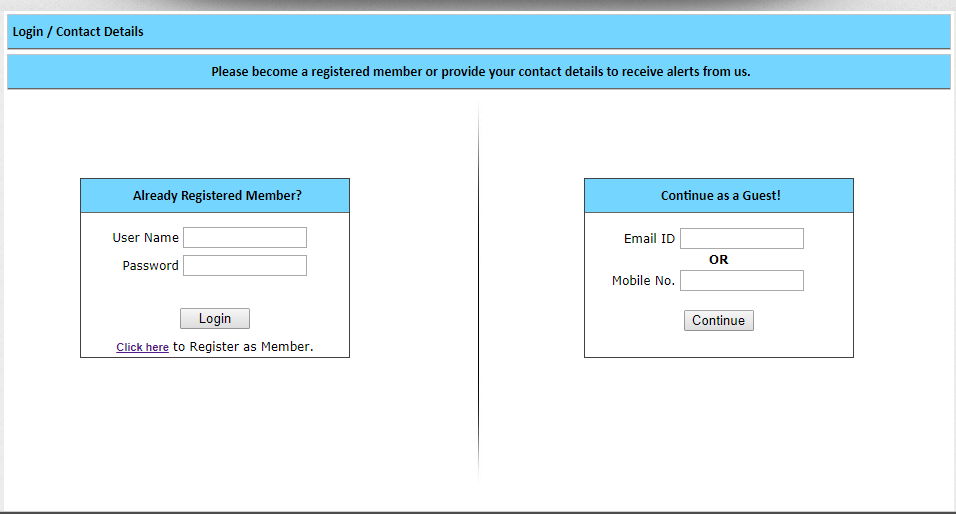 Karnataka FSSAI Registration and License - Login
Step 7: The application form for obtaining the license or registration appears based on the service selected.
Step 8: Fill in the form and upload the documents required and click submit.
Karnataka FSSAI Registration and License - Login
Step 7: The application form for obtaining the license or registration appears based on the service selected.
Step 8: Fill in the form and upload the documents required and click submit.
Renewal of License
Renewal of license should be made 30 days before the expiry of the license delaying of which will attract penalties.
Documents Required for Renewal
- Duly completed Form B
- Annual Audit Report
- Form IX – Nomination of a person along with the Board of Resolution by the company.
- Self-declaration