

RENU SURESH
Expert
Published on: Jul 30, 2026
Device And Word Marks In Trademark Registration
Trademark registration is a pivotal step for businesses to safeguard their intellectual property, ensuring exclusive rights to their brand's identity. Whether you're protecting a brand name, logo, or slogan, choosing the right trademark category is essential to securing long-term protection. In India, the primary trademark categories include Word Marks and Device Marks. Both categories offer distinct advantages and limitations depending on your business's branding needs. This article provides an in-depth exploration of both Device Marks and Word Marks in trademark registration, explaining their characteristics, advantages, and best practices for registration.
Understanding Trademark Categories in India
Trademarks are classified into various categories based on their form and use. In India, businesses can register trademarks under the following categories:
- Word Marks
- Device Marks
- Colour Marks
- Three-Dimensional Marks
- Sound Marks
In this article, we focus on the two most common categories: Word Marks and Device Marks.
What is a Word Mark?
A Word Mark consists solely of words, letters, numerals, or a combination thereof. Importantly, a Word Mark focuses exclusively on the textual aspect, without any design or graphic element. This trademark does not protect the specific style, font, or graphical representation of the words, but rather the words themselves as a unique identifier for goods or services.
Key Features of Word Marks:
- Protection of the text: A Word Mark ensures that the business is the sole entity allowed to use the specific word or combination of words in the context of their goods or services.
- Flexibility in representation: Once registered, the owner of a Word Mark can represent the words in any style, font, or format without losing the protection provided by the trademark registration.
- Wider applicability: This category is perfect for businesses that want to protect their brand name irrespective of its visual representation. For example, a company can use the word "Apple" in any font or design, as long as it relates to their technology products.
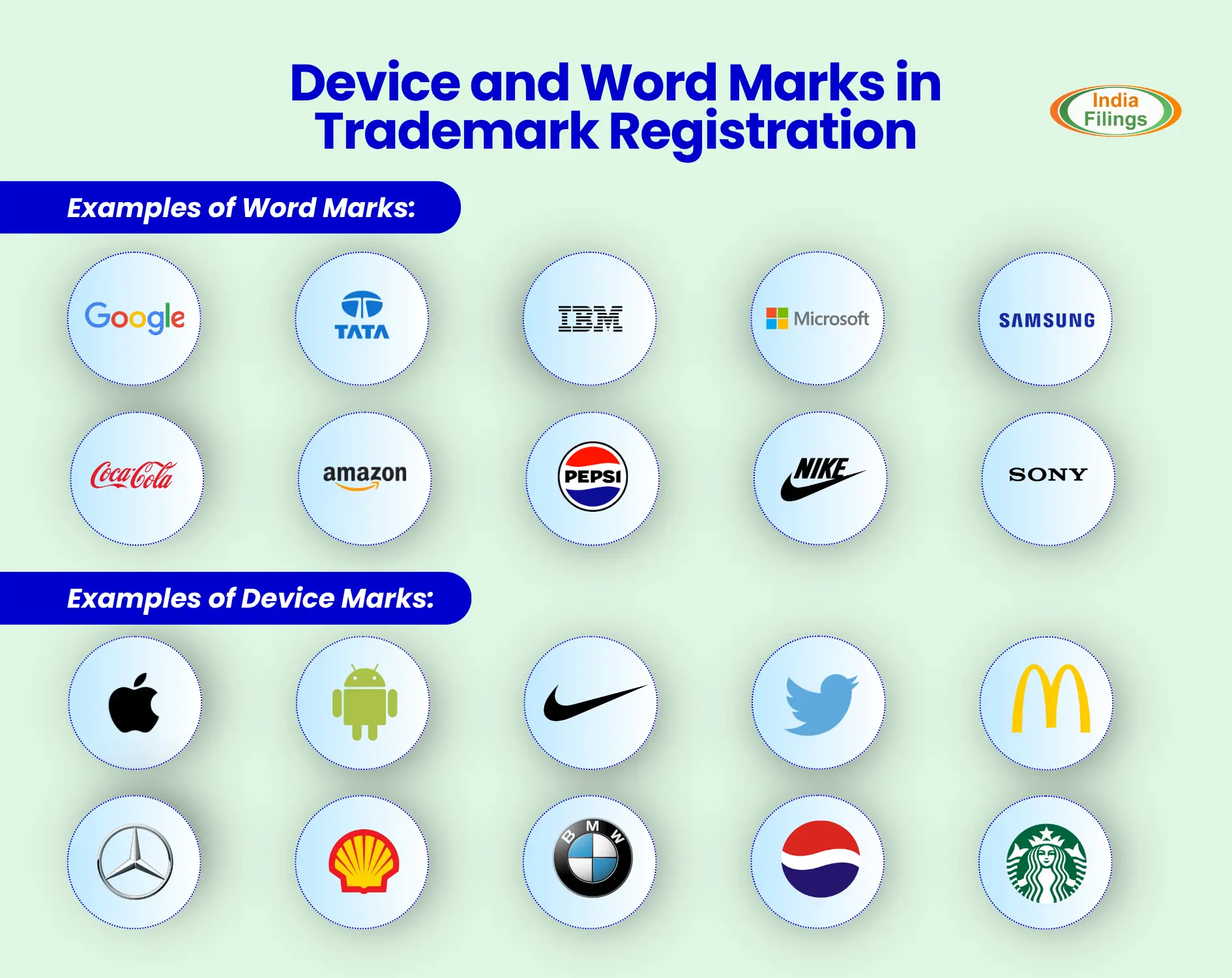
Examples of Word Marks:
- IBM
- TATA
What is a Device Mark?
A Device Mark refers to a trademark that includes a design or logo, often alongside words. Unlike a Word Mark, which focuses solely on textual elements, a Device Mark encompasses a graphic or visual representation of the brand. This can include logos, symbols, and images, which may be accompanied by text or stand alone. The design in a Device Mark could include shapes, patterns, or any creative graphic work used by the business to represent their products or services.
Key Features of Device Marks:
- Protection of the design: A Device Mark protects the unique graphical representation of the logo or image, and this protection extends to the specific colours, shapes, and layouts used in the mark.
- Less flexibility than Word Marks: Once registered, the design must be used as it was originally filed. Any significant changes to the design would require re-registration, which can be more complex and costly than rebranding a Word Mark.
- Distinctive appeal: Logos and designs are more visually appealing and can be more memorable than words. A Device Mark allows for immediate brand recognition through a unique visual identity.
Examples of Device Marks:
- Apple Logo
- Android Symbol
- Nike Swoosh
Pros and Cons of Word Marks
Word Marks offer significant advantages for businesses looking to protect their brand name in its simplest textual form. These trademarks safeguard the word or combination of words without restricting the design or style, offering flexibility in representation. However, this comes with some limitations, particularly regarding visual appeal and the potential for consumer confusion if not used consistently. Let’s explore the key pros and cons of Word Marks.
Pros of Word Marks
- Flexibility: The greatest advantage of a Word Mark is the freedom it offers in how the word is represented. Businesses can change the font, colour, or overall design of their branding without losing trademark protection.
- Broader Protection: Word Marks grant broader protection since they encompass all visual representations of the word, not limited to a specific style or font.
- Ease of Use: A Word Mark is easier to adapt to various marketing materials, whether digital or print. You can use it on websites, advertisements, and merchandise without worrying about the exact design.
Cons of Word Marks
- Visual Appeal: Word Marks are often less visually appealing than Device Marks, which can hinder consumer recognition. People may find it harder to remember the brand name unless it is paired with a memorable slogan or visual element.
- Risk of Confusion: If a company constantly changes the font or style of its Word Mark, it may confuse consumers. The trademark is still valid as long as the word itself is not altered, but frequent changes can make it difficult for customers to associate the word with the brand.
Pros and Cons of Device Marks
Device Marks are powerful tools for creating strong brand recognition through logos and graphical elements. These marks are visually appealing and can make a lasting impact on consumers, often becoming synonymous with the brand itself. However, they come with some limitations, such as reduced flexibility and the need for exact representation. Below are the key pros and cons of Device Marks.
Pros of Device Marks
- Brand Recognition: A Device Mark, especially a distinctive logo, is highly effective for brand recognition. Logos are memorable and are often recognized at a glance, which is essential in today’s crowded marketplace.
- Visual Appeal: A well-designed logo or symbol has greater emotional impact and recall value compared to words alone. Iconic brands like Nike, Apple, and Mercedes-Benz have achieved global recognition largely because of their device marks.
Cons of Device Marks
- Less Flexibility: A Device Mark is rigid in its representation. Once registered, the design cannot be changed without filing a new trademark application, which can be costly and time-consuming.
- Complex Trademark Search: Trademark searches for Device Marks are more complex than for Word Marks. The design elements must be carefully described, and a thorough search must be conducted to ensure that the design is not too similar to any existing marks.
How to Choose Between Word Mark and Device Mark?
Choosing between a Word Mark and a Device Mark depends on the nature of your business and branding strategy. Consider the following factors:
- Brand Identity: If your brand is highly dependent on a word or combination of words, registering a Word Mark might be the best option. For instance, if you own a service-based business that operates under a specific name, protecting that name is crucial.
- Visual Representation: If your business identity relies more on a logo or visual identity, you should consider registering a Device Mark. A logo provides a visual association that can transcend language barriers and be more universally recognizable.
- Brand Longevity: A Word Mark offers more flexibility and long-term protection, especially if your branding might evolve over time. A Device Mark provides a more rigid protection, but it’s a better choice if you have a distinct and recognizable logo.
Filing a Trademark for Word Marks and Device Marks
When filing for a trademark in India, businesses must complete the following steps:
1. Conduct a Trademark Search
Before applying for a trademark, it is essential to conduct a comprehensive trademark search to ensure that your desired word or logo is not already registered by someone else. This search can be done through the Trademark Registry in India or by engaging a professional service.
2. Choose the Right Category
Ensure that you are filing for the correct category of trademark. You will need to decide whether to apply for a Word Mark or Device Mark (or both). If applying for both, you must file separate applications, as each mark serves a different purpose.
3. Prepare the Necessary Documents
Prepare all the required documents, including:
- Name and address of the applicant
- Description of goods or services
- Representation of the trademark (word or logo)
- Signed power of attorney (if applicable)
4. Submit the Application
Once the necessary documents are ready, you can submit your trademark application with the Indian Trade Marks Office. The application will be examined, and any objections will be addressed. If no objections are raised, the trademark will be published in the Trademark Journal.
5. Wait for Registration
After publication, the trademark is open for opposition for a period of four months. If there are no oppositions, the trademark will be registered, and the owner will receive a Trademark Registration Certificate.
Click here to know the complete Trademark Registration Procedure.
Common Issues in Word Mark and Device Mark Registration
While Word Marks and Device Marks offer strong protection for your brand, the registration process can encounter a few challenges. Here are the most common issues faced during the trademark registration for both categories:
- Similarity to Existing Marks: One of the most common reasons for refusal is that the proposed trademark is too similar to an existing registered mark. Both Word Marks and Device Marks must be distinct to avoid conflicts with existing trademarks, which could lead to rejection or opposition.
- Misleading Marks: Trademarks that may mislead consumers about the nature, quality, or origin of goods/services are often rejected. This is particularly relevant for Word Marks that resemble well-known brands or Device Marks that closely mimic an existing logo or design.
- Lack of Distinctiveness: A trademark needs to be unique and capable of distinguishing your goods or services from others. Word Marks that are too generic or descriptive, and Device Marks that resemble commonly used designs or symbols, may not meet the distinctiveness requirement.Descriptive or Generic Terms: For Word Marks, terms that describe the product or service, like "fresh" for a food product, may be denied. Similarly, Device Marks that are purely decorative or lack originality could face objections.
- Non-Compliance with Registration Guidelines: For Device Marks, failure to submit a clear, accurate representation of the design or logo can delay or prevent registration. Additionally, incomplete documentation or failure to meet the necessary legal criteria may hinder the approval process.
Conclusion
The decision to register a Word Mark or Device Mark depends on your business's branding needs. Word Marks offer flexibility and broader protection, while Device Marks are visually distinctive and can make a stronger impact on consumer recognition. It is often beneficial for businesses to register both types of trademarks for maximum protection.
If you're considering registering a Word Mark or Device Mark, IndiaFilings provides comprehensive trademark registration services. Our experts can guide you through the process, ensuring that your brand is properly protected and compliant with all legal requirements.
Protect your brand and secure your intellectual property today. Contact IndiaFilings for expert trademark registration services and get started on the path to safeguarding your business's unique identity. File your trademark now with IndiaFilings and enjoy peace of mind knowing your brand is protected.