
Renu Suresh
Published on: Sep 15, 2026
Pradhan Mantri Awas Yojana (PMAY)
The PMAY or Pradhan Mantri Awas Yojana Programme is a flagship initiative by the Ministry of Housing and Urban Poverty Alleviation (MoHUPA) aimed at providing housing for all by 2022. Launched by the Honourable Prime Minister of India on 17 June 2015, this comprehensive and progressive mission empowers people to own their dream homes. Let's delve into the details of the PMAY scheme.
Objective of PMAY Scheme
The mission aims to address the housing requirements of the urban poor, including slum dwellers, through the following programme verticals:
- Slum rehabilitation of Slum Dwellers with private developers using land as a resource. A slum is defined as a compact area with at least 300 people or about 60-70 households living in poorly built, congested tenements in unhygienic environments with inadequate infrastructure and lacking proper sanitary and drinking water facilities.
- Promotion of affordable housing for weaker sections through credit-linked subsidy.
- Affordable housing in partnership with public and private sectors.
- Subsidy for beneficiary-led individual house construction or enhancement.
PMAY Scheme Beneficiaries
The beneficiaries under the Pradhan Mantri Awas Yojana include:
- The scheme primarily focuses on women and economically backward groups of Indian society.
- It seeks to protect transgender persons and widows, as well as members of lower-income groups and the urban poor.
- Scheduled Castes and Scheduled Tribes receive preference when availing the affordable housing scheme.
- Older and differently-abled persons are given priority in the allotment of ground floors under the scheme.
Benefits under PMAY Scheme
- Beneficiaries receive an interest subsidy of 6.5 percent on housing loans for 15 years.
- Eco-friendly and sustainable technologies are employed during construction.
- The scheme covers the entire urban areas in the country, including 4041 statutory towns, with the first priority given to 500 Class I cities across three phases.
- The credit-linked subsidy aspect is implemented from the initial stages in all statutory towns.
For more schemes similar to PMAY, you can learn about the DiyaGreen City Affordable Housing Scheme.
PMAY Scheme Subsidy
The credit-linked subsidy scheme (CLSS) under Pradhan Mantri Awas Yojana provides home loan subsidies for the purchase, construction, extension, or improvement of houses. It caters to Economical Weaker Section (EWS), Lower Income Group (LIG), and Middle Income Group (MIG) beneficiaries. Eligible individuals can procure housing loans from Primary Lending Institutions for new construction and enhancements to existing dwellings, known as incremental housing.
The subsidy applies to loan amounts up to Rs 6 lakhs, with an interest subsidy of 6.5% for a tenure of 20 years or the loan tenure, whichever is lower. Each beneficiary can avail a total interest subsidy of Rs.2.30 lakhs under this component.
Economical Weaker Section (EWS)
EWS households have an annual income up to Rs. 300,000. States/UTs have the flexibility to redefine this criterion as needed in consultation with the Centre.
Low Income Group (LIG):
LIG households earn between Rs. 3,00,001 and Rs. 6,00,000 annually. States/UTs may adjust the threshold based on local conditions.
Middle Income Group (MIG)
Under CLSS, MIG beneficiaries with annual income between Rs. 6 lakh and Rs. 12 lakh can receive a 4.00% interest subsidy on a 20-year loan up to Rs. 9 lakh.
For incomes between Rs. 12 lakh and Rs. 18 lakh, categorized as MIG II, the subsidy is 3.00% on a 20-year loan component of up to Rs. 12 lakh.
Primary Lending Institutions (PLI)
PLIs include Scheduled Commercial Banks, Housing Finance Companies, Regional Rural Banks (RRBs), State Cooperative Banks, and Urban Cooperative Banks.
Eligibility for CLSS
- The scheme is available to families comprising a husband, wife, and unmarried children.
- An adult earning member, irrespective of marital status, can be treated as a separate household in the MIG category.
- Families should not own a pucca house anywhere in India.
You can also explore options like the Akanksha Housing Scheme to understand the diverse housing plans available in India.
CLSS scheme details
| Scheme Type | Eligibility Family Income (Rs.) | Carpet Area-Max (sq. m.) | Subsidy calculated on a max loan of | Interest Subsidy (%) | Max Subsidy (Rs.) | Validity of scheme | Woman Ownership |
| EWS | 0 to 300000 | 30 | 600000 | 6.50 | 2.67 Lakh | 31/3/2022 | Mandatory |
| LIG | 300001 to 600000 | 60 | 600000 | 6.50 | 2.67 Lakh | 31/3/2022 | Mandatory |
| MIG- I | 600001 to 1200000 | 120 | 900000 | 4.00 | 2.35 Lakh | 31/3/2022 | |
| MIG-II | 1200001 to 1800000 | 150 | 1200000 | 3.00 | 2.30 Lakh | 31/3/2022 |
Note: The house should be in the name of the female head of the household or jointly with the male head and his wife. If no adult female member is present, it can be in the male member's name. This stipulation applies to new purchases, not new constructions on existing land.
To gain insights into similar regional schemes, explore the Assam Housing Scheme.
PMAY Scheme Online Application
Step 1: Visit the PM Awas Yojana official website.
Step 2: Under "Menu," select "Citizen Assessment."
Step 3: Choose "For slum dwellers."
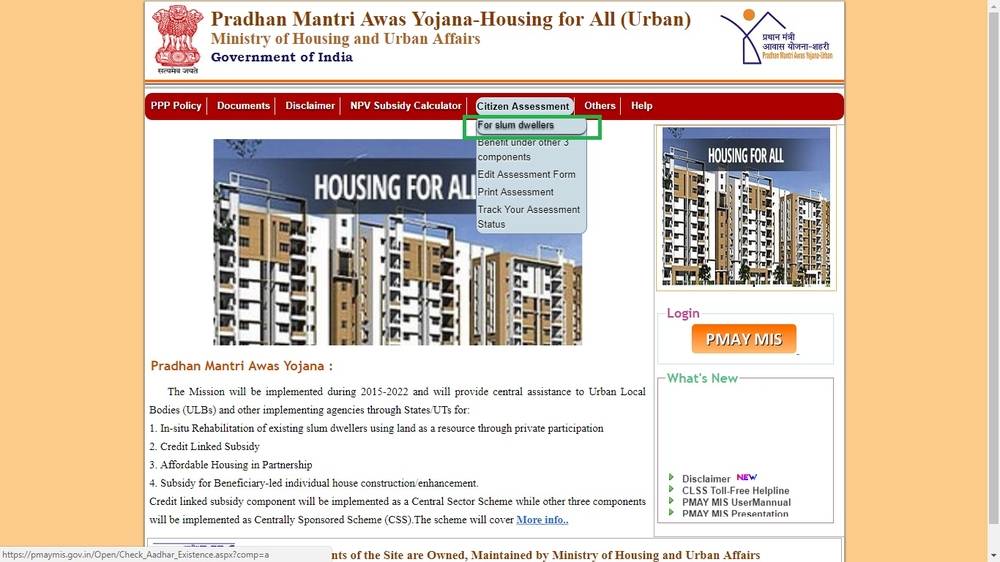
Image 1 PMAY
Step 4: Enter your 12-digit Aadhaar card number.
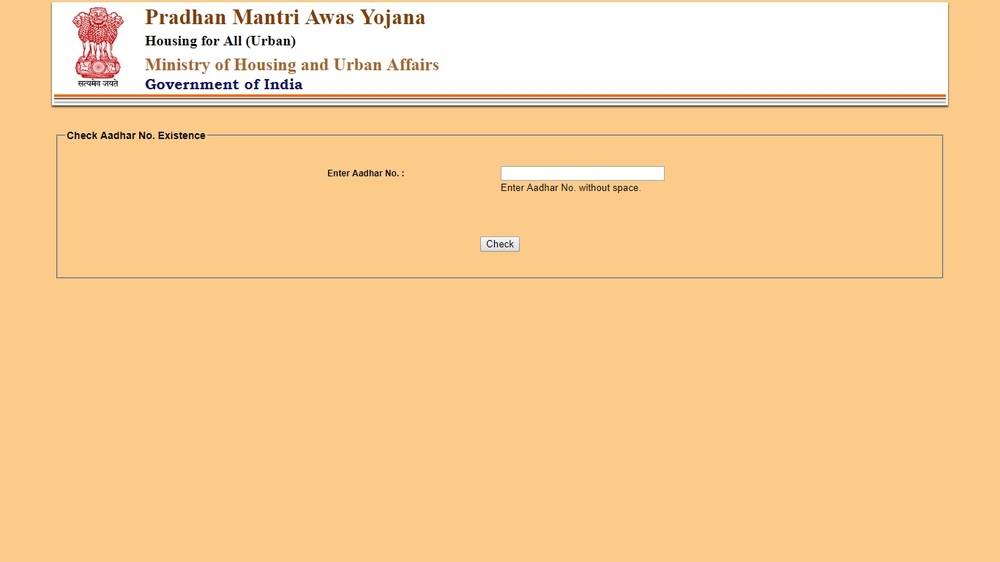
Image 2 PMAY
Step 5: After entering your Aadhaar information, you will be redirected to the application page.
Step 6: Enter personal details, income, current residential address, and bank account details.
Step 7: Fill in the application.
Step 8: Select "I am aware of" at the page end and click "Save."
Step 9: On clicking "save," a system-generated application number appears, save it for future reference.
Step 10: Download and print the completed application.
Step 11: Submit the form with required documents at your nearest CSC office or financial institution/banks.
Step 12: If eligible for subsidy, the application is forwarded to the Central Nodal Agency (CNA).
Step 13: If approved, CNA credits the subsidy amount to the lender.
Step 14: The subsidy is credited to your account, reducing the total loan amount.
Consider the subsidy example: With an annual income of Rs 7 lakhs and a Rs 9 lakh loan, the subsidy is Rs 2.35 lakhs. Loans exceeding the maximum eligible amount incur prevailing interest rates.
For further exploration, the impact of GST on Affordable Housing can offer additional insights into financial aspects.
Check PMAY Beneficiary List
Although the beneficiary list of PM Awas Yojana is not available for download, one can verify their name's presence by following these simple steps:
Step 1: Search Name
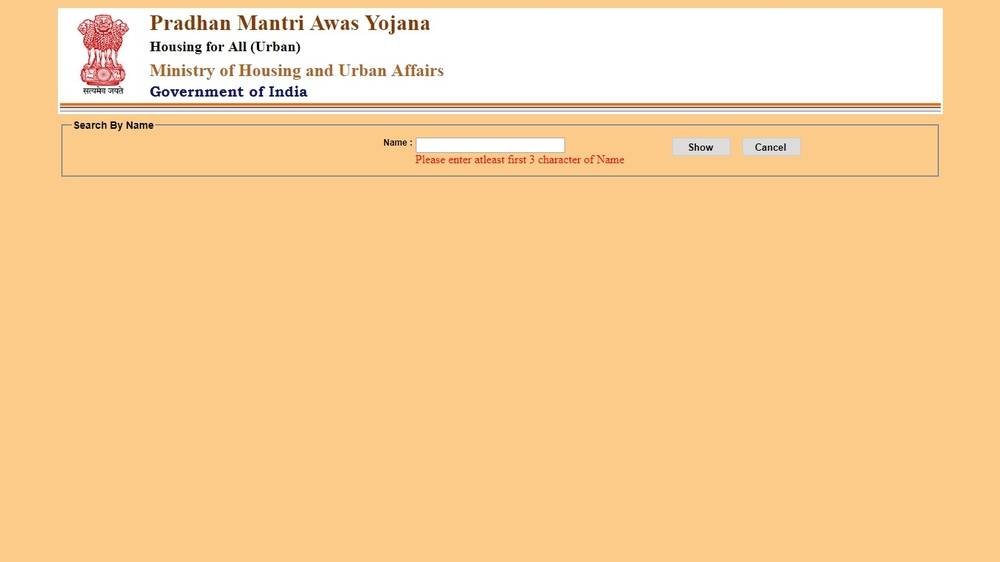
Image 3 PMAY
Step 2: Enter the name or the first three letters and click "SHOW."
Step 3: The list of PMAY beneficiaries matching your name appears.
Verify your existence in the list by matching your name with your father’s name, gender, religion, city, or state name.
Step 4: View the complete details by clicking the beneficiary name and then entering your mobile number to verify via OTP.
For more housing opportunities, you might want to know about the Puducherry Housing Scheme.