

RENU SURESH
Expert
Published on: Jul 30, 2026
CBDT Extends ITR Filing Deadline to September 16, 2025 for AY 2025-26
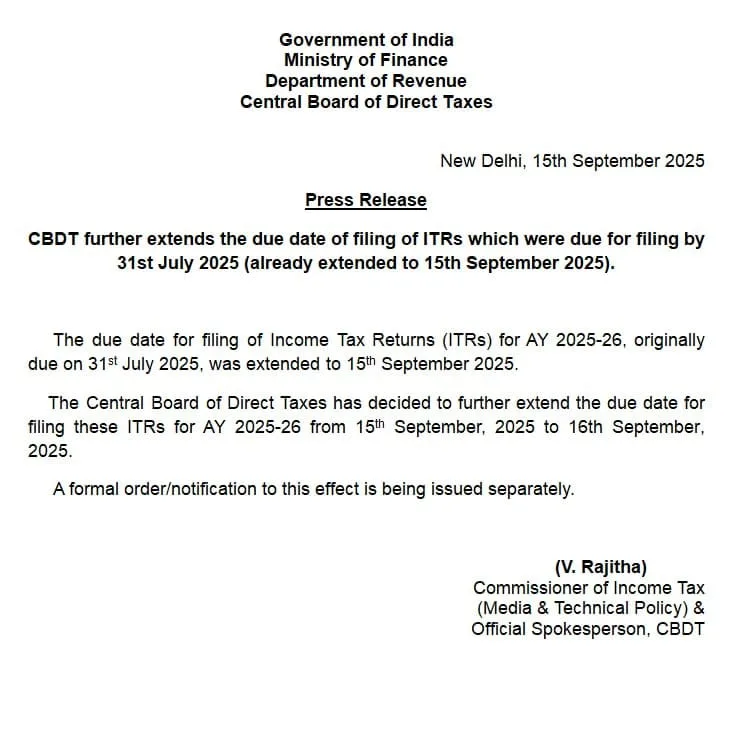
The Central Board of Direct Taxes (CBDT) has extended the Income Tax Return (ITR) filing deadline by one day, from September 15 to September 16. This decision came after several chartered accountants and tax experts highlighted issues such as technical glitches on the e-filing portal, delays in the release of Excel utilities, and other filing-related challenges.
Taxpayers are now advised to complete their ITR filing by today, September 16, before 12 midnight to avoid any penalties.
Earlier ITR Due Date Extension
The Central Board of Direct Taxes (CBDT) has extended the due date for filing Income Tax Returns (ITRs) for the Assessment Year (AY) 2025-26. Salaried individuals and taxpayers not subject to audit will now have until "September 15, 2025" to file their returns for the Financial Year (FY) 2024-25. The original deadline was July 31, 2025.
You can refer to the official CBDT notification attached below for complete details regarding the ITR due date extension.
ITR Filing Due Date for FY 2024-25 (AY 2025-26)
The usual last date to file Income Tax Returns (ITR) for non-audit taxpayers is July 31 of the assessment year following the financial year. For the Financial Year 2024-25 (Assessment Year 2025-26), the original deadline was July 31, 2025.
However, with the recent extension announced by the CBDT, the due date for filing ITR for AY 2025-26 has now been pushed from September 15, 2025 to September 16, 2025 , giving taxpayers additional time to file their returns without penalties.
Click here to learn about Tax Audit Due Date for FY 2024- 25
Who is the ITR Filing Due Date Extension Applicable To?
Extension to 15th September 2025 applies to:
- Individuals
- Hindu Undivided Families (HUFs)
- Association of Persons (AOPs)
- Body of Individuals (BOIs)
Businesses and firms not subject to audit, including:
- Private Limited Companies (Non-Audit)
- One Person Companies (Non-Audit)
- LLPs and Partnerships (Non-Audit)
No extension for the following categories:
- Audit cases (businesses, trusts, political parties, etc.)
- Audit Report Due: 30th September 2025
- ITR Due: 31st October 2025
- Transfer Pricing cases
- ITR Due: 30th November 2025
- Returns filed under Section 92E
- ITR Due: 31st October 2025
- Revised or Belated Returns
- Last Date: 31st December 2025
Reason for ITR Due Date Extension
The extension aims to provide adequate time for taxpayers and the Income Tax Department to adjust to significant changes introduced in the ITR forms for AY 2025-26, following reforms announced in Budget 2024.
1. Changes in ITR Forms
The ITR forms for AY 2025-26 have undergone substantial revisions due to updates announced in Budget 2024. These changes aim to:
- Simplify compliance requirements
- Enhance transparency
- Improve accuracy in reporting
As a result, more time is needed to update, integrate, and test the e-filing systems and utilities.
2. System Development Needs
The income tax portal is being updated to reflect the changes in the ITR forms. These system upgrades are essential for:
- Enabling smooth and secure filings
- Ensuring accurate validation of data
- Reducing technical glitches and errors
3. Delayed Reflection of TDS Credit
- TDS (Tax Deducted at Source) statements, which are due to be filed by May 31, 2025, will only start reflecting in early June.
- This would leave taxpayers with a very short effective window to file their ITRs by July 31.
- The extension provides more breathing room to verify TDS details and file accurate returns.
Key Takeaways
- New ITR deadline for AY 2025-26: September 16, 2025 (extended from September 15).
- Applies to taxpayers who are not subject to audit, primarily salaried individuals.
- Extension prompted by significant updates in ITR forms to enhance accuracy and compliance.
Also read: 7 Major Changes in ITR-1 and ITR-4 Excel Utilities
Need Help Filing Your ITR?
With the ITR deadline now extended to September 16, 2025, this is the perfect time to get expert help and avoid last-minute stress. At IndiaFilings, our tax professionals ensure your return is filed accurately, on time, and with maximum savings. Whether you're salaried, self-employed, or managing multiple income sources, we’ve got you covered.
Start your ITR filing with IndiaFilings today!
FAQs on ITR Filing Due Date Extension (AY 2025–26)
1. What is the new due date for filing Income Tax Returns for AY 2025–26?
The new due date is September 16, 2025, for individuals and taxpayers not required to get their accounts audited.
2. Who is eligible for the extended due date?
The extension applies to salaried individuals, pensioners, and other taxpayers not liable for tax audit under the Income Tax Act.
3. Why has the due date been extended?
The extension was granted due to:
- Significant revisions in ITR forms following Budget 2024.
- The need for updated e-filing utilities and backend system changes.
- Delayed availability of TDS credit information.
4. Do I still need to file my ITR even if the deadline is extended?
Yes, filing your ITR is still mandatory if your income exceeds the taxable threshold. The extension simply gives you more time to do so without penalties.
5. Will there be a penalty if I file after September 16, 2025?
Yes, if you file your ITR after the extended due date, late filing fees under Section 234F and possible interest penalties may apply.
6. Are audit cases or companies covered under this extension?
No, this extension is only for non-audit cases. Taxpayers who are required to have their accounts audited have different due dates, which remain unchanged unless notified separately.
7. Can I file my ITR now, or should I wait?
If your TDS details and income information are ready and accurate, you can start filing. However, many prefer to wait until TDS credits are fully reflected on the portal, expected by early June.
8. How can IndiaFilings help me with my ITR?
IndiaFilings offers expert-assisted ITR filing services, ensuring accuracy, compliance, and maximum tax benefits. You can get started easily online or speak to a tax advisor.