

RENU SURESH
Expert
Published on: Mar 27, 2026
Tax Audit Due Date for FY 2024- 25
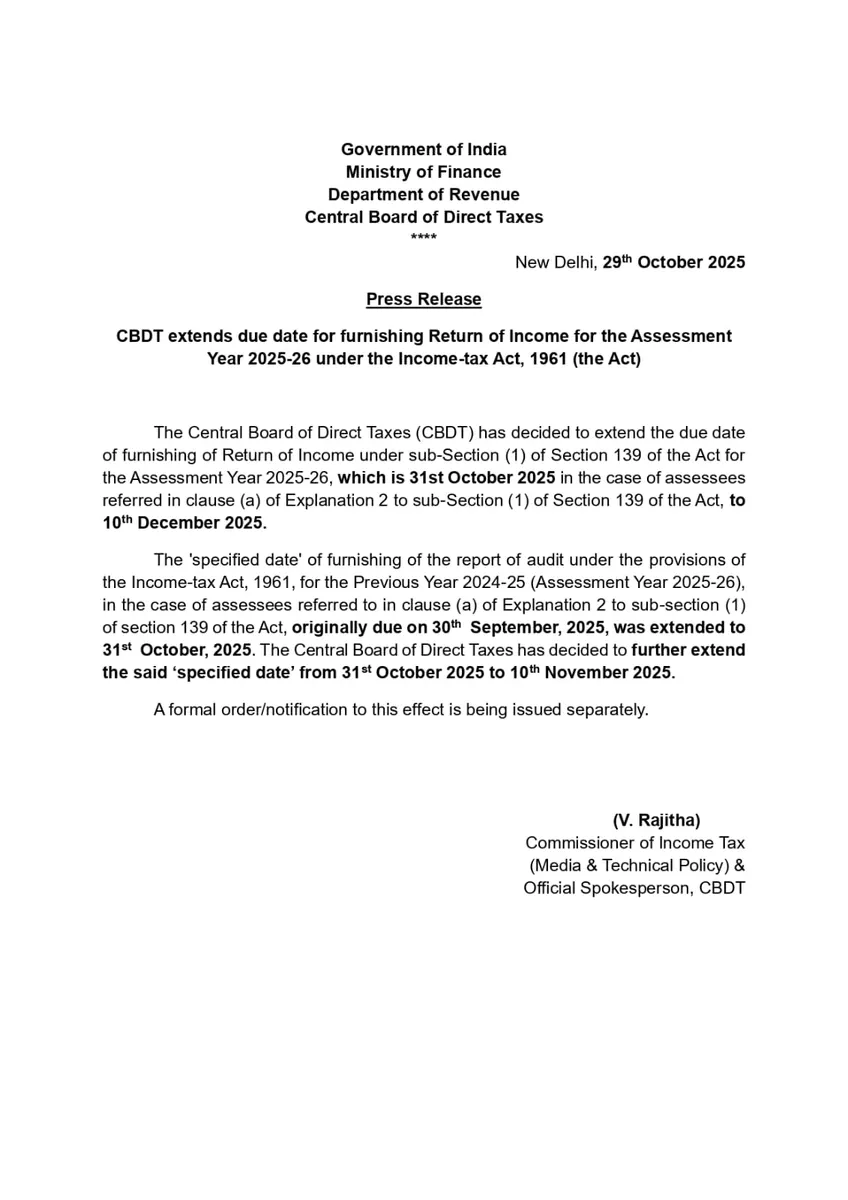
For Financial Year (FY) 2024–25, the due date for submitting the tax audit report has been extended to 10th November 2025. The Income Tax Return (ITR) filing deadline for taxpayers requiring an audit has been extended to 10th December 2025.
The tax audit due date is one of the most important deadlines on the income tax calendar, especially for businesses, professionals, and partnership firms. Understanding who is required to conduct a tax audit, the implications of missing the due date, and how to prepare in advance can help taxpayers avoid penalties and ensure compliance with the Income Tax Act, 1961.
Tax Audit Due Date Extension
The CBDT has extended the deadlines for furnishing the Tax Audit Reports and Income Tax Returns (ITR) under the Income-tax Act, 1961, for the Assessment Year 2025-26 (Financial Year 2024–25).
The deadline for submitting the Tax Audit Report, which was originally due on 30th September 2025, was extended to 31st October 2025. Now, the CBDT has granted a further extension, setting the new deadline for 10th November 2025.
Similarly, the deadline for filing the Income Tax Return was initially set for 31st October 2025, but has now been extended to 10th December 2025.
Click here to know more about the CBDT Extends Tax Audit Report Filing Deadline for AY 2025-26
What is a Tax Audit?
A tax audit is a detailed examination of an entity’s books of accounts conducted by a Chartered Accountant (CA). The objective is to ensure that the taxpayer has maintained proper records and that the income and deductions claimed are accurate.
Under Section 44AB of the Income Tax Act, certain categories of taxpayers are mandatorily required to get their accounts audited.
Also read: Income Tax Audit Forms Now Live on ITR e-Filing Portal
Tax Audit Due Date for FY 2024–25
Here are the critical deadlines for FY 2024–25 (Assessment Year 2025–26):
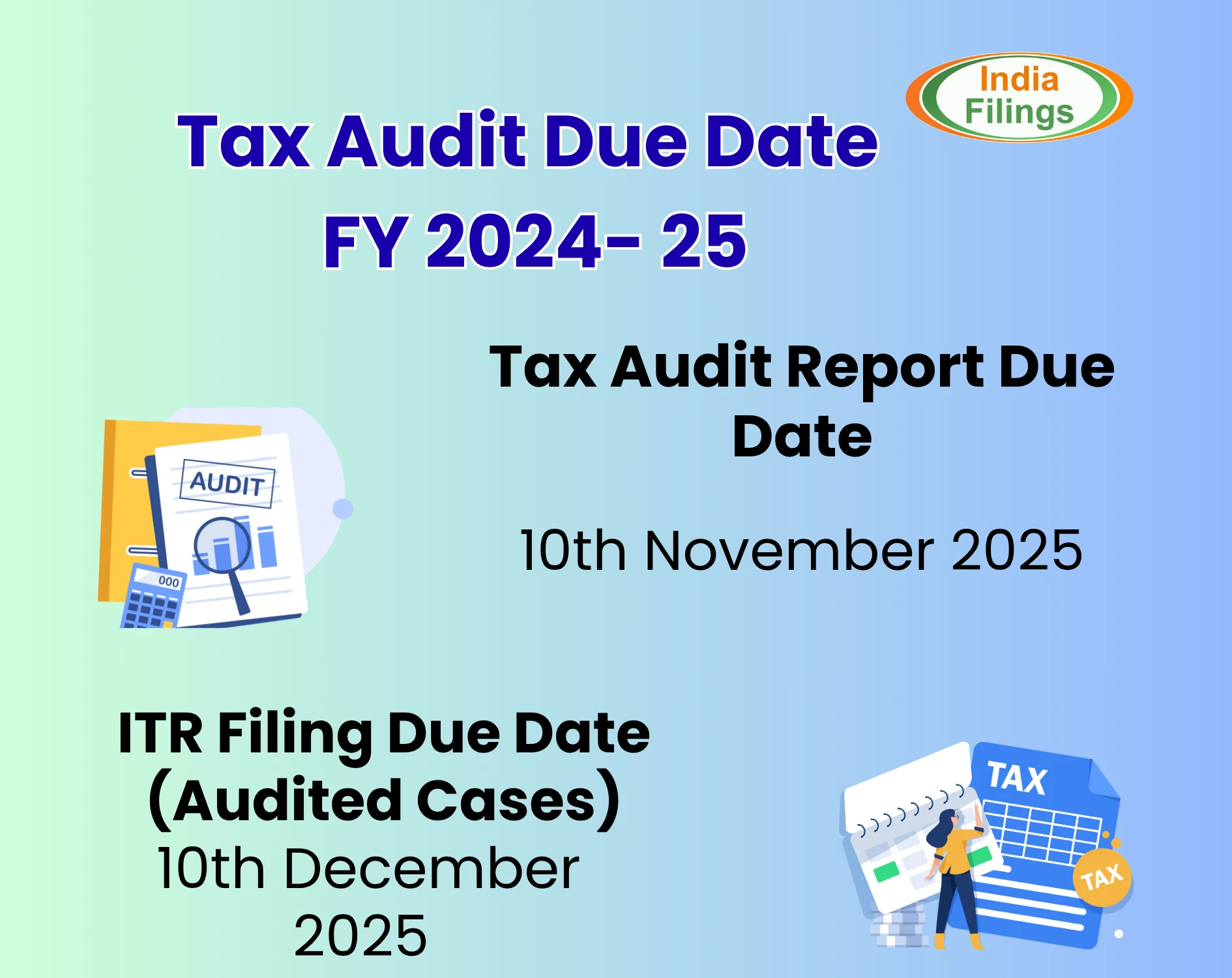
- Tax Audit Report Due Date: Originally due by 30th September 2025, has now been extended to
10th November 2025
- ITR Filing Due Date (Audited Cases): October 31, 2025
Timely submission of the tax audit report is essential. The Income Tax Return cannot be filed without the audit report being uploaded and accepted by the Income Tax Department.
Who Needs to Complete a Tax Audit Before the Due Date?
Section 44AB of the Income Tax Act, 1961 mandates a tax audit for certain taxpayers based on their turnover, professional receipts, and taxation method. Understanding who falls under the purview of tax audit requirements is essential to avoid penalties and ensure timely compliance.
Tax audits are applicable to two main categories of taxpayers:
- Businesses
- Professionals
Below is a detailed breakdown of tax audit limits and conditions for each category:
1. Business Not Opting for the Presumptive Taxation Scheme
- Mandatory Tax Audit if total sales, turnover, or gross receipts exceed ₹1 crore in the financial year.
- Relaxed Threshold (₹10 crore) applies only if both of the following conditions are satisfied:
- Cash receipts do not exceed 5% of total receipts
- Cash payments do not exceed 5% of total payments
This relaxation promotes digital transactions and reduces audit burden for cashless businesses.
2. Business Opting for Presumptive Taxation under Section 44AE, 44BB, or 44BBB
Tax audit is required if the business declares income lower than the presumptive income rate specified under these sections.
3. Business Opting for Presumptive Taxation under Section 44AD
Tax audit is mandatory if:
- Taxable income is less than 8% or 6% of turnover (depending on mode of receipts), and
- Total income exceeds the basic exemption limit of ₹2.5 lakhs
4. Business Opting Out of Presumptive Taxation (Section 44AD)
Once a business opts out of the presumptive scheme in any financial year, a tax audit becomes mandatory for the next five years if income exceeds the basic exemption limit in any of those years.
This ensures continuity in the presumptive scheme and discourages misuse.
Tax Audit in Case of Business Loss (Non-Presumptive Scheme)
If a taxpayer:
- Has a total income exceeding the basic exemption limit, and
- Reports a business loss, and
- Has turnover exceeding ₹1 crore,
Then a tax audit is mandatory, even if no profit is earned. This helps the tax department validate loss claims accurately.
Tax Audit Applicability for Professionals
Tax audit is compulsory if the gross receipts from the profession exceed ₹50 lakhs in the previous financial year.
This includes professionals such as:
- Doctors
- Chartered Accountants
- Architects
- Consultants
- Lawyers
- Freelancers providing professional services
Tax Audit Applicability Limits
Category | Threshold for Tax Audit |
Business (non-presumptive) | Turnover > ₹1 crore (₹10 crore if cash transactions ≤ 5%) |
Profession | Gross receipts > ₹50 lakhs |
Presumptive Scheme (44AD/44AE/44BB/BBB) | Income < presumptive rate AND total income > ₹2.5 lakhs |
Opting out of 44AD | Tax audit mandatory for five subsequent years if income > limit |
Business Loss | Turnover > ₹1 crore AND income > exemption limit |
If you fall into any of the categories above, you must complete your tax audit by October (extended) for FY 2024–25 to be eligible for timely ITR filing by 10th December 2025.
Why You Should Complete a Tax Audit and File ITR Before the Due Date?
Timely completion of your tax audit and filing your Income Tax Return (ITR) is essential not only for compliance but also for maximising tax benefits and avoiding financial penalties. For taxpayers whose accounts are subject to audit under Section 44AB of the Income Tax Act, 1961, the tax audit due date and the ITR filing deadline are tightly connected.
Here's why it’s critical to complete both before the respective due dates:
ITR Filing Depends on Timely Tax Audit
If you fall under the category of taxpayers requiring a tax audit, your ITR cannot be filed unless:
- Form 3CA/3CB (Audit Report)
- Form 3CD (Statement of particulars)
are uploaded and verified by a Chartered Accountant on the Income Tax portal. Missing the tax audit due date (10th November 2025 for FY 2024–25) effectively prevents you from filing your ITR by the due date.
Avoid Penalties Under Sections 271B & 234F
Tax Audit Delay Penalty (Section 271B)
Failure to complete the audit and submit the report on time may result in a penalty, which is:
- 0.5% of total turnover/gross receipts, or
- ₹1,50,000 (whichever is lower)
Penalties may be waived if you can prove reasonable cause (e.g., auditor resignation, natural disasters, loss of records).
Late ITR Filing Penalty (Section 234F)
Filing your return after the deadline attracts a penalty of:
- ₹5,000, or
- ₹1,000 (if total income is below ₹5 lakh)
These penalties are avoidable simply by meeting the due dates.
Carry Forward Losses
Both tax audit completion and timely ITR filing are mandatory for claiming and carrying forward certain types of losses, such as:
- Business losses
- Speculative losses
- Capital losses
Missing the deadline may forfeit your right to carry forward these losses to future years, increasing your long-term tax liability.
Faster Refund Processing
When you file your ITR on time, especially after completing your tax audit early, the return is processed faster. This ensures that:
- Your refunds are credited quickly
- There is less scrutiny or delay from the tax department
Delays in either audit or ITR filing often result in slower assessments and refund release.
Establishes Proof of Income
A timely filed ITR acts as valid proof of income for:
- Loan applications
- Visa approvals
- Government tenders
- Credit evaluations
- Startup funding and investment due diligence
For self-employed individuals and professionals, this is especially vital to establish financial credibility.
Avoid Interest on Tax Dues
If your tax payment is delayed due to late ITR filing, interest is levied under Section 234A on the unpaid amount. This adds to your tax burden unnecessarily. Filing on time helps avoid these interest charges.
Whether you're a business owner, professional, or working partner in a firm, meeting the tax audit due date and filing your ITR by the deadline is not optional—it’s a critical part of your financial and legal responsibility.
What Should You Do If You Miss the Tax Audit Deadline?
If you miss the tax audit deadline, it's important to act quickly to minimise the consequences and regain compliance. Here's what you should do:
1. File the Audit Report and ITR As Soon As Possible
Even if the deadline has passed, you should complete your tax audit and file the audit report along with your Income Tax Return (ITR) at the earliest. Late compliance is still better than non-compliance, and it may help reduce penalties.
2. Understand the Penalty Under Section 271B
If you fail to get your accounts audited or submit the audit report within the extended due date the Assessing Officer may impose a penalty under Section 271B:
Penalty Amount: The lesser of: 0.5% of the total sales, turnover, or gross receipts, or ₹1,50,000
3. Check if You Have a Valid Reason for Delay
The Income Tax Department may waive the penalty if you can show a “reasonable cause” for missing the deadline. Some accepted reasons include:
- Natural calamities
- Resignation or sudden unavailability of your auditor
- Technical issues in the e-filing portal
- Health issues or the death of the key person responsible
- Records destroyed due to theft, fire, or disaster
If any of these apply, consult your Chartered Accountant to prepare a detailed representation.
4. Prepare for Scrutiny or Notices
Missing a tax audit deadline increases the chances of receiving a notice or scrutiny from the tax department. Keep your books of accounts well-prepared, and ensure all financial details are accurate and transparent.
5. Seek Professional Guidance
Engage with a qualified Chartered Accountant or a tax compliance expert to evaluate your situation and assist with late filing, representation, and penalty waiver (if applicable).
Start early next year — avoid last-minute rushes by beginning your tax audit process well before the due date.
Documents Required for Tax Audit
Here’s a checklist of common documents and information needed for a tax audit:
- Trial balance and general ledger
- Purchase and sales register
- Bank statements
- Fixed asset register
- Details of loans and advances
- Stock-in-trade details
- GST returns and reconciliations
- TDS returns and certificates
- Agreements or contracts with clients or vendors
- Details of related party transactions
Keeping these documents organised and updated throughout the year can greatly reduce the last-minute rush.
Strategies to Meet the Tax Audit Deadline
The following strategies can help businesses and professionals streamline the audit process, stay compliant, and meet the September 30th deadline with confidence.
1. Plan Early
Don’t wait until August or September to start the audit process. Ideally, the books should be finalized by July or early August.
2. Maintain Regular Books
Businesses should use accounting software or hire professional bookkeepers to ensure the accounts are always up-to-date.
3. Work Closely with Your CA
Regularly coordinate with your CA to ensure there are no pending queries or documentation gaps.
4. Monitor Turnover Thresholds
If you're close to the audit limits (like ₹1 crore or ₹50 lakh), evaluate your tax planning early in the year to avoid falling under compulsory audit due to avoidable decisions.
Final Thoughts
The tax audit due date is a non-negotiable compliance deadline that affects not only businesses and professionals but also working partners in firms. For FY 2024–25, taxpayers required to undergo a tax audit must ensure that their audit report is filed by the extended due date of 10th November 2025 and their ITR by 10th December2025.
Timely preparation, documentation, and coordination with your CA can help you meet these deadlines efficiently. With penalties and financial repercussions at stake, being proactive is key to staying on the right side of the Income Tax Department.
Complete Your Tax Audit Before the Due Date with IndiaFilings!
The tax audit due date has now been extended to 10th November 25, for FY 2024–25. Missing this deadline can delay your ITR filing and lead to hefty penalties. IndiaFilings offers expert tax audit services handled by certified Chartered Accountants who ensure timely, accurate reporting and full compliance with the Income Tax Act.
Start your tax audit process with IndiaFilings today and stay ahead of deadlines!