
IndiaFilings
Expert
Published on: Jul 30, 2026
All in 1 Digital Signature Certificate Guide in India
A Digital Signature Certificate (DSC) is a cryptographically secure key issued by certifying authorities (CAs) to validate and verify the identity of the person who holds this certificate. DSCs are predominantly issued and utilized when businesses need to digitally sign documents online, securely authenticate the Signature, and validate the signed copy. The present article briefs Digital Signature Certificate in India.Difference between a Digital Signature and Digital Signature Certificate
Digital signatures and digital certificates are security measures when signing electronic documentation.Digital Signature
The Digital Signature is a method of confirming the authenticity of a transaction, document, or message. It guarantees that the sender generates the message/document and is not modified by the external party.Digital Signature Certificate
Digital Signature Certificate functions similarly to identification cards issued by recognized (government) authorities. The certificate provides the following security benefits:- Details of Certifying Authority
- Name & other information of the subscriber
- Subscriber's public key
- DSC validity period
Benefits of a Digital Signature Certificate
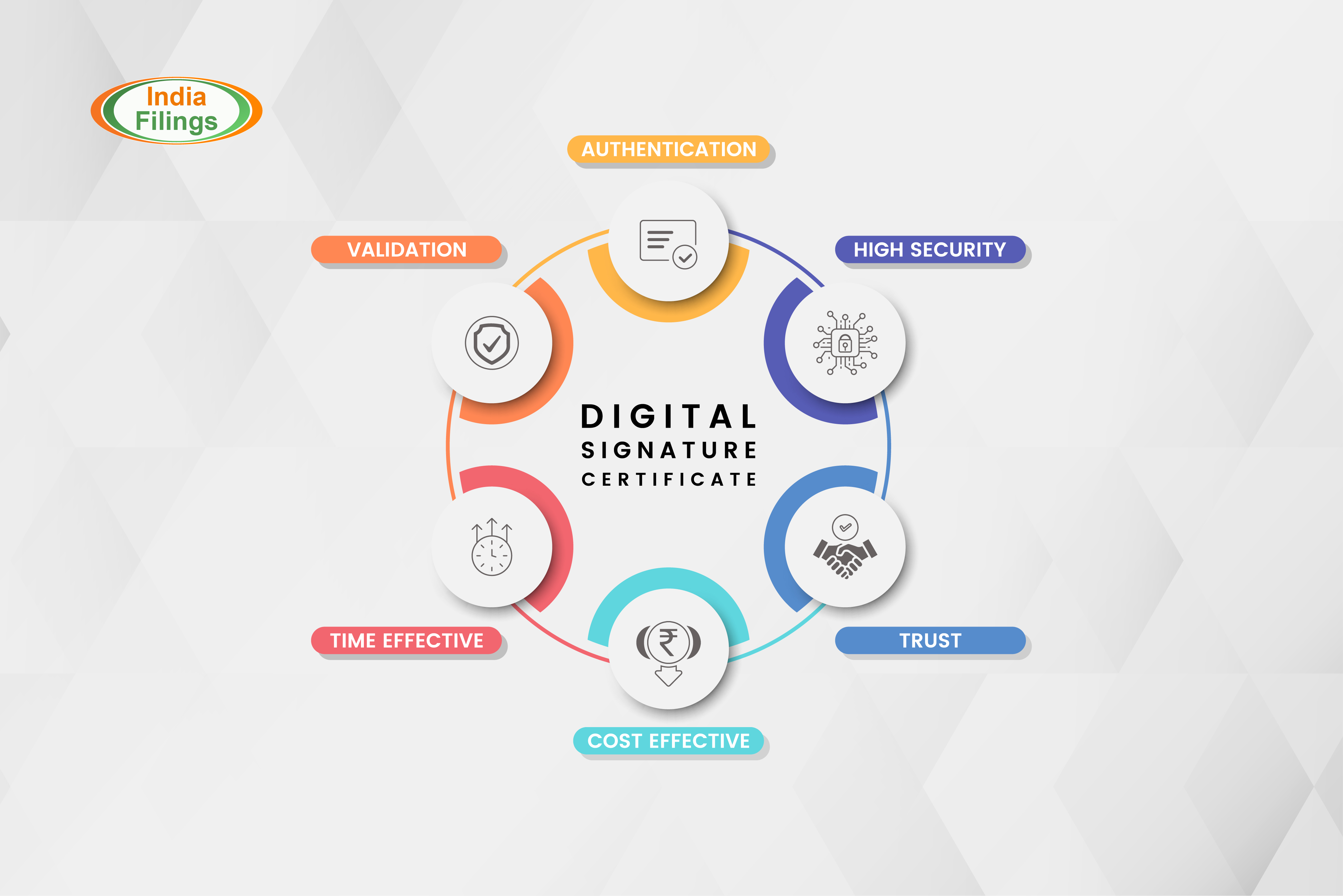 Benefits of Digital Signature
- Authentication: A digital Signatures Certificate also helps create the document's authenticity, which can use in court as a shred of evidence.
- High Security- A DSC reduces the chances of fraud and alteration of the document/message. This certificate makes sure that the Signature is verified.
- Cost-effective: A digital signature certificate reduces the cost required to complete a transaction because the DSC holder is not required to be present in person to carry out or authorize a business transaction.
- Time- Effective: As DSC is in the virtual format, the documents can sign with one click; it saves time and is quicker and cheaper.
- Easy Verification: The DSC holder can present the DSC to government agencies to facilitate quick verification of the business transaction if needed.
Use of DSC in Digitally signing a document
Digitally signing a document places the encrypted with the document. As mentioned above, A digital signature certificate is embedded in electronic documents, emails, and other digitally transmitted documents. These signatures provide and enhance security using encryption technology. Sensitive information such as the signature is encrypted, after verification; the sensitive information is decrypted and made available. Both Digital and electronic signatures are created online and are used to sign the documents.Importance of DSC for Compliances
- Individuals and entities must get their accounts audited and file their income tax returns compulsorily using a DSC.
- The Ministry of Corporate Affairs (MCA) has a mandate for companies to file all reports, applications, and forms using a DSC.
- A company can only get GST registration by verifying the application through a digital signature.
- DSC is necessary even for filing all Governmnet applications, amendments, and other related forms.
Format of Digital Signature
There are two formats of Digital Signature certificates.- PFX File
- USB Token
PFX File
PFX File is a Digital Signature Certificate that is in a file format (.pfx format). This type of signature can be easily circulated through e-mail, which makes it easier for users. However, there is a risk of misuse if not handled properly.USB Token
A Digital Signature certificate in a USB Token looks similar to a pen drive, which is attached to the PC for using a digital signature. The main advantage of it is that it safeguards DSC from misuse which is more likely in a pfx file.Type of Digital Signature Certificates
Sign DSC
This type of DSC can be used for signing documents. The most popular usage of this type of DSC is signing the PDF file for filing on Government websites. Signing via DSC gives the assurance of the integrity of the signer and the data. It is proof of unhampered and unaltered data.Encrypt DSC
Encrypt DSC can only use to encrypt a document. It is mostly used in the tender portal to help the organization to encrypt documents. Encrypt DSC is useful for documents that are highly confidential and contains information that needs to be protected.Sign & Encrypt DSC
Sign & Encrypt DSC can use for both signing and encrypting. A signature certificate is used to sign a document, while an encryption certificate is used to encrypt the data. It is suitable for users who need to authenticate and maintain the confidentiality of the information shared.Classes of Digital Signature Certificates
Certifying authorities issue three different types of DSCs. Depending on their purpose and requirements, applicants can choose from three types of digital signature certificates.Class 1 DSC
Class 1 Digital signatures are used to verify an email address's association with a person. It is not used for validating any documents and therefore holds no legal validity in the signing of documents.Class 2 DSC
Class 2 Digital signatures are used to verify a person's identity against a pre-verified database. This type of Digital Signature is issued to a person as a USB token and is used for company registration, LLP registration, IT return filing, MCA returns filing, and IE code registration and for filing documents with the Ministry of Corporate Affairs and the Income Tax Department. On 26-November-2020, The Controller of Certifying Authorities, India (CCA) issued guidelines to the Certifying Authorities (CA) stating that only class-3 Digital Signature Certificates (DSC) will be issued from 01-January-2021. Certifying Authorities (CA) is not issuing class 2 DSC (fresh and renewal) from 01-01-2021. However, the existing class-2 DSC will remain valid till its expiry.Class 3 DSC
Class 3 Digital signatures are the most secure form of Digital Signature certificates used to establish the identity of the signee in e-commerce and e-tendering. For instance, many online e-tenders require auction participants to participate in the bidding using a Class 3 Digital Signature to establish their acceptance of the bid electronically. Class 3 DSC can also be used for trademark registration. Class 3 Digital Signatures are issued after the Registering Authority verifies the identity of the applicant in in-person. Class 3 Digital Signature can be used for the following purposes:- MCA e-filing
- Income Tax e-filing
- e-Tendering
- LLP registration
- GST application
- IE code registration
- Form 16
- Patent and trademark e-filing
- Customs e-filing
- e-Procurement
- e-Biding
- e-Auction and more
Components of a Digital Signature Certificate
- Public Key - This is required as part of a verification system.
- Name and Email Address - This is required for contact information purposes and ease of identification.
- Name of the Company - This section identifies the company that owns the Signature.
- Serial Number of the Digital ID - This part is a unique number bundled with the Signature for tracking ad extra identification reasons.
- Digital Signature of the Certification Authority - This is a signature of the DSC's issuing authority.
Validity of Digital Signatures
DSCs are generally valid for one or two years; however, this certificate is renewable. Submit the request for renewal of DSC not less than 45 days before the expiry of the validity period for the DSC.Prescribed Authority to Issue the DSC
To get the Digital Signature Certificate, the applicant needs to apply to the Certifying Authority for the issuance of DSC. The Office of the Controller of Certification Agencies appoints the Certification Authorities under the Information Technology Act, 2000. Consequently, CCA has given authority to 8 Certification Agencies to issue DSCs to persons seeking the same. The list of these Certification Authorities is as follows:- National Informatics Centre (NIC)
- IDRBT Certifying Authority
- SafeScrypt CA Services
- SIFY Communications Ltd
- (n) Code Solutions CA
- E-MUDHRA
- CDAC
- NSDL
- Capricorn
- PantasignIDSIGN
- Versys
- XtraTrust
Procedure for obtaining Digital Signature
A digital signature can get from Certifying Authority by submitting a signed DSC application with gazette copies of documents. Click here to get the Documents required for obtaining the DSC To purchase a Class 3 Digital Signature with ePass Token, visit IndiaFilings.comClass 3 Digital Signature with ePass Token
For security reasons, the Digital Signature Certificate is stored on a hardware device, a Cryptographic USB Token known as ePass. IndiaFilings can help you get a Class 3 Digital Signature Certificate with an ePass Token with a validity of 2 years and a secure USB token. Applicants do not need to submit the documents manually or through a courier. All the Digital Signatures are provided with a FIPS-compliant ePass USB token to protect the Signature until the end of validity. https://www.youtube.com/watch?v=iH-Ipc89cJkHow to use a Class 3 Digital Signature with ePass Token?
The Digital Signature Certificate will issue in the E-pass token; you can use the DSC to sign the documents digitally:- Step 1: Attach the USB E-Pass token to the USB Portal
- Step 2: A popup will appear asking for a password; enter the password, Click on approves, and uses the DSC.