Renu Suresh

Expert

Published on: Jun 24, 2026

What Are The Types Of Registration?

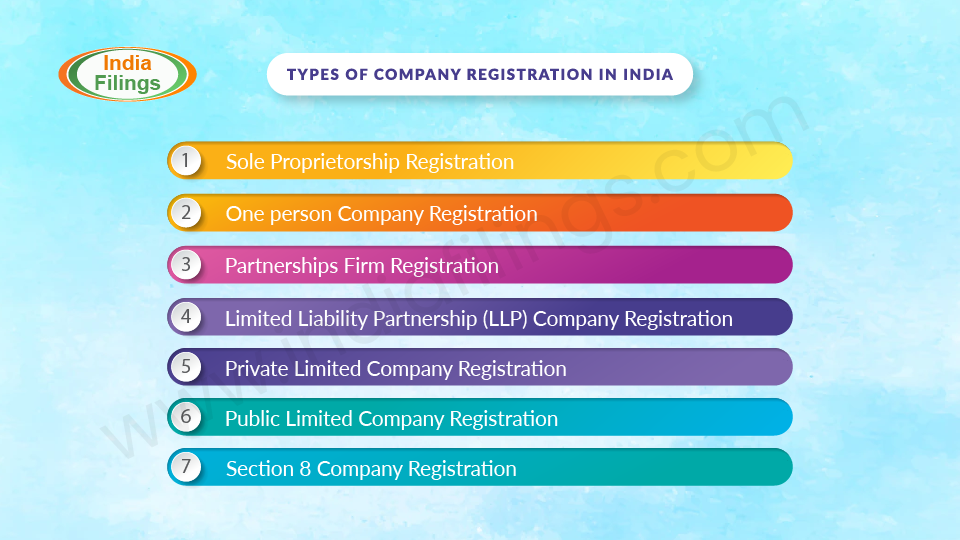
Company registration is mandatory in India to start any business, so fixing the business structures is crucial. The organizational structure you choose will determine the taxes you must pay, the compliance measures you must follow, and the eligibility criteria you need to meet. Hence, it is one of an entrepreneur's most vital decisions. In India, there are seven different types of company registration. Knowing about these seven types of Company Registration in India will help you make the right decision for your business. This article will explore the seven kinds of Company Registration in India.

Types of Company Registration in India

What are the Types of Registration? What Are The Types Of Registration?

Sole Proprietorship Registration

A sole proprietorship registration is nothing but a business managed by a single person. The firm and its operator are treated as a single entity. Usually, in sole proprietorship companies, the owner is responsible for all profits or losses. It's an individual company, and pretty easy to set up the business.  

One-person Company Registration

One Person Company is a corporation or business entity with a single individual director and member. As a result, the firm's operations will be managed by a single person without having all the personal liabilities. 

Partnerships Firm Registration 

Two or more partners who have already determined their role and profit-sharing can enter into a partnership and conduct business activities. For a Partnership Firm Registration, you need to use a binding agreement referred to as the Partnership Deed. You can specify duties, commitments, responsibilities, and the number of shares owned under business registration.

Limited Liability Partnership (LLP) Company Registration

LLP is an alternative corporate firm form that gives the benefits of the limited liability of a firm and the flexibility of a partnership. Since LLP contains elements of a corporate structure and a partnership firm structure, LLP is called a hybrid between a company and a partnership. Low registration fees and easy maintenance make LLP a first choice for many small businesses in India.  Click here to learn more about the Limited Liability Partnership (LLP)

Private Limited Company Registration

A Private Limited Company (PLC) is one of India's most common types of legal entity. A Private Limited Company is governed by the Companies Act 2013 and requires a minimum of 2 Directors and 2 Shareholders, with one of the Directors being an Indian Resident and Indian Citizen. To register a company in India, the following are the minimum requirements:
  • 2 Directors – 1 Person should be an Indian National and Indian Resident
  • 2 Shareholders – The Directors can be shareholders
  • Registered Office in India
100% Foreign Direct Ownership (FDI) is permitted in most sectors in India, and there is no restriction on foreign shareholding of a private limited company. Hence, most foreign subsidiaries are established in India as a private limited companies.

Public Limited Company Registration

The public limited company registration is identical to private limited company registration. The sole distinction is that the company's shares can perform trading activities on the stock exchange. Therefore, it allows the transfer of shares from one member to another.

Section 8 Company Registration  

Commonly called a non-profit organization, Section 8 company registration work for charitable purposes. The purpose is to promote arts, science, literature, education, caring for the needy, and protecting the environment. Moreover, all their profits are used to achieve these objectives, and the members do not take dividends for themselves. 
Back to Learn

Frequently Asked Questions

Common questions about Company Registration Types in India.

A sole proprietorship is a business owned and managed by a single individual, where there is no legal distinction between the owner and the business. On the other hand, a one-person company is a separate legal entity from its single owner and director, providing limited liability protection.
To register a partnership firm in India, a minimum of two partners is required. The roles, responsibilities, profit-sharing ratios, and other terms and conditions must be outlined in a legally binding partnership deed.
The primary advantage of an LLP is that it combines the benefits of limited liability for its partners, similar to a company, with the flexibility and tax benefits of a partnership firm. It offers a hybrid structure with low registration fees and easy maintenance.
Yes, to register a private limited company in India, it is mandatory to have at least one director who is an Indian resident and an Indian citizen.
Yes, public limited companies in India can have foreign shareholders. Most sectors in India permit 100% foreign direct investment (FDI) and there is no restriction on foreign shareholding in a public limited company.
A Section 8 company, also known as a non-profit organization, is registered for charitable purposes such as promoting arts, science, literature, education, caring for the needy, and protecting the environment. Its profits are primarily used to achieve these objectives, and members do not receive dividends.
Yes, an LLP company can be converted into a private limited company by following the prescribed procedure and complying with the relevant provisions of the Companies Act, 2013.
A private limited company in India requires a minimum of two shareholders. These shareholders can also be the directors of the company.
Yes, a sole proprietorship can be converted into other types of business entities, such as a partnership firm, a private limited company, or a Limited Liability Partnership (LLP), by following the necessary legal procedures and fulfilling the respective registration requirements.
Public limited companies in India are subject to more stringent compliance requirements compared to other business entities. These include holding annual general meetings, maintaining statutory records, filing annual returns and financial statements with the Registrar of Companies, and adhering to various provisions of the Companies Act, 2013, and other applicable laws.