

RENU SURESH
Expert
Published on: Jul 30, 2026
Startup Company -A Complete Guide for Indian Entrepreneurs
In today’s fast-moving business world, the term startup has become a buzzword synonymous with innovation, disruption, and rapid growth. But what exactly is a startup company, and what sets it apart from traditional businesses? A startup Company is a young, innovative business in its early stages of development, typically founded by one or more entrepreneurs aiming to bring a new product, service, or business model to market. Unlike traditional companies, startups prioritise speed, innovation, and scalability. They're often built to solve a specific problem in a novel way, leveraging technology, lean operations, and a risk-taking culture to challenge established industries. In this article, we’ll explore the fundamentals of startup companies, including their characteristics, lifecycle, funding sources, challenges, and a roadmap for how to launch one successfully.
Defining a Startup Company
A startup is not just any new business. While every startup is a new company, not every new company is a startup.
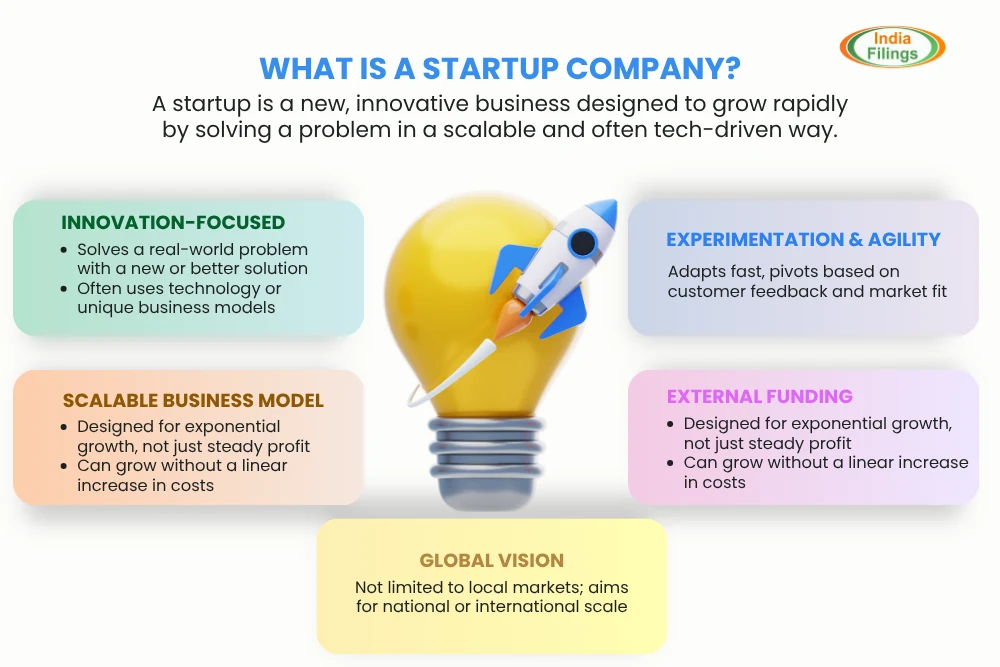
Key Characteristics of Startups:
- Innovation: Startups often introduce new solutions, technologies, or business models that challenge the status quo.
- Scalability: They are built to grow quickly and serve large markets, often through digital platforms or automation.
- High Risk, High Reward: Startups operate in uncertain environments, with the potential for significant losses or massive returns.
- Lean Structure: They start small, with limited staff and resources, focusing on agility and adaptability.
- External Funding: Most startups raise capital from investors such as angel investors, venture capitalists, or crowdfunding.
- Goal-Oriented: Their long-term objective is to build a sustainable, high-impact company, often with the aim of being acquired or going public.
10 Things Every Aspiring Entrepreneur Must Know
Before you dive into building your startup, here are 10 key things to understand:
1. Startups Solve Real Problems
Your startup must solve a genuine pain point. If it doesn’t make someone's life easier, better, or cheaper, it probably won’t succeed.
2. It’s All About Innovation
Startups are not just businesses — they’re solutions built through creativity and technology.
3. Speed Matters More Than Perfection
You don’t need a perfect product on Day 1. Build a Minimum Viable Product (MVP), launch it, and iterate.
4. Product-Market Fit Is the Holy Grail
This means you’ve created something that a market really wants. Until you reach this point, don’t worry about scaling.
5. Funding Isn’t Everything — But It Helps
Startup capital can come from:
- Personal savings
- Angel investors
- Venture capital
- Crowdfunding
The key is to match the right funding to your stage of growth.
6. Startups Are Built by Teams
Your co-founder, early employees, and advisors shape your startup’s success. Surround yourself with skilled and motivated people.
7. Marketing Begins Before You Launch
Start building hype early. A strong brand identity and social presence can give you an edge from Day 1.
8. Data-Driven Decisions Win
Track your metrics: user behaviour, conversion rates, feedback, churn, burn rate, etc. Let data guide your decisions.
9. Failure Is Part of the Process
The majority of startups fail. What matters is how fast you learn, adapt, and try again.
10. Legal & Financial Basics Matter
Forming a legal entity, protecting your IP, managing taxes—these are essential, not optional.
Types of Startup Companies
Understanding the type of startup you aim to build is crucial to defining your market potential, funding needs, and long-term vision. Each type of startup caters to different goals, personalities, and business models. Here are the six most common types of startups:
1. Lifestyle Startups
Lifestyle startups are born from passion. These businesses allow founders to turn their hobbies and personal interests into a sustainable career. The primary goal isn’t massive scale, but rather fulfilment and independence.
Example: A guitarist who opens a music academy or a surfer launching a beachwear brand.
2. Small Business Startups
These are traditional, locally operated businesses that started to provide a stable income and serve a specific community or niche. They typically don’t seek large-scale growth or outside investment.
Example: A neighbourhood bakery, salon, grocery store, or family-run café.
3. Scalable Startups
These startups aim for rapid growth and big impact. Built on innovative ideas and backed by venture capital, scalable startups are designed to expand fast and dominate large markets.
Example: Tech companies like Flipkart, Ola, or Freshworks.
4. Social Impact Startups
Also known as social enterprises, these startups are driven by a mission to create positive social or environmental change. Profit may be secondary to purpose, and some operate as nonprofits.
Example: Startups offering affordable education in rural areas or clean water solutions in underserved regions.
5. Large Company Startups
Big corporations often create internal startups to innovate, enter new markets, or keep up with changing technology. These are new ventures backed by established companies, with access to resources and capital.
Example: Google launching Waymo (self-driving cars) or Tata building Tata Neu (super app).
6. Buyable Startups
These startups are built specifically to be acquired. Rather than focusing on long-term growth, the goal is to create a valuable product or service quickly and sell it to a larger company. Example: Many app developers or SaaS startups aim to be bought by tech giants like Meta or Microsoft.
Choosing the right startup type depends on your goals — whether it’s lifestyle freedom, social impact, financial independence, or exponential growth.
The Lifecycle of a Startup Company
Startups evolve through a series of defined stages, each with its own priorities and hurdles.
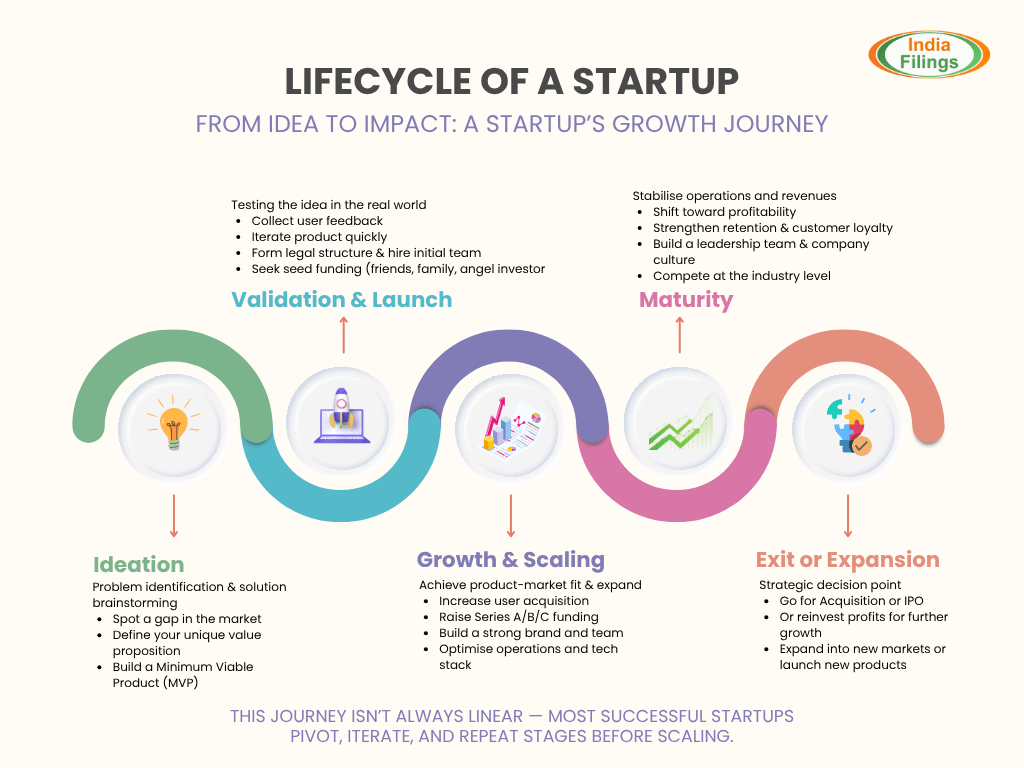
1. Ideation Stage
This is the birth of the startup. Entrepreneurs identify a market gap or an unsolved problem and brainstorm solutions. At this stage, the focus is on research, conceptualising the idea, and developing a minimum viable product (MVP)—a basic version of the product to test in the market.
2. Validation and Launch
Once the MVP is ready, startups begin testing their assumptions in the real world. Customer feedback is essential, and constant iteration is expected. The startup begins forming a legal structure, hiring initial team members, and perhaps securing seed funding from friends, family, or angel investors.
3. Growth and Scaling
When a startup finds product-market fit, it enters the growth phase. This involves expanding the team, increasing user acquisition, and often raising Series A/B/C funding rounds from venture capitalists. Efficiently managing operations and maintaining service quality becomes critical.
4. Maturity
At this point, the startup operates more like a traditional company, with stable revenues, systems, and structures. Focus shifts to profitability, retention, and market leadership. Some startups plateau here; others prepare for further expansion or strategic acquisitions.
5. Exit or Expansion
Successful startups often aim for one of two exits: an acquisition by a larger firm or an initial public offering (IPO). Others may choose to reinvest profits into new markets, features, or global growth.
Pros and Cons of a Startup Company
Starting a startup can be an exciting and rewarding journey, but it also comes with real challenges. Here's a breakdown of what aspiring founders should expect:
Advantages of Starting a Startup
- Full Autonomy & Flexibility: As a founder, you control how the business operates — from the products you build to the team you hire. You set your schedule and direction.
- Pursue Your Passion: Most startups are built around a personal vision or problem the founder wants to solve. You work toward something you truly believe in.
- Positive Impact on Customers: Startups often solve real-world problems. Knowing your product or service makes lives easier or better brings deep personal satisfaction.
- Financial Upside: If your startup grows or gets acquired, the returns can be life-changing. Equity and ownership can lead to significant long-term wealth.
- Innovation Playground: You’re free to innovate, test new ideas, and challenge traditional business models — creating something unique in your industry.
Disadvantages of Starting a Startup
- High Risk of Failure: Around 90% of startups fail. The risk is significant, and success is never guaranteed, even with a great idea and hard work.
- Intense Pressure & Stress: Founders often work long hours, face constant decision-making, and deal with financial uncertainty — all while managing growth.Financial Insecurity Many founders go without a stable salary in the early stages. You may need to self-fund, borrow, or depend on uncertain investor funding.
- Competitive Environment: Most industries are saturated. Standing out requires continuous innovation and the ability to adapt quickly.
- Unpredictable Work-Life Balance: Startups can consume your time, energy, and mental bandwidth, often blurring the line between personal and professional life.
How to Launch a Startup Company: A Step-by-Step Guide
Here are the essential steps to launch your startup—from idea to execution—along with practical tips to avoid common pitfalls and increase your chances of success.
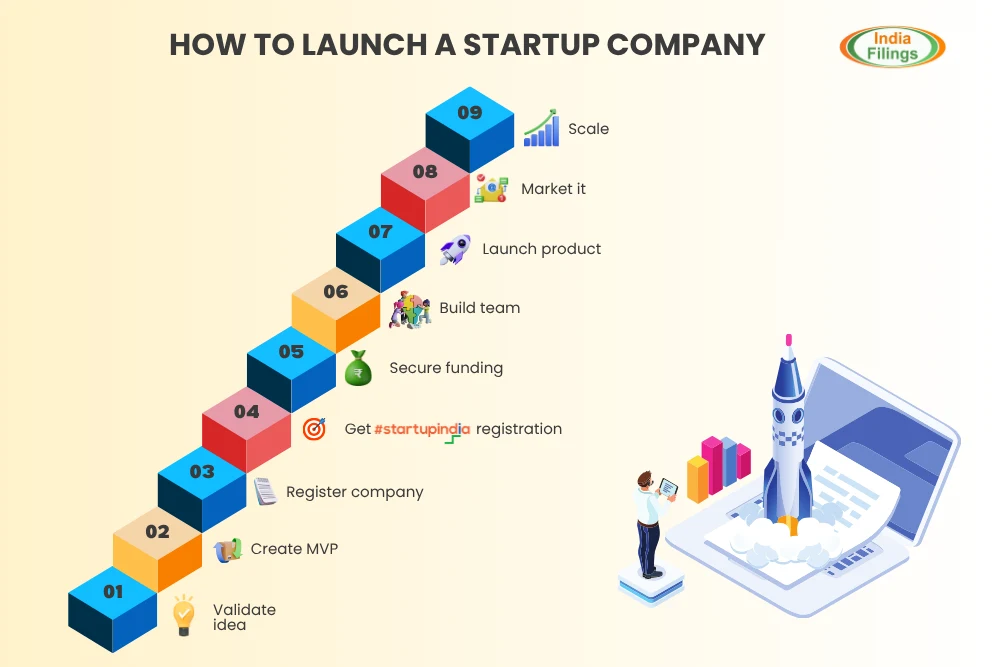
1. Refine and Validate Your Idea
The first step in launching a successful startup is to refine your idea and ensure it solves a real-world problem. A great startup isn't just based on creativity—it’s based on value.
Ask Yourself:
- What problem am I solving?
- Who is affected by this problem?
- How is my solution different or better than existing alternatives?
Once you have a clear value proposition, conduct market research to understand your target audience’s needs, challenges, and preferences. Interviews, surveys, and competitor analysis are great starting points.
Click here to learn about Startup Business Ideas
Build an MVP (Minimum Viable Product)
Rather than investing heavily upfront, develop a simplified version of your product that delivers the core value. This MVP will allow you to test your assumptions and gather feedback from early adopters, helping you iterate quickly before a full launch.
2. Develop a Business Plan
A startup without a plan is like a ship without a compass. Your business plan is a roadmap that guides your vision, operations, and growth strategy.
What to Include:
- Executive Summary: A brief overview of your mission, vision, and business model.
- Market Analysis: Insights into your target audience, competitors, and industry trends.
- Product/Service Offering: What you’re selling and why it’s valuable.
- Revenue Model: How your company will make money.
- Marketing & Sales Strategy: Channels, pricing, positioning.
- Operational Plan: Logistics, suppliers, fulfilment, technology stack.
- Financial Projections: Expenses, revenue forecasts, cash flow estimates.
Even if you’re bootstrapping, this document is vital when pitching to investors, co-founders, or team members.
Also read about Essential Legal Documents for a Startup
3. Choose the Right Legal Structure
Choosing the right legal structure for your startup in India is crucial, as it affects your liability, taxation, compliance requirements, and ability to raise funds. Here are the most common options:
- Sole Proprietorship: Easiest to start and run, but the founder is personally liable for all debts and obligations. Suitable for very small businesses.
- Partnership Firm: Two or more people share ownership, profits, and liabilities. Registration under the Indian Partnership Act is optional but recommended.
- Limited Liability Partnership (LLP): Combines the flexibility of a partnership with limited liability protection. LLPs are easier to manage and have fewer compliance requirements than companies.
- Private Limited Company (Pvt Ltd): The most preferred structure for startups looking to raise venture capital. It provides limited liability, allows equity funding, and is recognised under the Companies Act, 2013. Requires registration with the Ministry of Corporate Affairs (MCA).
Consult IndiaFilings startup experts to determine the best fit based on your location, growth plans, and fundraising strategy.
- Register your business with local or national authorities.
- Apply for business licenses or permits.
- Open a business bank account for better financial management.
4. Startup India Registration
If you're launching a startup in India, registering with the Startup India initiative can unlock powerful benefits. Launched by the Government of India, Startup India is a flagship program designed to foster innovation, support budding entrepreneurs, and simplify business processes. To be eligible, your startup must be less than 10 years old, have an annual turnover of under ₹100 crore, and be working toward innovation, development, or improvement of products or services.
Once registered through the Startup India portal & obtained a Startup India certificate, you gain access to a wide range of perks, including tax exemptions, easier compliance, fast-track patent processing, and access to government funding schemes like the Fund of Funds for Startups (FFS) or Startup India Seed Fund Scheme (SISFS). Registration also boosts your credibility, making it easier to attract investors, partners, and customers. For founders in India, this is a strategic first step that combines formal recognition with tangible support.
5. Secure Funding
Even the leanest startups need capital to get off the ground. Start by estimating your startup costs, which may include:
- Product development
- Website or app creation
- Marketing campaigns
- Legal and licensing fees
- Hiring and salaries
- Office or remote tools
Create a compelling pitch deck that outlines your vision, traction, and market opportunity when approaching investors.
Click here to learn about 11 Ways to Raise Funds for Startups in India
6. Build the Right Team
A startup's success often hinges on the strength of its founding team. Look for co-founders and early hires who share your vision and bring complementary skills.
Look for Team Members Who:
Have deep expertise in product, engineering, design, or marketing.
- Are adaptable and comfortable in fast-paced environments.
- Can work under pressure and uncertainty.
- Believe in the mission and culture of the startup.
If you can’t afford full-time employees initially, consider hiring freelancers, contractors, or equity-based contributors.
6. Build and Test Your Product or Service
Use agile development principles to build and improve your product quickly. Launch your MVP to a small segment of users and track their feedback, engagement, and pain points.
Prioritize:
- Usability
- Core functionality
- Speed to market
Resist the temptation to perfect every detail before launching. It’s more important to ship early and iterate fast.
7. Launch Your Marketing and PR Campaign
Launching your product without marketing is like opening a store without telling anyone. Start building awareness early through pre-launch campaigns, community building, and social engagement.
Key Marketing Channels:
- Website and SEO: Your digital storefront must clearly explain what you do and why it matters.
- Social Media: Build a following on platforms where your audience spends time.
- Content Marketing: Blog posts, guides, and videos that provide value and build trust.
- Email Marketing: Nurture leads with updates, offers, and educational content.
- Paid Ads: Use Google Ads, Facebook, or LinkedIn to test messaging and drive traffic.
PR & Outreach:
- Write and distribute press releases.
- Reach out to journalists, bloggers, and influencers.
- Seek guest posts, podcast interviews, or startup features.
8. Focus on Sales and Customer Acquisition
Revenue is the lifeblood of any startup. Focus your efforts on acquiring paying customers, validating your business model, and building repeatable sales processes.
Tips to Succeed:
- Identify your ideal customer profile (ICP).
- Track your sales funnel metrics (conversion rate, churn rate, lifetime value).
- Use CRM tools to manage leads and relationships.
- Offer personalised onboarding and exceptional customer support.
Happy customers are your best marketers. Encourage referrals, testimonials, and word-of-mouth buzz.
9. Set Up Systems and Operations
As your business grows, establish efficient processes to handle daily operations. Building scalable systems early will save time and money as you expand.
10. Measure, Learn, and Scale
After launching, keep a close eye on your key performance indicators (KPIs). These might include:
- Revenue growth
- Customer acquisition cost (CAC)
- Churn rate
- Customer satisfaction (CSAT or NPS)
- Burn rate and runway
Use these metrics to assess performance and identify areas for improvement. Most startups go through several iterations or pivots before finding product-market fit.
Once You’ve Validated Your Model:
- Expand into new customer segments or markets.
- Add complementary products or features.
- Hire more staff and delegate responsibilities.
- Seek additional rounds of funding if needed.
Startups vs. Small Businesses: What’s the Difference?
Many people confuse startups with small businesses. While both may begin small, they’re very different in purpose and approach:
Aspect | Startup | Small Business |
Purpose | Disrupt the market with innovation | Serve a local or niche demand |
Growth Goal | Scalable, exponential growth | Steady, linear growth |
Innovation | High — often based on new tech or business models | Low — traditional or proven business models |
Risk Level | High (unproven ideas, market uncertainty) | Moderate to low (known markets, predictable income) |
Funding | Seeks angel/VC funding or accelerators | Usually bootstrapped or uses small loans |
Common Challenges Faced by Startup Companies
Launching a startup is thrilling, but far from easy. Founders must navigate multiple challenges, including:
1. Product-Market Fit
The most common reason startups fail is building a product no one wants. Finding a match between your offering and customer needs is essential.
2. Cash Flow Management
Startups often burn through cash rapidly. Without solid financial planning, they can run out of money before reaching sustainability.
3. Talent Acquisition
Attracting skilled employees can be difficult due to limited funds and job security concerns compared to established companies.
4. Customer Acquisition
Acquiring and retaining customers in competitive markets can be expensive and slow. Startups need smart marketing strategies to scale effectively.
5. Competition
Startups face pressure from other startups and established companies. Without unique value or rapid execution, they can be outpaced.
6. Regulatory Hurdles
Startups in industries like fintech, healthcare, and edtech must deal with complex regulations and compliance issues from the beginning.
Examples of Startup Companies
Startups can span across various industries, from technology to healthcare to finance. Some of India’s most notable startup success stories include Zomato, which transformed food delivery and restaurant discovery; Paytm, a pioneer in digital payments and financial services; Ola, a ride-hailing platform that disrupted traditional transportation; and BYJU’S, which redefined online education. Globally, startups like Airbnb, Uber, and Stripe have scaled rapidly by addressing unmet needs through innovation and technology. These companies all began as startups with a bold idea and a scalable vision, growing into major players by solving real problems at scale.
Final Thoughts
Starting a company is one of the most rewarding yet challenging paths you can take as an entrepreneur. A startup isn’t just a small version of a big company—it’s a unique, high-growth venture driven by bold ideas, lean strategies, and relentless execution.
To succeed, entrepreneurs need not only a brilliant idea but also resilience, adaptability, and a strong understanding of the startup journey.
Whether you’re planning to launch a tech product, revolutionise your industry, or solve a pressing global issue, now is the time to take action. The startup ecosystem is full of opportunities for those willing to innovate, take risks, and build something that matters.
Ready to Launch Your Startup Company? Let IndiaFilings Help You Build It Right
Starting up in India? Don’t do it alone. IndiaFilings offers end-to-end support to help turn your idea into a successful venture — all in one place. From crafting a winning business plan, registering your company and completing your Startup India registration, to preparing your pitch deck and managing ongoing legal and tax compliances, our experts guide you at every step. Whether you're bootstrapping or fundraising, IndiaFilings is your trusted partner to launch and grow with confidence.
Start your entrepreneurial journey with IndiaFilings today.