
Karthiga
Expert
Published on: Aug 14, 2026
Form GST RET-1
In the proposed GST return filing, Form GST RET-1 has been introduced to replace Form GSTR-1 and Form GSTR-3B. Currently, companies are required to file tax returns using GSTR-1 and GSTR-3B by providing the details of inward and outward supply. However, under this new return system, there is one basic return Form GST RET-1 which contains two annexures namely Form GST ANX-1 and Form GST ANX-2. In this article, we look at the Form GST RET-1 in detail.Form GST RET-1
Form GST RET-1 is the return form which has to be filed either monthly or quarterly by the small taxpayers with annual turnover up to Rs.5 crores along with the details of the supplies made.Form GST ANX-1
The format of Form GST ANX-1 is similar to GSTR–1 return form. In Form GST ANX-1 the respective taxpayer will have to provide all output and inward supplies which attracts reverse charge and import of goods and services. This details will be reported invoice-wise on a real-time basis except for B2C supplies.Form GST ANX-2
GST ANX-2 contain the details of inward supplies. The recipient can take action by either accepting or rejecting the uploaded document by the supplier or the same can be kept pending for action to be taken later.Features of GST RET-1
- Invoices can be uploaded in real-time basis by a supplier, which is made available for the buyer to view and take action on Form GST ANX-2.
- Invoices can be marked as rejected or accepted by the buyer, or the same can be retained pending for action to be taken later.
- The mechanism for availing input tax credit by the recipient on a provisional basis is created if the supplier does not upload the invoice or file return. IN such cases, the credit available would not be more than 20% of the specified value.
- The proposed return system will have a provision to file two amendment returns for each tax period. Therefore, taxpayers will be able to amend their returns once registered.
Who can file GST RET-1?
Any taxpayers making B2B suppliers, B2B suppliers, inward supplies attracting reverse charge mechanism, nil rated, zero-rated or supplies through e-commerce operators can file GST RET-1. In addition to the above, the taxpayers with the annual turnover more than Rs.5 crore will have to file return monthly and also the small taxpayers with annual turnover up to Rs.5 crore can file for GST RET-1 every quarter.Format of Normal GST RET-1
The GST RET-1 return form consists of seven parts are listed below:- Profile Updation
- Form GST ANX-1
- Form GST ANX-2
- Form GST RET-1
- Form GST ANX-1A
- Form GST RET-1A
- Form GST PMT-8
Profile Updation
In Profile Updation, the taxpayer needs to provide answers to several questions to their preferred options for return monthly/quarterly and the type of quarterly return (Sahaj/Sugam/Normal).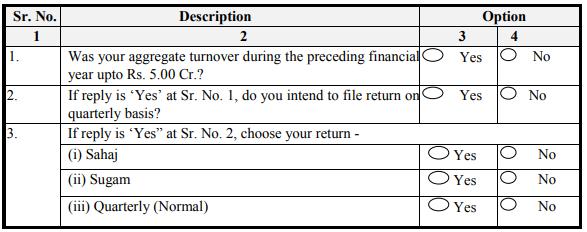 Form GST RET-1 - Profile Updation
Form GST ANX-1
Form GST ANX-1 will contain the details of outward supplies, imports, and inward supplies, attracting a reverse charge.
Form GST RET-1 - Profile Updation
Form GST ANX-1
Form GST ANX-1 will contain the details of outward supplies, imports, and inward supplies, attracting a reverse charge.
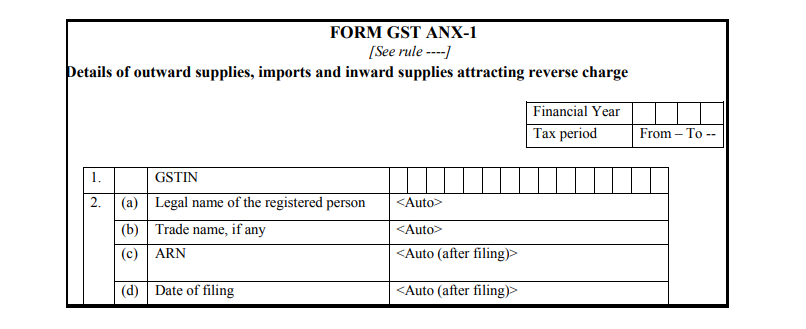 Form GST RET-1 - Form GST ANX-1
Form GST ANX-2
Form GST ANX-2 will contain the details of auto drafted inward supplies (Form GST ANX-1, Form GSTR-5 and Form GSTR-6).
Form GST RET-1 - Form GST ANX-1
Form GST ANX-2
Form GST ANX-2 will contain the details of auto drafted inward supplies (Form GST ANX-1, Form GSTR-5 and Form GSTR-6).
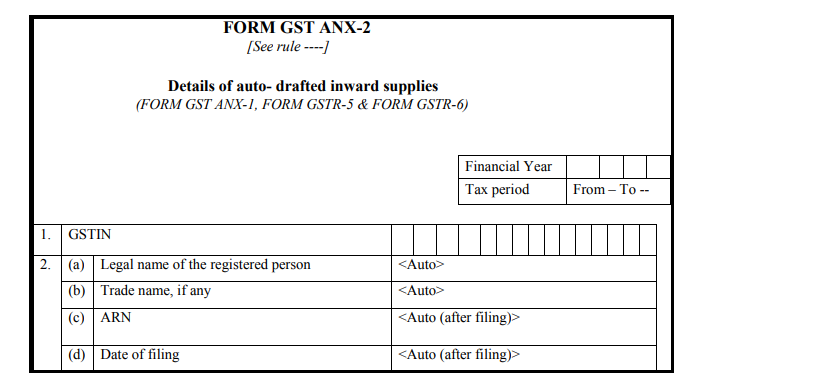 Form GST RET-1 - Form GST ANX-2
Form GST RET-1
This is the Normal (Monthly/Quarterly) return which a taxpayer should file by providing the details of inward supplies attracting a reverse charge, outward supplies, advanced received, debit/credit notes issued, supplies without liabilities, and total supply value with tax liability.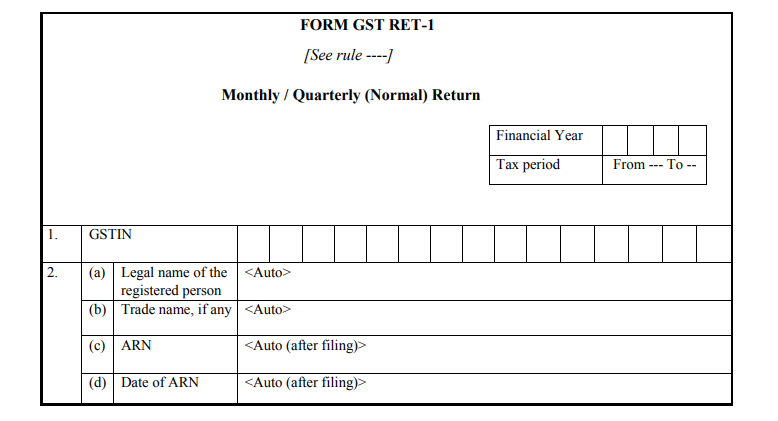 Form GST RET-1
Form GST ANX-1A
Form GST ANX-1A has to be filed for making amendments in form GST ANX-1 by providing the details of imports, outward supplies and inward supplies attracting reverse changes.
Form GST RET-1
Form GST ANX-1A
Form GST ANX-1A has to be filed for making amendments in form GST ANX-1 by providing the details of imports, outward supplies and inward supplies attracting reverse changes.
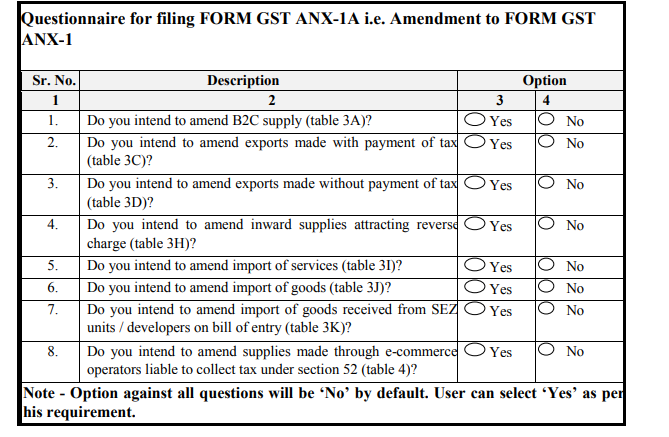 Form GST RET-1 - Form GST ANX-1A
Form GST RET-1A
Form GST RET-1A has to be filed for making amendments in form GST RET-1 by providing the details of the amendment to the summary of outward supplies and inward supplies attracting a reverse charge.
Form GST RET-1 - Form GST ANX-1A
Form GST RET-1A
Form GST RET-1A has to be filed for making amendments in form GST RET-1 by providing the details of the amendment to the summary of outward supplies and inward supplies attracting a reverse charge.
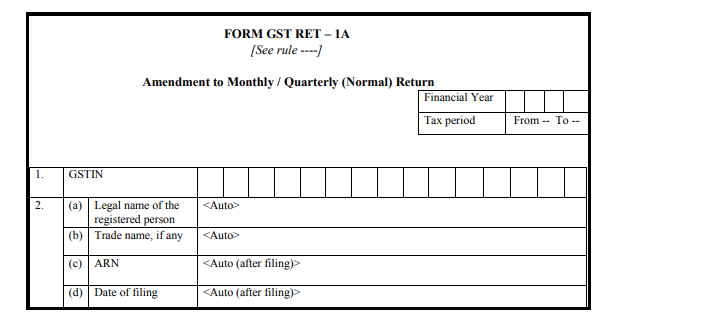 Form GST RET-1 - Form GST RET-1A
Form GST PMT-8
Form GST PMT-8 has to be filed by the taxpayers for payment of self-assessed tax as it contains the details of summary of self-assessed liability, payment of tax and input tax credit availed.
Form GST RET-1 - Form GST RET-1A
Form GST PMT-8
Form GST PMT-8 has to be filed by the taxpayers for payment of self-assessed tax as it contains the details of summary of self-assessed liability, payment of tax and input tax credit availed.
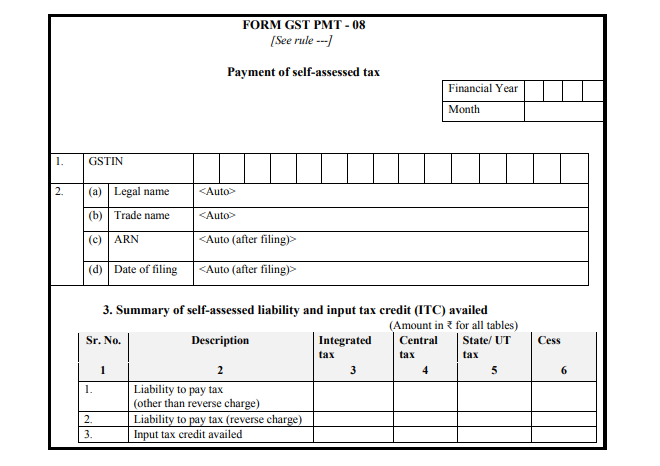 Form GST RET-1 - Form GST PMT -08