

RENU SURESH
Expert
Published on: Jul 30, 2026
56th GST Council Meeting Highlights: Updates, Outcome, Press Release and Latest News
The 56th GST Council meeting happened on 3rd September 2025 at New Delhi, chaired by Union Finance Minister Nirmala Sitharaman, along with state finance ministers and Union Territory representatives. This crucial session comes after a six-month gap and is expected to pave the way for next-generation GST reforms that could reshape India’s indirect taxation system.
Below, we provide a comprehensive breakdown of the key highlights of GST council meetng.
Key Takeaways
- The 56th GST Council meeting began on 3rd September 2025 in New Delhi and continues on 4th September 2025 at New Delhi.
- On 15th August 2025, during the 79th Independence Day address, Prime Minister Narendra Modi announced the rollout of Next-Generation GST reforms.
- The Council has approved these reforms, which include:
- Removal of the 12% and 28% tax slabs, with goods now shifted into either the 5% or 18% slabs.
- Introduction of a new 40% slab for demerit goods.
- Correction of the inverted duty structure on fertilizers, fabrics, and several other products.
- Additional agenda items, such as pre-filled GST returns and automated refund mechanisms, are expected to be taken up on 4th September 2025.
Highlights from the 56th GST Council Meeting
The 56th GST Council meeting, held in New Delhi on 3rd September 2025, brought several key reforms aimed at simplifying the tax system, easing compliance, and providing relief to the common man.
Reforms Focused on the Common Man
The Finance Minister said that the latest GST reforms were framed with the needs of ordinary citizens in mind. She noted that all taxes on daily-use items were reviewed carefully, and in most cases, the rates have been brought down substantially.
GST Exemption on Insurance
The Council approved a complete exemption of GST on life and health insurance policies, offering relief to policyholders.
Tobacco Taxation and Valuation
- Tobacco and related products will continue to attract the existing 28% GST rate until compensation liabilities, such as loans and interest, are fully cleared.
- The Council also recommended shifting from the current transaction value method to a retail sale price-based valuation for tobacco products.
Effective Date of Other Rate Changes
All other GST rate revisions on goods and services (excluding tobacco) will be applicable from 22nd September 2025.
Simplified GST Registration Process
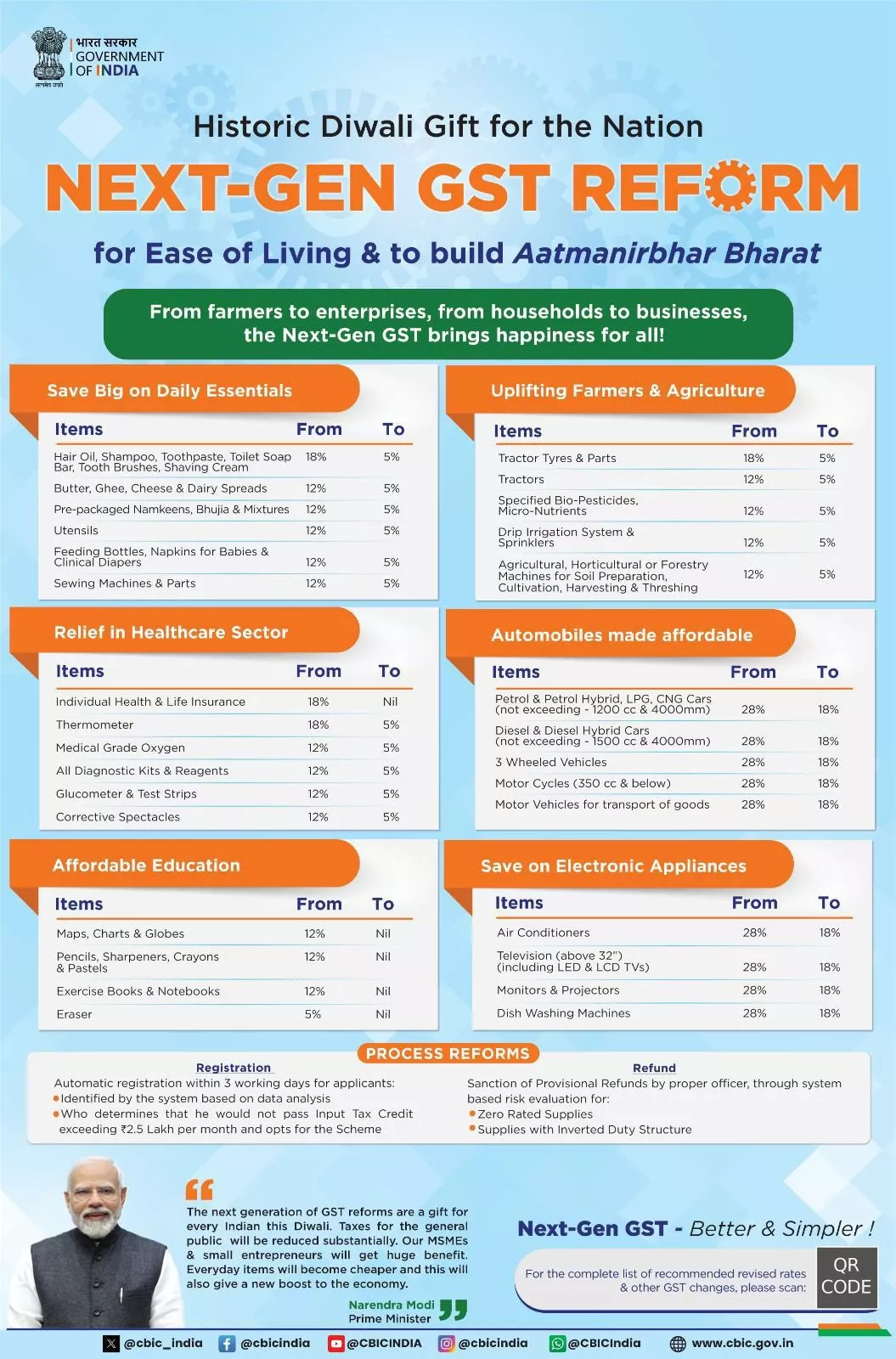
- Automatic registration within three working days for:
- Low-risk applicants are identified through risk parameters and data analysis.
- Applicants who opt for the scheme where ITC claims do not exceed ₹2.5 lakh per month.
- A new withdrawal process, similar to registration, will also be introduced, guided by risk checks.
- This reform is expected to benefit nearly 96% of new applicants.
GST Rate Rationalisation
One of the most anticipated reforms, the rationalisation of GST slabs, has now been officially implemented. India’s multi-tier GST structure, which previously included rates of 5%, 12%, 18%, and 28%, has been simplified:
- The 12% and 28% slabs have been removed, with most goods and services now classified under either 5% or 18%.
- A 40% GST slab has been introduced for demerit or sin goods, including tobacco, alcohol substitutes, and select luxury items.
- The inverted duty structure affecting sectors such as textiles, footwear, fertilizers, and packaging has been corrected.
This reform streamlines the GST rate system, reduces classification disputes, and enhances transparency in the indirect tax framework.
No Change in Monthly Returns
During the media briefing, the secretary confirmed that there will be no changes to the monthly GST return filing.
Operationalisation of GSTAT
The Goods and Services Tax Appellate Tribunal (GSTAT) will become functional in 2025, with the Principal Bench also serving as the National Appellate Authority for Advance Ruling.
- Appeals to be accepted until 30th September 2025
- Hearings to begin by 31st December 2025
- Backlog appeals to be filed before 30th June 2026
Provisional Refund System
From 1st November 2025, the CBIC will roll out a revised system for granting 90% provisional refunds for inverted duty structures and zero-rated supplies. This will be based on automated data analysis and risk evaluation.
Export Refunds Simplified
The Council recommended removing the threshold limit on refunds for exports made with tax payment, thereby reducing compliance burdens for exporters who send goods through post and courier services.
Amendments to CGST Act
- Sections 15 and 34 have been amended:
- The requirement of linking discounts only to pre-supply agreements and invoices has been removed.
- If a post-sale discount reduces the value of supply through a GST credit note, the recipient must reverse the corresponding ITC.
- A detailed GST Circular will be issued to clarify these changes.
GST Rate Cuts
The 56th GST Council meeting announced major rate reductions across essential goods, agriculture, healthcare, automobiles, education, and electronics. These changes aim to make daily-use items more affordable, support farmers, boost healthcare access, and encourage sustainable consumption.
Category | Items | From (%) | To (%) |
Daily Essentials | Hair Oil, Shampoo, Toothpaste, Toilet Soap Bar, Tooth Brushes, Shaving Cream | 18 | 5 |
Butter, Ghee, Cheese & Dairy Spreads | 12 | 5 | |
Pre-packaged Namkeens, Bhujia & Mixtures | 12 | 5 | |
Utensils | 12 | 5 | |
Feeding Bottles, Napkins for Babies & Clinical Diapers | 12 | 5 | |
Sewing Machines & Parts | 12 | 5 | |
Uplifting Farmers & Agriculture | Tractor Tyres & Parts | 18 | 5 |
Tractors | 12 | 5 | |
Specified 12 bio-Pesticides and micro-Nutrients | 12 | 5 | |
Drip Irrigation System & Sprinklers | 12 | 5 | |
Agricultural, Horticultural or Forestry Machines (Soil Preparation, Cultivation, etc.) | 12 | 5 | |
Healthcare Sector | Individual Health & Life Insurance | 18 | Nil |
Thermometer | 18 | 5 | |
Medical Grade Oxygen | 12 | 5 | |
All Diagnostic Kits & Reagents | 12 | 5 | |
Glucometer & Test Strips | 12 | 5 | |
Corrective Spectacles | 12 | 5 | |
33 drugs and medicines, listed in the press release | 12 | Nil | |
Agalsidase Beta, Imiglucerase and Eptacog alfa activated recombinant coagulation factor VIIa drugs | 5 | Nil | |
Drugs and medicines such as Faricimab, Pertuzumab, Fluticasone Furoate + Umeclidinium + Vilanterol FF/UMEC/VI, Ocrelizumab, and Brentuximab Vedotin | 12 | 5 | |
Automobiles | Petrol & Petrol Hybrid, LPG, CNG Cars (≤1200cc & ≤4000mm) | 28 | 18 |
Diesel & Diesel Hybrid Cars (≤1500cc & ≤4000mm) | 28 | 18 | |
Three wheelers | 28 | 18 | |
Motorcycles (≤350cc) | 28 | 18 | |
Motor Vehicles for the transport of goods | 28 | 18 | |
Education | Maps, Charts & Globes | 12 | Nil |
Pencils, Sharpeners, Crayons & Pastels | 12 | Nil | |
Exercise Books & Notebooks | 12 | Nil | |
Eraser | 5 | Nil | |
Electronic Appliances | Air Conditioners | 28 | 18 |
Television (above 32") (inc. LED & LCD TVs) | 28 | 18 | |
Monitors & Projectors | 28 | 18 | |
Dish Washing Machines | 28 | 18 |
GST Rate Hike
At the same time, the Council approved higher GST rates on sin goods, luxury products, mining, and certain sectors. The move is intended to discourage consumption of harmful products, generate additional revenue, and promote responsible use of resources.
Category | Item description | From (%) | To (%) |
Mining | Coal, lignite, peat | 5 | 18 |
Sin goods | Pan masala | 28 | 40 |
Aerated waters | 28 | 40 | |
Caffeinated beverages | 28 | 40 | |
Carbonated beverages of fruit drinks / with fruit juice | 28 | 40 | |
Other non‑alcoholic beverages | 18 | 40 | |
Motor cars and larger hybrids (beyond small‑car thresholds) | 28 | 40 | |
Motorcycles exceeding 350cc | 28 | 40 | |
Aircraft for personal use | 28 | 40 | |
Yachts and vessels for pleasure/sports | 28 | 40 | |
Smoking pipes and cigarette/cigar holders | 28 | 40 | |
Revolvers & pistols | 28 | 40 | |
Admission to casinos, race clubs, and sporting events like IPL | 28% with ITC | 40% with ITC | |
Licensing of bookmakers by race clubs | 28% with ITC | 40% with ITC | |
Specified actionable claims (betting, casinos, gambling, horse racing, lottery, online money gaming) | 28% with ITC | 40% with ITC | |
Leasing/rental without operator of goods attracting 40% GST | 28% with ITC | 40% with ITC | |
Paper sector | Dissolving‑grade chemical wood pulp | 12 | 18 |
Various papers/paperboards, other than exercise‑book paper | 12 | 18 | |
Textiles | Apparel/Made‑ups > Rs 2,500 per piece | 12 | 18 |
Quilted/cotton quilts and quilted products more than Rs.2,500 per piece | 12 | 18 |
Press releases
3rd September 2025: 56th GST Council meeting highlights
Review of Compensation Cess
-
Certain products, including pan masala, gutkha, cigarettes, chewing tobacco (zarda), unmanufactured tobacco, and beedis, will continue to attract existing GST rates and compensation cess.
-
The continuation of the compensation cess is necessary until all loan and interest obligations under the compensation cess account are fully cleared.
-
Once these obligations are settled, the GST Council will transition these goods to the revised GST rates as part of the overall rate rationalization.
-
This phased approach ensures fiscal stability while implementing the new, simplified GST structure.
Conclusion
The 56th GST Council meeting has introduced major reforms to simplify India’s tax system, reduce rates on essential goods, healthcare, agriculture, and daily-use items, and provide relief to citizens. At the same time, higher rates on sin and luxury goods, along with corrections to inverted duty structures, ensure fiscal balance. With new exemptions, streamlined processes, and the operationalisation of GSTAT, these changes make GST more transparent, citizen-friendly, and supportive of economic growth.