

Renu Suresh
Expert
Published on: Aug 24, 2026
Partnership Deed: Meaning, Importance, Contents & Registration
A partnership deed is a legal written document mutually agreed upon by business partners. It's preferred by entrepreneurs due to its benefits, including eligibility for a PAN, opening a bank account, and obtaining GST registration or an FSSAI license. The key features of the partnership deed include rights, rules, responsibilities, profit-sharing ratio, terms between partners and other important details. Signing a partnership deed before investing your savings and efforts is a wise decision to prevent disagreements, financial issues, or internal conflicts and safeguard each party's interests.
Interested in learning more about what a partnership deed? In this article, we'll explain everything about partnership deeds and provisions of the Indian Partnership Act of 1932 and their importance.
Register Your Partnership Firm Now!
What is a Partnership Deed?
A Partnership deed is a legal agreement that outlines the terms and conditions of a partnership between partners in a business venture. This legal document ensures a clear understanding of each partner's role and is crucial for the smooth operation of the firm. It details key aspects such as profit and loss sharing, responsibilities, procedures for admitting new partners, salary structures, and exit processes. Registered under the Indian Registration Act of 1908, the partnership deed is legally binding and helps resolve any potential legal disputes.
Importance of Partnership Deed
A partnership deed establishes clarity among partners and ensures smooth business operations within a firm. It serves as a legal agreement that clearly defines the roles, responsibilities, and rights of each partner, thereby minimising the chances of misunderstandings and legal disputes.
Here are some key reasons why keeping a partnership deed is important:
- Clear Profit and Loss Sharing: It specifies the ratio in which profits and losses are distributed among partners, promoting transparency and fairness.
- Defined Duties and Roles: The deed assigns specific responsibilities to each partner, ensuring everyone is aware of their obligations and contributing effectively.
- Dispute Resolution Mechanism: It includes clear procedures for dispute resolution, making conflict management more efficient and structured.
- Legal Safeguard: In times of disagreement, the partnership deed serves as a legal point of reference to protect the interests of all parties.
- Guidelines for Changes in Partnership: It lays down the process for the induction or exit of partners, helping maintain continuity and stability in the firm.
Types of Partnership Deeds
There are three distinct types of partnership deeds:
General Partnership Deed
- A general partnership deed is the most common type of partnership legal agreement.
- It clarifies the roles and responsibilities of each partner, their capital contributions, profit-sharing ratios, and the management of the partnership business.
Limited Partnership Deed
- This partnership deed includes both general and limited partners.
- General partners are responsible for managing the business and carry unlimited liability for the partnership's debts.
- Limited partners act as passive investors and have limited liability, restricting their liability to the extent of their capital contributions.
Limited Liability Partnerships (LLP) Deed
- A Limited Liability Partnership (LLP) is a partnership structure in which all partners benefit from limited liability.
- The LLP agreement outlines the roles and responsibilities of each partner, their capital contributions, profit-sharing ratios, and the management of the LLP business.
- It also defines and establishes the relationship between partners and the LLP.
Contents of the Partnership agreement
A partnership agreement serves as a safeguard for your interests in case of disputes or confusion regarding various matters within the partnership. Therefore, the Deed must contain all the legal details related to the partnership firm. Although there isn't a standardised format for drafting a Partnership Deed, we've compiled a list of essential information typically found in a partnership agreement:
- Purpose of Partnership: Includes the names and addresses of all partners and essential details that describe the nature of the business undertaken by the partners.
- Principal Place of Business: Specifies the location(s) from which the firm will operate, as determined by the Partners.
- Partnership Duration: Indicates the date of the firm's establishment and the duration of the partnership.
- Capital Contribution: Details the contribution of the firm's capital, whether in cash, property, goods, or services, with agreed-upon values (allocated share-wise).
- Capital Withdrawals: Specifies the partner drawing policy and whether interest will be paid to the firm on such withdrawals.
- Salary & Commission: Outlines the ratio or percentage of partners' salaries.
- Profit & Loss Ratio: Defines the profit/loss distribution ratio among the Partners.
- Dissolution of Partnership: Describes how the firm's accounts will be handled in the event of the dissolution of partnership firm.
- Admission of New Partners: Provides details regarding the admission, retirement, and exit of partners in the future.
- Bankruptcy Rules: Specifies procedures to follow if a partner declares bankruptcy.
- Accounting and Audit: Ensures that complete and accurate books of account for the firm's transactions are available for inspection by any partner at reasonable times.
- Voluntary Withdrawal of a Partner: Outlines rules for a partner's voluntary withdrawal from the partnership.
- Duties of Partners: Defines the roles and responsibilities of each partner.
- Banking and Partnership Funds: Addresses the placement of funds held in the firm's name into a designated bank account chosen by the Partners.
- Borrowings: Requires written consent from all partners for obtaining loans from banks, financial institutions, or third parties to fulfil the firm's financial needs.
- Partnership Financial Year: Specifies the financial year for the partnership.
Executing a Partnership Deed
To formalize a partnership agreement, it is typically printed on a Non-Judicial Stamp Paper valued at Rs.100/- or more, depending on the value of assets held within the partnership firm. The signing of the partnership agreement usually takes place in the presence of all partners, and each partner retains a signed original copy for their records. After the partners sign the document, it is witnessed, and each partner retains a duplicate or triplicate signed copy of the partnership deed.Partnership Deed Format
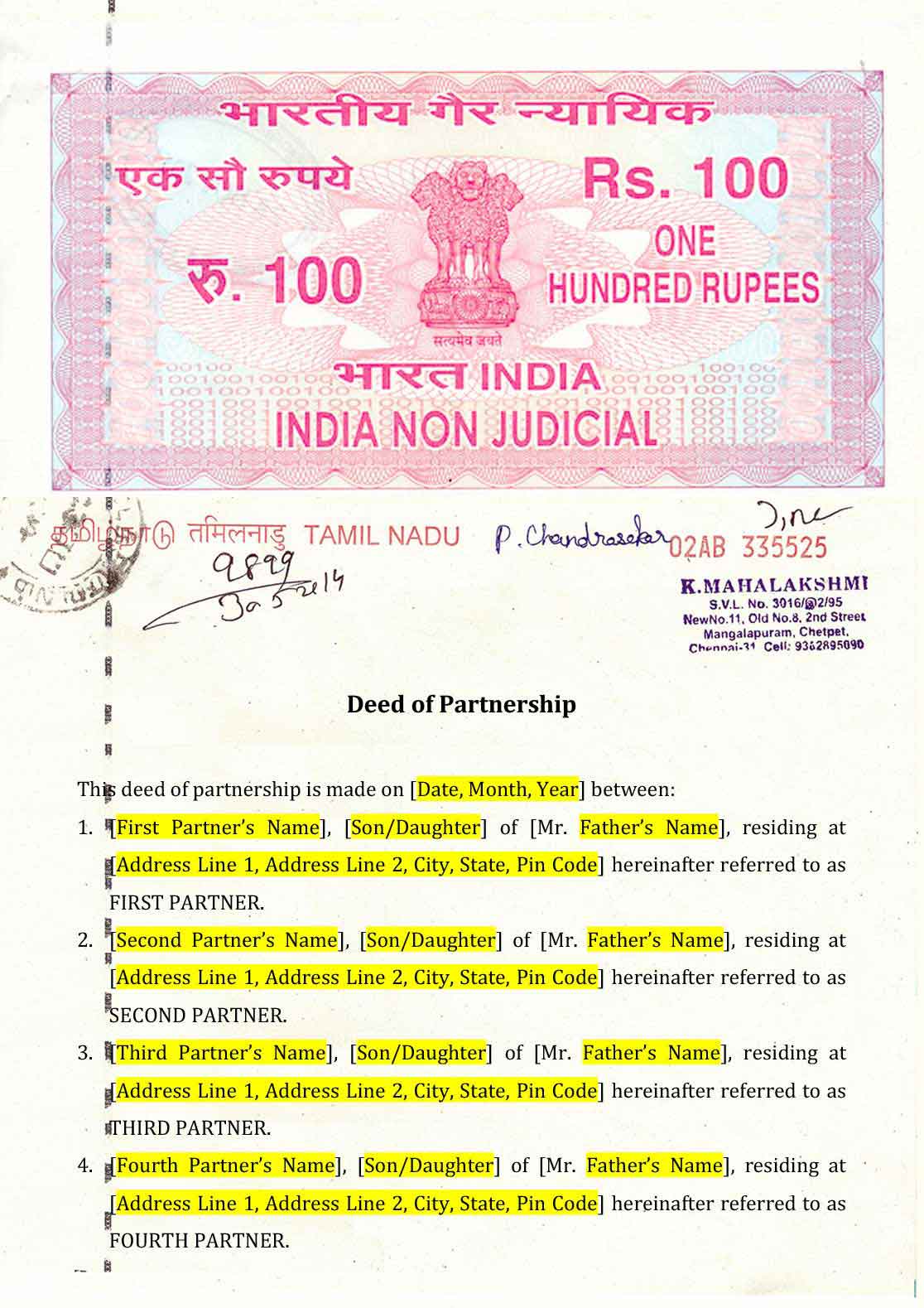
Download Partnership Deed Format (PDF and Word)
How to Draft a Partnership Deed?
A partnership deed can be either oral or written, but it is always advisable to opt for a written agreement. A written deed is a formal record of the mutual understanding between partners and helps prevent future disputes. It also plays a critical role during tax assessments and is essential for the official registration of the partnership firm.
Key Points to Consider While Drafting a Partnership Deed:
- Include All Essential Clauses: The deed should cover important clauses such as profit-sharing ratio, roles and responsibilities, dispute resolution mechanisms, and procedures for changes in the partnership.
- Minimum of Two Partners: The deed must be executed by at least two or more individuals entering into the partnership.
- Mutual Consent: All terms and conditions should be mutually agreed upon by the partners before drafting.
- Clarity in Language: Avoid vague or ambiguous language. Every clause should be clearly worded and descriptive to avoid misinterpretation.
- Stamp Paper Requirement: The deed should be drafted on non-judicial e-stamp paper of a minimum value of ₹200 or as per the applicable stamp duty based on the firm's capital.
- Signatures: All partners must sign the deed, preferably on each page, to signify their acceptance.
Documents Required for Partnership Deed Registration
To register a partnership deed, certain documents must be submitted along with the application. These documents help establish the identity of the partners and the existence of the firm. Below is the list of documents typically required:
- PAN Card of All Partners: A copy of the Permanent Account Number (PAN) card of each partner is mandatory for identification and tax-related purposes.
- Address Proof of All Partners: Valid documents such as Voter ID, Aadhaar card, Driving Licence, or Passport serve as acceptable proof of address for each partner.
- Address Proof of the Firm: This can include the latest utility bill (electricity, water, or telephone), rent agreement (if the premises are rented), or property ownership documents (if owned) to establish the firm’s business location.
Step-by-Step Procedure to Register a Partnership Deed
Below, we have laid out the step-by-step procedure to register a partnership deed:
Step 1: Selecting a Unique Name
Partners must choose a unique and distinctive name for the partnership firm not already registered with the Registrar of Firms.
Step 2: Preparing the Partnership Deed
Partners need to draft a clear, comprehensive and mutually agreed-upon partnership deed. This legal document should include essential details such as the partnership firm's name, partners' names and addresses, nature of the business, profit-sharing ratios, and other terms and conditions governing the partnership.
Step 3: Payment of Stamp Duty
The partnership deed must be printed on non-judicial stamp paper of the appropriate value, which varies from one state to another. The stamp duty amount is determined based on the value of the partnership firm.
Step 4: Submission of Documents
Partners must submit the partnership deed and the prescribed form to the Registrar of Firms. The form should contain information such as the partnership firm's name, partners' names and addresses, and the date of the partnership deed.
Step 5: Verification and Registration
The Registrar of Firms examines the submitted documents. If all requirements are met and the Registrar is satisfied, the partnership firm is registered. The partnership deed is then officially stamped and returned to the partners.
Unregistered partnership deed
An unregistered partnership deed, according to the Indian Partnership Act of 1932, is an agreement that's written down but not officially recorded with the Registrar of Firms. It's still a valid agreement among the partners, but it comes with certain limitations:- It can't be used as proof to resolve disputes in court, whether among partners or involving third parties.
- Partners can't enforce the terms of the partnership deed against outsiders.
- Partners can't claim tax benefits or deductions unless the partnership deed is registered.
- In case of a dispute, partners can't sue each other or the firm.
Consequences of Not Forming a Partnership Agreement
Not creating a partnership deed in India can lead to several consequences:- Lack of Clarity: The absence of a partnership deed results in ambiguity regarding the terms of the partnership, including capital contributions, profit-sharing ratios, and the rights and responsibilities of each partner. This can give rise to misunderstandings, disputes, and even dissolution of the partnership.
- Lack of Legal Recognition: A partnership without a registered partnership deed lacks legal recognition. Consequently, the partnership cannot initiate legal actions or be subject to legal actions, enter into contracts, or hold property in its name.
- Unlimited Liability: In an unregistered partnership, each partner assumes unlimited liability for the partnership's debts and obligations. This means that personal assets of the partners can be utilized to settle the partnership's debts.
- Limited Access to Loans and Credit: Banks and financial institutions often require a registered partnership agreement as evidence of the partnership's existence before granting loans or credit.
- Challenges in Obtaining Licenses and Permits: To secure licenses and permits for the business, a registered partnership agreement may be a prerequisite.
Provisions of the Indian Partnership Act, 1932
The Indian Partnership Act of 1932 acts as a default agreement when no formal partnership deed is in place. Here are some key default provisions outlined in the Act:
- Profit and Loss Sharing: Without an agreement, profits and losses are shared equally among all partners (Section 18).
- Management: All partners have equal business management rights and must consent to any new partner (Sections 19 and 30). Decisions are made by majority vote (Section 25).
- Capital Contributions: The Act is silent on capital contributions. Partners might need to settle this through separate agreements, or courts may determine it based on the facts (e.g., a partner who invested more money might be entitled to a larger share of profits).
- Interest on Capital and Drawings: The Act is silent on interest for capital contributions or drawings.
- Salaries/Remuneration: Partners are not entitled to any salary or payment for their work in the business unless there's a specific agreement (Section 7(2)).
- Admission and Retirement of Partners: Admission of new partners requires the consent of all existing partners (Section 30). The Act is silent on the formal retirement process, but courts might determine a partner's rights based on the nature of the business.
- Dissolution: The partnership dissolves upon the happening of any of the following (Section 35):
- The death of a partner.
- The insolvency of a partner.
- The happening of any event which makes the business unlawful.
- The completion of the undertaking or the expiry of the term, if any, agreed upon.
- By the consent of all partners.
- Dispute Resolution: The Act doesn't specify a dispute resolution mechanism. Partners would likely need to resolve disagreements through negotiation or litigation.
IndiaFilings offers Expert Guidance for Partnership Firm Registration.
IndiaFilings offers valuable assistance in preparing and registering your partnership agreement, guaranteeing a streamlined and compliant process. Our experienced professionals will guide you through every step, from drafting the partnership deed to ensuring all legal requirements are met. By leveraging our expertise, you can confidently navigate the complexities of partnership registration, allowing you to focus on your business's growth and success.Register Your Partnership Firm Now!
FAQs
1. What is a partnership deed?
A partnership deed is a legal document that outlines the rights, responsibilities, and obligations of each partner in a business partnership. It serves as the foundation for the partnership’s operations and helps prevent disputes among partners.
2. Is a partnership deed mandatory?
While not legally mandatory in India, having a partnership deed is highly recommended to ensure clarity in business operations and to provide legal protection for all partners.
3. What information should be included in a partnership deed?
A typical partnership deed should include:
- Name and address of the firm and partners
- Nature of business
- Duration of partnership
- Capital contributions by each partner
- Profit and loss sharing ratio
- Duties and responsibilities of partners
- Admission and retirement of partners
- Dispute resolution mechanism
- Terms of dissolution.
4. Can a partnership deed be oral?
Yes, a partnership agreement can be oral or written, but a written deed is necessary for legal and tax purposes.
5. Can a partnership function without a written deed?
Yes, but in the absence of a written deed, the partnership will be governed by the default provisions of the relevant partnership laws, which may not reflect the partners' intentions.
6. Can a partnership deed be modified?
Yes, it can be amended with the mutual consent of all partners.
7. What happens if there is no partnership deed?
The firm will be governed by the default rules of the Partnership Act, which may not suit the specific needs of the partners.
8. Is registration of a partnership deed compulsory?
Registration is not compulsory but is highly recommended. A registered partnership firm enjoys certain legal rights, such as the ability to sue other parties in court.
9. What are the steps to register a partnership deed?
The typical process includes:
- Drafting the partnership deed on non-judicial stamp paper
- Getting the deed signed by all partners
- Paying the applicable stamp duty
- Submitting the deed and required documents to the Registrar of Firms
- Verification and registration by the Registrar.
10. What documents are required for registration?
- Certified copy of the partnership deed
- PAN cards and ID proof of all partners
- Address proof of the firm (rent agreement, utility bills)
- GST registration (if applicable)
- Affidavit certifying the correctness of details
- Application form (Form 1).
11. What is the stamp duty for partnership deed registration?
The stamp duty varies by state and is based on the capital of the partnership firm. The deed must be printed on non-judicial stamp paper of the prescribed value.
12. Is notarization required for the partnership deed?
Yes, notarization is generally required along with registration for authenticity.
13. Can the partnership deed be updated after registration?
Yes, the deed can be amended if all partners agree, and the changes should be registered with the Registrar of Firms.
14. What are the advantages of registering a partnership deed?
Legal recognition, ability to enforce rights in court, clarity in business operations, and reduced risk of disputes.