
IndiaFilings
Expert
Published on: Jul 30, 2026
Starting An Ice Cream Business
Ice cream business, a subset of the dairy industry has steadily grown over the years in India. The growing middle class and culture of dining out have given a tremendous boost to the ice cream industry, which is expected to record healthy growth rates over the next decade. Improvements in the availability of power and growing distribution of cold chain networks in India is further expected to strengthen and help the ice cream businesses. In this article, we look at the procedure for starting an ice cream manufacturing business in India.
Trends in Ice Cream Business
The ice cream business used to be largely unorganized in India. However, the growth of retail chains and the entry of foreign ice cream brands into India has transformed the landscape. Ice cream businesses are becoming more organized with a few players manufacturing / importing ice cream into India, supported by a large number of ice cream parlours / retail chains for selling the ice cream. Also, the choices of ice cream types available in the market have increased with the following types of ice creams now witnessing growing demand:
- Low fat ice creams
- Frozen yoghurts
- Cake ice creams
- Imported Ice Creams
- Milkshakes
- Prepackaged Ice Cream
According to researchers and developers of ice creams - changing lifestyle and the large youngster's population in India will contribute towards 9 to 12% growth in the current market for ice creams. Thereby leaving ample scope for the development of several successful ice cream brands in the country.
Infrastructure required for ice cream manufacturing
The size and capacity of the ice cream manufacturing business play an important role in the decision to start an ice cream manufacturing business. It is recommended that an ice cream manufacturing unit be set up with at least the capacity to produce five thousand units to ensure optimal break even. The following machinery would be recommended for the business:
- Refrigeration compressor (open type): 5 TR capacity complete with motor and accessories.
- Cooled condenser complete with piping and water spray assembly.
- Liquid receiver
- M.S. Brine tank
- Agitator fan assembly
- Thermocole
- Push Cart trolleys
- Ice-cream freezer complete with an extension including valve, shut off valve etc.
- Electrical including motors: Complete set ranging from ½ to 20 hp
- Mechanical accessories such dehydrator with the complete set suction line, copper pipe, liquid distribution, pipe, shut off valve etc.
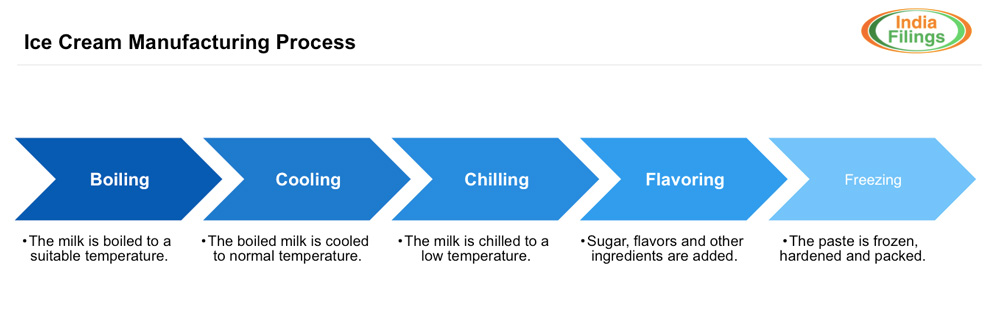 Ice cream manufacturing process
Registrations and licenses required for ice cream business
Entrepreneurs setting up an ice cream manufacturing unit can register as a private limited company or limited liability partnership (LLP). Further, obtain MSME registration for those manufacturing units in which the investment in plant and machinery does not exceed Rs.10 crores. MSME registration will help the business avail subsidy for setting up of cold chain or cold storage units.
In addition, the business registration, FSSAI food business license would be required for any ice cream manufacturing business. Based on the capacity of the diary processed, the license falls under the purview of the Central Government or State Government.
Also, for the sale of ice creams, the manufacturing unit must possess a GST registration from the State's sales tax department. GST registration is required for an ice cream manufacturing business.