
IndiaFilings
Expert
Published on: Aug 11, 2026
Share Transfer Procedure in Private Limited Company
The ownership of a private limited company is determined by the shareholding of the Company. To induct new investors or transfer ownership of the Company, the share of the private limited company would have to be transferred. In this article, we look at how to transfer shares of a private limited company.
Share Transfer Restrictions in AOA
A private limited company is considered to be a "closed corporation" of members, similar to a Partnership Firm. Therefore, the share transfer in a Private Limited Company can be restricted by the 1. Hence, the Articles of Association of the Company must be reviewed prior to beginning the share transfer procedure.
Restrictions on right of the shareholders to transfer shares are usually in two forms:
- Rights of pre-emption: If a shareholder wishes to sell some or all of his shares, such shares must first be offered to other existing members of the private limited company at a price determined by the Directors or the Auditor of the Company. The value of the shares can be determined based on the formula / method prescribed in the Articles of Association. In no existing shareholder is interested, then shares of the Company can be freely transferred to an outsider.
- Powers of Directors to refuse: The Director may have the powers to refuse registration of transfer of shares under certain circumstances - prescribed in the Articles of Association.
Only restriction contained the Articles of Association are considered legally binding. Any private agreement between the shareholders are not binding either on the company or on the shareholders. Further, share transfer can only be restricted by the Articles of Association. The right to transfer shares of a private limited company cannot be an total prohibition or ban on share transferability.
Share Transfer Procedure Initiation
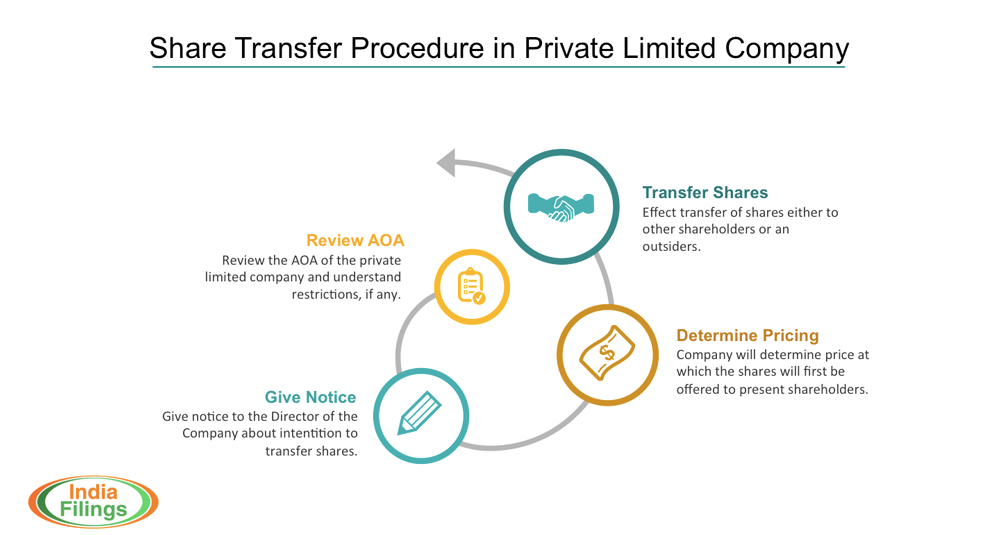 Share Transfer Procedure in Private Limited Company
To initiate the share transfer procedure, the following steps must be followed:
- Step 1: Review the AOA: Articles of Association of the Private Limited Company must be reviewed and restrictions, if any must be addressed.
- Step 2: Shareholder must give notice in writing to the Director of the Company about intention to transfer share of the company.
- Step 3: Determine the price as per Articles of Association at which the shares of the Company will first be offered to present shareholders of the Company. (Usually this price is determined by the Directors of the Company or an Auditor of the Company.)
- Step 4: The company must then give notice to the other shareholders about the availability of share, the last date to purchase the shares and the price at which the share are available.
If any of the present shareholders come forward for the purchase of shares, such shares must be allotted to them. In case no present shareholder is interested or excess shares are available, the same can be transferred to the outsider.
How to Transfer Shares of a Private Limited Company
To effect the share transfer, the following steps must be followed:
- Step 1: Obtain share transfer deed in the prescribed format.
- Step 2: Execute the share transfer deed duly signed by the Transferor and Transferee.
- Step 3: Stamp the share transfer deed as per the Indian Stamp Act and Stamp Duty Notification in force in the State.
- Step 4: Have a witness sign the share transfer deed with his/her signature, name and address.
- Step 5: Attach the share certificate or allotment letter with the transfer deed and deliver the same to the Company.
- Step 6: The company must process the documents and if approved, issue new share certificate in the name of the transferee.
To know more about
share transfer of a private limited company, visit IndiaFilings.com.