
IndiaFilings
Expert
Published on: Jul 30, 2026
Penalty for Trademark Infringement in India
A registered trademark is a distinctive mark or symbol to which a person or company has declared ownership by filing the trademark registration application with the Indian Trademark Registrar Office, Controller General of Patents Designs and Trademarks. Once a trademark is registered, it enjoys legal protection against trademark infringement under the Trademark Act of India. In this article, we look at the penalty applicable for trademark infringement in India.
Trademark Infringement
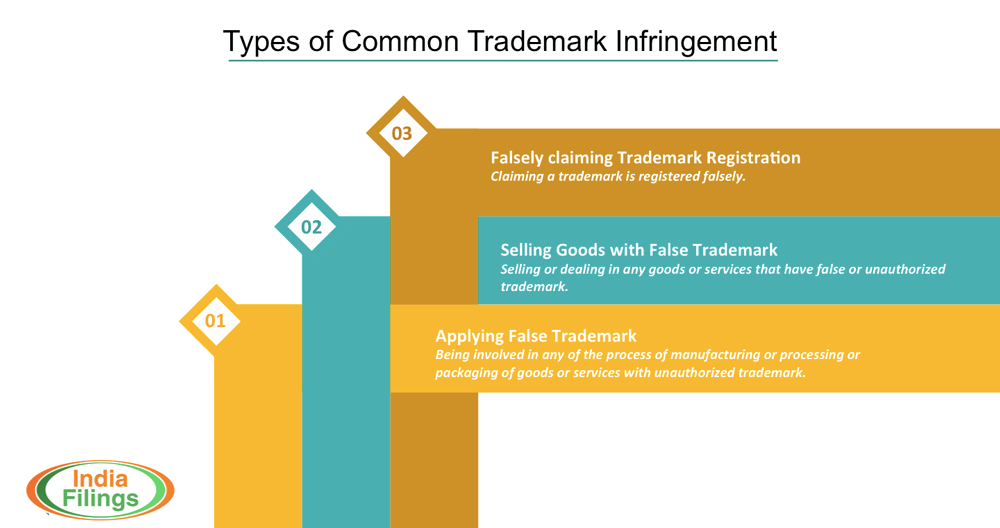 Common Types of Trademark Infringement
Trademark infringement occurs when a trademark used by a person is similar or identical to that of a registered trademark rights of another person or company in the jurisdiction. The most common standards for testing trademark infringement are: (a) close similarity of a mark and its associated goods and/or services to a prior registered trademark and its associated goods and/or services; and/or (b) use of a mark that creates a likelihood of confusion with a prior registered trademark among the relevant consumers.
While proving trademark infringement, it may be helpful for the registered trademark owner to show that the trademark infringer is a competitor with similar goods or services. However, trademark infringement proceedings doesn't necessarily have to be brought only against a competitor. In most cases, a registered trademark owner needs to only show that the trademark infringer's goods and services are sufficiently related to and consumer confusion is likely.
Improper or Unauthorised Trademark Use
A penalty and imprisonment is applicable for any person who is deemed to falsifying and falsely using a registered trademark. A person is considered to be use a trademark unauthorised if:
- A person without the assent of the proprietor of the trademark makes that trademark or a deceptively similar trademark; or
- A person falsifies any genuine trademark, whether by alteration, addition, effacement or otherwise.
A person is deemed to falsely apply to goods or services a trademark if:
- He/she without the assent of the registered trademark owner applies such trademark or a deceptively similar trademark to goods or services or any package containing goods;
- He/she without the assent of the registered trademark owner uses any package bearing a mark which is identical with or deceptively similar to the trademark of such proprietor, for the purpose of packing, filling or wrapping any goods other than the genuine goods of the registered trademark owner.
Penalty for Trademark Infringement - Applying Unauthorised Trademark
A person is considered to be applying a trademark wrongfully if:
- Falsifies any trademark.
- Falsely applies to goods or services any trademark.
- Makes, disposes of, or has in his possession, any die, block, machine, plate or other instrument for the purpose of falsifying or of being used for falsifying, a trademark.
- Applies any false trade description to goods or services.
- Applies to any goods to which an indication of the country or place in which they were made or produced or the name and address of the manufacture or person for whom the goods are manufactured is required to be applied. A false indication of such country, state, place, name or address.
- Tampers with, alters or effaces an indication of origin which has been applied to any goods to which it is required to be applied.
For the above offences, a person is punishable with imprisonment for a term which shall not be less than six months but which may extend to three years and with fine which shall not be less than fifty thousand rupees but which may extend to two lakh rupees.
Penalty for Trademark Infringement - Selling Goods or Services with Unauthorised Trademark
Any person who sells, lets for hire or exposes for sale, or hires or has in his possession for sale, good or things, or provides or hires services, to which any unauthorised trademark or false trade description is applied is punishable with imprisonment for a term of not less than six months and upto three years. A fine can also be levied to an amount of not less than rupees fifty thousand to a maximum of rupees two lakhs. However, the person shall not be punishable if he/she proves:
- That, he/she has taken all reasonable precautions against committing an offence and at the time of committing of the offence had no reason to suspect the genuineness of the applied trademark.
- That, he/she on demand by or on behalf of the Prosecutor, gave all information in his power with respect to the person from whom he obtained such goods or things or services.
- That, he/she otherwise had acted innocently.
Penalty for falsely representing trademark as registered
If any person falsely represents to the effect that a registered trademark is registered in respect of any goods or services, which is not in fact registered, then he/she is punishable with imprisonment for a term which may extend to three years or with fine, or both.