
IndiaFilings
Expert
Published on: Jul 30, 2026
How to Start a Yoga Studio
Yoga, an ancient Indian practice encompassing physical, mental, and spiritual wellness has become one of the hottest trends in the fitness and wellness industry. Stress and an unhealthy lifestyle continue to create diseases and ailments amongst a majority of the population, leading to more and more people looking at yoga for wellbeing. Further, the investment for starting a yoga studio is minimal - making it an ideal business for those interested in yoga. In this article, we look at how to start a yoga studio in India.
Health and Wellness Industry Outlook
The overall wellness market in India is estimated at INR 490 billion. Wellness services under which yoga studios or fitness studios would fall under alone comprise 40% of this market. Over the next three years, the Indian wellness industry would grow at a CAGR of 20% to reach INR 875 billion. The consumers changing mindset from remedial care to a preventive care approach is set to drive this tremendous growth in the wellness industry in India. With the practice of Yoga playing an important role in preventive care, the opportunity for establishing a successful yoga studio in India is excellent.
Space and Infrastructure
Before embarking on the startup portion of a new business, it is important to have a business plan that details the business objectives along with the requirements to achieve the business objective. A key consideration in a yoga studio startup is the investment, maximum class capacity, positioning, cost per session, location, human resource requirement and more. The maximum class capacity directly impacts investment cost, revenue and positioning of the studio throughout its lifecycle. Hence, care must be taken while fixing maximum class capacity. A typical yoga studio needs approximately 20 square feet of studio space per person per visit. Therefore, a 500 square foot studio room space (changing area, welcome area, restroom, office area - not included) can accommodate 25 students and a 1000 square feet yoga studio can accommodate 49 students.
In terms of location, it is vital for a yoga studio to have ample parking space for all persons for accommodation in the class in a safe and secure nearby area. Having a place with ample parking and high visibility would ensure high chances of success for the yoga studio.
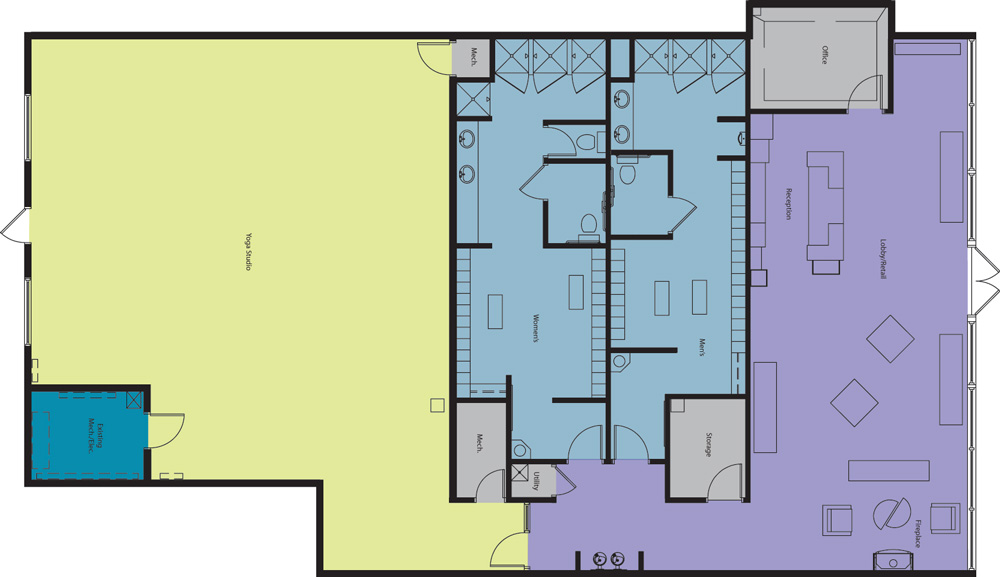 Yoga Studio Layout
Investment Requirement
The investment required for starting a yoga studio is relatively less compared to other projects in the beauty and wellness industry. The major investment in a yoga studio is only the interiors and must ensure calm and serene interiors. In addition to the interiors, the rental deposit would be the other major requirement for establishing a yoga studio. Keeping in mind the above two requirements, start a yoga studio with an investment of anywhere between 5 - 100 lakhs based on the location, size and interior investment.
Banks would not favour lending for starting a Yoga Studio - as there is no creation of physical assets. Hence, property-based loan or mortgage loan based on the income of the promoters or savings can be used to start a yoga studio.
Business Registration
It is recommended that yoga studios be started as a Limited Liability Partnership (LLP) or Company to ensure the investment in terms of rental deposit or interiors are transferrable to another person in the future if the need arises. If the yoga studio is set up as a separate artificial judicial person, then all the agreements and registrations would be in the name of the separate legal entity - making it easy to transfer in the future.
In addition to the incorporation, a yoga studio would require GST Registration
For help starting a yoga studio in India, get in touch with an IndiaFilings Business Advisor.