
IndiaFilings
Expert
Published on: Jul 30, 2026
How to get apostille
Public documents like birth certificates,
passport copies, judgments, patents, or notarial attestations of signatures may need to be used in foreign countries. However, before a foreign country can use or accept a document issued by a foreign country, it must be authenticated. Typically, authentication of documents is done by a process called legalization wherein the officials of the country where the document was issued as well as the foreign Embassy or Consulate of the country where the document is to be issued authenticate the document. However, as this process is usually slow, cumbersome, and costly, a number of countries have signed the Hague Convention, thereby adopting the Apostille Convention. Apostille makes the authentication of public documents used abroad very simple and easy. In this article, we look at the process of getting a document apostilled.Apostille
A large number of countries all over the world have joined a treaty that simplifies the authentication of public documents used abroad. This treaty is called the Hague Convention Abolishing the Requirement of Legalisation for Foreign Public Documents or the Apostille Convention. In countries for which the Apostille Convention applies, the treaty reduces the authentication process to a single formality: the issuance of an authentication certificate by an authority designated by the country where the public document was issued. This certificate is called an Apostille.
Authentication of Document - NOT under Apostille Convention
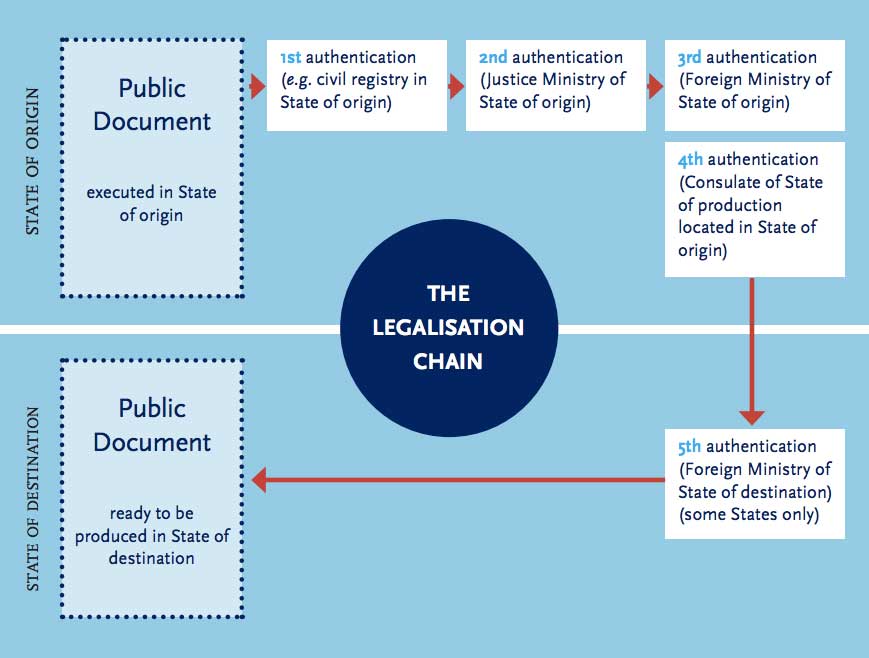 How-to-get-apostille-Legalisation-Chain
Authentication of Document under Apostille Convention
 How-to-get-apostille-Process
Apostille Certificate
An apostille certificate can be used to authenticate public documents like passport copy, driver's license copy, business documents, judgments, the extract of a register, or a notarial attestation. Apostille certificate can be issued only for documents issued in a country party to the Apostille Convention, and that is to be used in another country, which is also a party to the Apostille Convention.
Countries Accepting Apostille Certificate
For an apostille to be acceptable, the country where the public document was issued, and the country where the document is to be used must be a member of the Apostille Convention. India is a member of the Hague Convention and has thus adopted the Apostille Convention. India can provide apostille documents or can require documents to be apostilled if the documents are from a country that has also adopted the apostille convention. The following are the countries that have adopted the apostille convention.
- Albania
- Andorra
- Antigua and Barbuda
- Argentina
- Armenia
- Australia
- Austria
- Azerbaijan
- Bahamas
- Bahrain
- Barbados
- Belarus
- Belgium
- Belize
- Bosnia and Herzegovina
- Botswana
- Brazil
- Brunei Darussalam
- Bulgaria
- Burundi
- Cape Verde
- Chile
- China, People's Republic of
- Colombia
- Cook Islands
- Costa Rica
- Croatia
- Cyprus
- Czech Republic
- Denmark
- Dominica
- Dominican Republic
- Ecuador
- El Salvador
- Estonia
- Fiji
- Finland
- France
- Georgia
- Germany
- Greece
- Grenada
- Honduras
- Hungary
- Iceland
- India
- Ireland
- IsraelTitle Page
- Italy
- Japan
- Kazakhstan
- Korea, Republic of
- Kosovo
- Kyrgyzstan
- Latvia
- Lesotho
- Liberia
- Liechtenstein
- Lithuania
- Luxembourg
- Malawi
- Malta
- Marshall Islands
- Mauritius
- Mexico
- Monaco
- Mongolia
- Montenegro
- Morocco
- Namibia
- Netherlands
- New Zealand
- Nicaragua
- Niue
- Norway
- Oman
- Panama
- Paraguay
- Peru
- Poland
- Portugal
- Republic of Moldova
- Romania
- Russian Federation
- Saint Kitts and Nevis
- Saint Lucia
- Saint Vincent and the Grenadines
- Samoa
- San Marino
- Sao Tome and Principe
- Serbia
- Seychelles
- Slovakia
- Slovenia
- South Africa
- Spain
- Suriname
- Swaziland
- Sweden
- Switzerland
- Tajikistan
- The former Yugoslav Republic of Macedonia
- Tonga
- Trinidad and Tobago
- Turkey
- Ukraine
- United Kingdom of Great Britain and Northern Ireland
- United States of America
- Uruguay
- Uzbekistan
- Vanuatu
- Venezuela
Apostille Requirement for Company Registration
During
registration of a company in India involving foreign nationals, the Companies Act 2013 requires the signatures of subscribers and identity/address proof to be notarized before a Notary public of that country and then apostilled as per the Hague Convention if both foreign national provides documents issued by a country listed above. Know more about the procedure for company registration in India with foreign nationals.