Renu Suresh

Expert

Published on: Jun 24, 2026

Highlights of  43rd  GST Council Meeting

The Goods and Service Tax (GST) council held its 43

rd  GST council meeting, via video conferencing, on 28th May 2021. The meeting was held under the Chairmanship of Finance Minister Nirmala Sitharaman. The council decided to exempt certain covid-19 relief material from IGST till 31st August 2021. The council also decided that certain drugs used to fight black fungus will also be given exemption. The key recommendations made by the GST council, during the meeting, are highlighted in the present article.

Key Highlights of 43rd GST Council Meeting

The biggest decision of the 43

rd  GST Council Meeting was on reducing the compliance burden on taxpayers,
  • To provide relief to small taxpayers, an amnesty scheme has been recommended for reducing the late fee
  • GST Return Filing Late fee also rationalized for future tax periods
  • Import of Covid-related relief items exempt from IGST till August 31st, 2021. Amphotericin B, used for treating Mucormycosis, will also be exempt from IGST.
  • Annual return filings will continue to be optional for small taxpayers for the financial year 2021.

Import Of Covid-Related Items Exempted From IGST

IGST exemption has been provided on the import of all COVID relief materials and medicines (including free of cost) till 31st August 2021. Also, the medicine for Black fungus – Amphotericin B is included in the exemption list. The Following list of specified COVID-19 related goods is exempted from IGST.

  • Medical oxygen,
  • Oxygen concentrators
  • Oxygen storage and transportation equipment
  • Certain diagnostic markers test kits
  • COVID-19 vaccines

The council also announced that a Group of Ministers (GoM) will be formed by 29th May 2021 and submit a report by 8th June 2021 on the need for further reductions and decide on any new rates in IGST exemptions.

Covid 19 Reliefs  - GST Rate of COVID vaccines

The 43

rd  GST Council decided to keep the GST rate of 5% as it is on COVID vaccines. Also, the Council ruled out the possibility of notifying COVID-related relief materials as zero-rated goods.

Measures for Trade facilitation

The key recommendations made by the 43

rd  GST Council for Trade facilitation is as follows:

Amnesty Scheme for small taxpayers

A GST Amnesty scheme has been announced for small taxpayers who delayed GSTR-3B filing to reduce the late fee. Also, the maximum late fee for small taxpayers is reduced for GST Returns to be filed in the future. To provide relief to the taxpayers, a late fee for non-furnishing FORM GSTR3B for the tax periods from July 2017 to April 2021 has been reduced as under:

  • Late fee capped to a maximum of Rs 500/- (Rs. 250/- each for CGST & SGST) per return for taxpayers, who did not have any tax liability for the said tax periods
  • Late fee capped to a maximum of Rs 1000/- (Rs. 500/- each for CGST & SGST) per return for other taxpayers

Note: The reduced rate of the late fee would apply if GSTR-3B returns for these tax periods are furnished between 01.06.2021 to 31.08.2021.

Rationalization of the late fee imposed under section 47 of the CGST Act

To reduce the burden of late fee on smaller taxpayers, the upper cap of

late fee is being rationalized to align late fee with tax liability/ turnover of the taxpayers, as follows:

Late fee for Delay in Furnishing of FORM GSTR-3B & FORM GSTR1

The late fee for delay in furnishing of FORM GSTR-3B and FORM GSTR1 to be capped, per return, as below:

For taxpayers having a nil tax liability
  • For taxpayers having nil tax liability in GSTR-3B or nil outward supplies in GSTR-1, the late fee to be capped at Rs 500 (Rs 250 CGST + Rs 250 SGST)
For other taxpayers
  • For taxpayers having Annual Aggregate Turnover (AATO) in preceding year upto Rs 1.5 crore, the late fee to be capped to a maximum of Rs 2000 (1000 CGST+1000 SGST)
  • For taxpayers having AATO in the preceding year between Rs 1.5 crore to Rs 5 crore, the late fee to be capped to a maximum of Rs 5000 (2500 CGST+2500 SGST)
  • For taxpayers having AATO in the preceding year above Rs 5 Crores, the late fee to be capped to a maximum of Rs 10000 (5000 CGST+5000 SGST)

Late fee for delay in furnishing of FORM GSTR-4

The late fee for delay in furnishing of FORM GSTR-4 by composition taxpayers to be capped to Rs 500 (Rs 250 CGST + Rs 250 SGST) per return, if the tax liability is nil in the return, and Rs 2000 (Rs 1000 CGST + Rs 1000 SGST) per return for others

Late fee payable for delayed furnishing of FORM GSTR-7

Late fee payable for delayed furnishing of FORM GSTR-7 to be reduced to Rs.50/- per day (Rs. 25 CGST + Rs 25 SGST) and to be capped to a maximum of Rs 2000/- (Rs. 1,000 CGST + Rs 1,000 SGST) per return

COVID-19 Related Relief Measures for Taxpayers

The 43

rd  GST Council Meeting has announced the following COVID-19 Related Relief Measures for Taxpayers

GST Return Filing Due-Date Extension

The due dates for IFF and GSTR-1 filing for May 2021 are extended by 15 days. Also, the due date for GSTR-4 for FY 2020-21 and ITC-04 for Jan-Mar 2021 is extended up to 31st July 2021 and 30th June 2021, respectively

  • Now, the taxpayers can cumulatively apply CGST Rule 36(4) for April, May, and June 2021 while filing GSTR-3B of June 2021
  • Companies can continue filing GST returns using EVC instead of digital signature till 31st August 2021.

GST Return Filing Late fee waiver and Interest Reduction

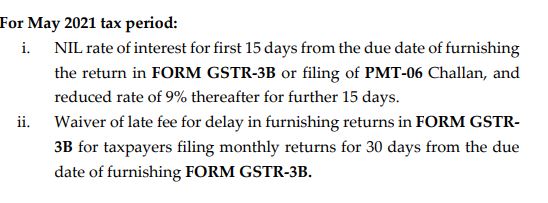
The late fee waiver and interest reduction have been announced for GSTR-3B or PMT-06 filing for March, April, and May 2021 and CMP-08 submission for Jan-Mar 2021 for taxpayers

For small taxpayers (aggregate turnover upto Rs. 5 crores) Highlights of 43rd GST Council Meeting - March and April 2021 tax periods Highlights of 43rd GST Council Meeting - March and April 2021 tax periods2 Highlights of 43rd GST Council Meeting - May tax periods For large taxpayers (aggregate turnover more than Rs. 5 crores)
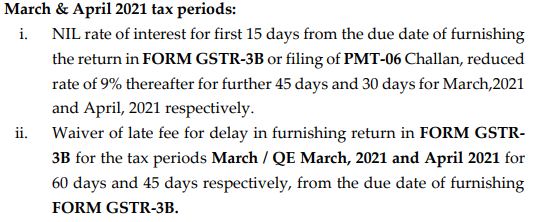

  • A lower rate of interest at 9% for the first 15 days after the due date of filing FORM GSTR-3B for the tax period May 2021 is announced
  • Waiver of late fee for delay in furnishing FORM GSTR3B for the tax period May 2021 for 15 days from the due date of furnishing FORM GSTR-3B

Relaxations under section 168A of the CGST Act

The time limit for completion of various actions, by any authority or by any person, under the GST Act, which falls during the period from 15th April 2021 to 29th June 2021, to be extended upto 30th June 2021, subject to some exceptions

Simplified Annual Return Filing for FY 2020-21

GST Annual Return (GSTR-9) filing is rationalized and continues to be optional for 2020-21 for small taxpayers with turnover up to Rs.2 crore. Also, GSTR-9C (Reconciliation statement) to be still applicable for taxpayers with an annual turnover of equal to or more than Rs.5 crore, allowing self-certification

Other Reliefs on Goods

To support the

LympahticFilarisis  (an endemic) elimination program being conducted in collaboration with WHO, the GST rate on Diethylcarbamazine (DEC) tablets has been recommended for reduction to 5%  from earlier 12%.

Clarifications on GST Rate on Certain Goods

Certain clarifications amendments have been recommended about GST rates.

  • Liability of IGST on repair value of goods re-imported after repairs
  • GST rate of 12% to apply on parts of sprinklers/ drip irrigation systems falling under tariff heading 8424 (nozzle/laterals) to apply even if these goods are sold separately.

Another decision of GST Council

  • Rate decisions on items ranging from MRO units of ships to shipping to annuity payments received as deferred payment for construction of the road.
  • Compensation cess payable to states this year is Rs 2.7 lakh crore of which Rs 1.58 lakh crore will be given to them via back-to-back loans. Same formula as last year to apply.
  • Separate meeting to be held to discuss states' demands regarding extension of compensation period beyond FY22
Click here to know more about the key recommendations made by the 43rd  GST Council Meeting
Back to Learn

Frequently Asked Questions

The 43rd GST Council Meeting, held on 28th May 2021 under the Chairmanship of Finance Minister Nirmala Sitharaman, focused on providing relief measures to taxpayers and exemptions on certain COVID-19 relief materials and medicines. The key decisions included amnesty schemes for late fee reduction, rationalization of late fees, and exemptions from IGST on imports of COVID-19 relief items and Amphotericin B (used for treating Mucormycosis) till 31st August 2021.
The GST Council announced an amnesty scheme for small taxpayers to reduce the late fee for delayed GSTR-3B filing from July 2017 to April 2021. The late fee has been capped at a maximum of Rs. 500 for taxpayers with nil tax liability and Rs. 1000 for others if returns are filed between 1st June and 31st August 2021. The Council also rationalized the late fee structure based on the taxpayer's annual aggregate turnover.
The GST Council exempted IGST on the import of all COVID-19 relief materials and medicines, including medical oxygen, oxygen concentrators, oxygen storage and transportation equipment, certain diagnostic markers test kits, and COVID-19 vaccines till 31st August 2021. Amphotericin B, used for treating Mucormycosis (black fungus), is also included in the exemption list.
Yes, the GST Council announced several relaxations and extensions related to GST returns filing. The due dates for IFF and GSTR-1 filing for May 2021 were extended by 15 days. The due date for GSTR-4 for FY 2020-21 and ITC-04 for Jan-Mar 2021 was extended up to 31st July 2021 and 30th June 2021, respectively. Additionally, companies can continue filing GST returns using EVC instead of digital signature till 31st August 2021.
For small taxpayers (aggregate turnover up to Rs. 5 crores), the late fee for delay in furnishing FORM GSTR-3B or PMT-06 for March, April, and May 2021, and CMP-08 submission for Jan-Mar 2021 was waived. For large taxpayers (aggregate turnover more than Rs. 5 crores), a lower interest rate of 9% was announced for the first 15 days after the due date of filing FORM GSTR-3B for the tax period May 2021.
Yes, the GST Council decided to continue with the optional filing of GST Annual Return (GSTR-9) for the financial year 2020-21 for small taxpayers with turnover up to Rs. 2 crore. However, GSTR-9C (Reconciliation statement) will still be applicable for taxpayers with an annual turnover of equal to or more than Rs. 5 crore.
The GST Council decided to maintain the existing GST rate of 5% on COVID-19 vaccines. The Council also ruled out the possibility of notifying COVID-related relief materials as zero-rated goods.
To support the Lymphatic Filariasis (an endemic) elimination program being conducted in collaboration with WHO, the GST Council recommended reducing the GST rate on Diethylcarbamazine (DEC) tablets from 12% to 5%.
Yes, the GST Council provided clarifications and recommended amendments on GST rates for certain goods. These include the liability of IGST on the repair value of goods re-imported after repairs, the GST rate of 12% on parts of sprinklers/drip irrigation systems falling under tariff heading 8424 (nozzle/laterals), and rate decisions on items ranging from MRO units of ships to shipping to annuity payments received as deferred payment for construction of the road.
The GST Council decided that the compensation cess payable to states this year is Rs. 2.7 lakh crore, out of which Rs. 1.58 lakh crore will be given to them via back-to-back loans. The same formula as last year will apply. A separate meeting will be held to discuss states' demands regarding the extension of the compensation period beyond FY22.
Using salary structure templates in LEDGERS Payroll Module ensures consistency and reduces errors in payroll calculations. By creating standard templates for different salary components like Basic, HRA, allowances, and deductions, HR teams can avoid manual mistakes and maintain uniformity across employees.
LEDGERS Payroll Module automatically calculates TDS based on factors like estimated annual income, claimed deductions, exemptions, tax regime, joining date, increments, and tax already deducted. It follows the same logic used by payroll professionals, ensuring accurate TDS calculations without manual intervention.
LEDGERS Payroll Module streamlines the monthly payroll process into three steps: attendance and LOP inputs, automatic application of salary rules, and one-click payroll run. It eliminates the need for multiple Excel sheets and manual calculations, saving time and reducing errors.
The payslips generated by LEDGERS Payroll Module include comprehensive details such as employer name and logo, employee details, monthly earnings breakdown, deductions for PF, ESI, and Professional Tax, TDS, net salary, bank details (if needed), and year-to-date summary. This ensures payslips are clear, detailed, and compliant.
LEDGERS Payroll Module focuses on automating compliance related to PF, ESI, Professional Tax, and TDS. It automatically checks eligibility criteria, calculates contributions and deductions, and generates summary reports and data in formats required for filing returns, reducing the risk of non-compliance and penalties.
LEDGERS Payroll Module offers several advantages, including rule-driven calculations that eliminate manual formula mistakes, complete Indian compliance adherence, user-friendly interface for accountants and HR, integration with LEDGERS accounting software, and scalability to handle payroll for any number of employees efficiently.
LEDGERS Payroll Module allows employees to choose between the old and new tax regimes. It automatically recalculates the entire TDS (Tax Deducted at Source) based on the selected regime, ensuring accuracy for tax notices and Form 16. This flexibility ensures compliance and proper tax deductions for each employee's unique situation.
LEDGERS Payroll Module streamlines the monthly payroll cycle into three simple steps: attendance and leave inputs, automatic application of salary rules, and a one-click payroll run. This process eliminates the need for multiple Excel sheets and manual calculations, reducing the risk of errors and saving significant time and effort.
LEDGERS Payroll Module offers robust features for statutory compliance, including automatic calculations for Provident Fund (PF), Employee State Insurance (ESI), Professional Tax (PT), and TDS. It generates ready-to-file data for ECR (PF), ESI contributions, PT slabs, and Form 24Q, ensuring accurate and penalty-free filings.
LEDGERS Payroll Module automatically recalculates TDS and adjusts deductions when mid-year changes occur, such as employee joining or leaving, salary revisions, bonuses, loss of pay (LOP), or updates to investment declarations. This automated recalculation ensures accurate payroll processing without manual rework.
Yes, LEDGERS Payroll Module generates clean, professional, and statutory-compliant payslips for each processed month. These payslips include detailed breakdowns of earnings, deductions (PF, ESI, PT, TDS), net salary, year-to-date summaries, and can be easily exported, emailed, or shared with employees.
LEDGERS Payroll Module stores comprehensive employee records in a centralized location, including KYC details, addresses, bank information, joining data, salary structure history, TDS regime, investment declarations, and exit/relieving data. This eliminates the need for multiple HR files and Excel sheets, ensuring a single source of truth for employee data.
LEDGERS Payroll Module calculates TDS like a real payroll engine, taking into account projected annual income, claimed deductions, exemptions, tax regime selected, bonuses or arrears, and tax already deducted in past months. This automated logic mimics how payroll professionals manually calculate TDS, ensuring high accuracy.
Yes, LEDGERS can handle mid-year changes automatically. If an employee joins mid-year, receives a salary revision, is awarded a bonus, has a change in leave, or updates their investment proofs, LEDGERS recalculates the TDS without any manual rework. This eliminates the need for accountants to spend hours adjusting TDS for such events.
Using salary structure templates in LEDGERS Payroll Module helps maintain consistency and eliminates errors in payroll calculations. By creating and saving standard templates for different salary components, HR teams avoid creating multiple versions of CTC breakups and ensure uniform application of rules for PF, HRA, and allowances. This consistency fixes around 90% of potential payroll mistakes right from the start.
LEDGERS Payroll Module streamlines the monthly payroll cycle into three simple steps: 1) Entering attendance and leave data, 2) Automatic application of salary rules and calculations, and 3) One-click payroll run for all employees. This replaces the need for multiple Excel sheets and manual calculations, generating net salary, statutory deductions, and payment sheets instantly.
The payslips generated by LEDGERS Payroll Module are clean, professional, and statutorily correct. They include the employer's name and logo, employee details, a breakdown of monthly earnings, deductions for PF, ESI, and Professional Tax, TDS calculation, net salary, bank details (if needed), and a year-to-date summary.
LEDGERS Payroll Module focuses strongly on automating compliance for PF, ESI, Professional Tax, and TDS – areas where businesses commonly make mistakes. It automatically checks eligibility criteria, calculates contributions, generates statutory summaries, and provides data in formats ready for filing, ensuring accuracy and avoiding penalties.
LEDGERS allows employees to choose between the old and new tax regimes. It automatically recalculates the TDS (Tax Deducted at Source) for each employee based on their selected tax regime, ensuring accurate tax calculations and compliance.
Yes, LEDGERS can handle mid-year changes seamlessly. If an employee receives a salary revision, bonus, or arrears during the year, or if their allowances or investments are updated, LEDGERS automatically recalculates the TDS and other deductions without any manual rework, ensuring accurate payroll processing.
LEDGERS streamlines the payroll process into three simple steps: 1) Entering attendance and leave details, 2) Automatic application of salary rules and calculations, and 3) One-click payroll run for all employees. This eliminates the need for multiple Excel sheets and manual calculations, reducing the chances of errors and saving time.
LEDGERS generates detailed and compliant payslips that include the employer's name and logo, employee details, monthly earnings breakdown, deductions for PF, ESI, Professional Tax, and TDS, net salary, bank details (if needed), and a year-to-date summary. These payslips can be easily downloaded, emailed, or shared with employees.
LEDGERS has built-in rules and calculations to handle PF (Provident Fund), ESI (Employee State Insurance), and Professional Tax compliance. It automatically checks eligibility criteria, calculates contributions, and generates summary sheets and data in the required formats for filing and reporting purposes, reducing the risk of non-compliance.
LEDGERS offers several advantages over traditional payroll methods, including: 1) Eliminating manual formula mistakes by using rule-driven calculations, 2) Being fully compliant with Indian labor laws and regulations, 3) Providing a user-friendly interface for accountants and HR teams, 4) Seamless integration with LEDGERS accounting for automated bookkeeping, and 5) Scalability to handle any number of employees efficiently.