

RENU SURESH
Expert
Published on: Aug 24, 2026
What is GSTIN Number? – Format and Example of 15-Digit GST Number
GSTIN, short for Goods and Services Tax Identification Number, is a unique 15 digit identification number assigned to every taxpayer (primarily dealer or supplier or any business entity) registered under the GST regime. It acts as a digital identity for taxpayers, helping businesses claim Input Tax Credit (ITC), ensure smooth tax compliance, and conduct transparent business transactions.
Whether you operate as a small startup, a growing medium enterprise, or a large corporation, knowing the structure and importance of GSTIN is essential for meeting legal obligations and maintaining operational efficiency.
This guide explains everything you need to know about GSTIN—its 15-digit format, structure, importance, the process of verification, the documents required for obtaining it, and tips to identify a fake GSTIN.
What is GSTIN?
Every business registered under the Goods and Services Tax (GST) in India is allotted a unique identification code called the Goods and Services Tax Identification Number (GSTIN). Commonly referred to as the GST number, this 15-digit alphanumeric code acts as the official identity of a taxpayer under the GST system. It is mandatory for businesses engaged in taxable supply of goods or services, and it enables them to collect tax, claim Input Tax Credit (ITC), and comply with GST regulations seamlessly.
GST Number Format & Example
Every registered taxpayer in India is allotted a 15-digit Goods and Services Tax Identification Number (GSTIN), which is based on their Permanent Account Number (PAN) and state of registration. This number is uniform across the country but is generated uniquely for each business, depending on its location and type of registration.
GSTIN Full Form: Goods and Services Tax Identification Number
Below is the detailed breakdown of the GSTIN format:
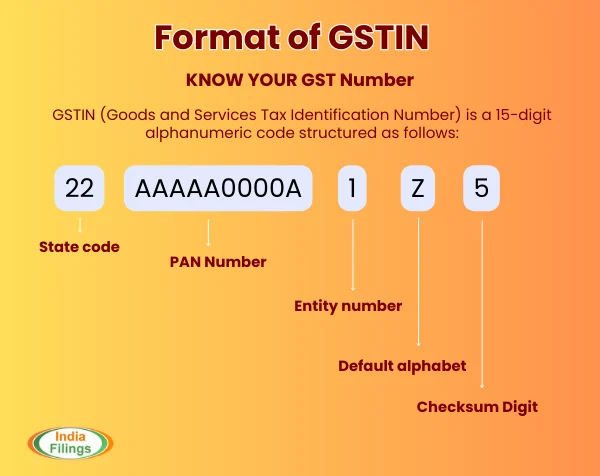
Format of GSTIN
A GSTIN (Goods and Services Tax Identification Number) is a 15-character unique code assigned to every GST-registered taxpayer. Its structure is as follows:
- First two digits – Represent the state code as per the Indian Census 2011.
- Example: Karnataka → 29, Delhi → 07
- Next 10 digits – Correspond to the PAN of the taxpayer.
- 13th digit – Indicates the number of registrations a taxpayer has within a state.
- 14th digit – Represents the taxpayer type:
- Z → Regular taxpayer (default)
- D → Tax deductor
- C → Tax collector
- 15th digit – A check code for error detection, which can be either an alphabet or a number.
State Code in GST Number
- 01 – Jammu & Kashmir
- 02 – Himachal Pradesh
- 03 – Punjab
- 04 – Chandigarh
- 05 – Uttarakhand
- 06 – Haryana
- 07 – Delhi
- 08 – Rajasthan
- 09 – Uttar Pradesh
- 10 – Bihar
- 11 – Sikkim
- 12 – Arunachal Pradesh
- 13 – Nagaland
- 14 – Manipur
- 15 – Mizoram
- 16 – Tripura
- 17 – Meghalaya
- 18 – Assam
- 19 – West Bengal
- 20 – Jharkhand
- 21 – Orissa
- 22 – Chhattisgarh
- 23 – Madhya Pradesh
- 24 – Gujarat
- 25 – Daman & Diu
- 26 – Dadra & Nagar Haveli
- 27 – Maharashtra
- 28 – Andhra Pradesh
- 29 – Karnataka
- 30 – Goa
- 31 – Lakshadweep
- 32 – Kerala
- 33 – Tamil Nadu
- 34 – Pondicherry
- 35 – Andaman & Nicobar Islands
Who Needs GSTIN?
Obtaining a Goods and Services Tax Identification Number (GSTIN) is mandatory for several categories of businesses and individuals operating in India. The requirement applies based on turnover, type of business, and nature of transactions.
GSTIN registration is required for:
- Businesses dealing in goods with an annual turnover exceeding ₹40 lakhs (for regular states).
- Service providers with an annual turnover exceeding ₹20 lakhs (for regular states).
- Businesses in special category states (such as the North-Eastern and hill states) with turnover exceeding ₹20 lakhs for goods and ₹10 lakhs for services.
- E-commerce operators and suppliers who sell through e-commerce platforms.
- Businesses engaged in interstate supply of goods or services.
- Non-Resident Taxable Persons (NRTPs) carrying out business in India.
- Casual Taxable Persons (CTPs) supplying goods or services occasionally in taxable territory.
- Input Service Distributors (ISDs) who distribute tax credits.
- Businesses are required to deduct TDS under GST.
- Agents or intermediaries supplying goods or services on behalf of registered taxpayers.
In addition, businesses with turnover below the prescribed threshold can voluntarily register under GST. Voluntary registration allows them to claim Input Tax Credit (ITC) and improve their market credibility. However, once registered, they must comply with all GST obligations, such as timely return filing and tax payment
Why Do You Need a GSTIN?
To run a business legally in India, you must obtain a GSTIN (Goods and Services Tax Identification Number) if your annual turnover is above ₹40 lakh (or ₹10 lakh for businesses in Northeastern states). Registering under GST not only keeps you compliant but also helps you avoid fines and penalties.
Here are the key reasons why having a GSTIN is essential:
- Mandatory compliance: GSTIN is legally required under the GST law. Failure to register when liable can result in penalties of ₹10,000 or the amount of tax due, whichever is higher.
- Input Tax Credit (ITC): Registered businesses can claim ITC on GST paid for purchases, reducing their net tax liability and improving working capital.
- Interstate trade: GSTIN allows businesses to expand across state borders without the hassle of multiple state-specific tax registrations.
- Business credibility: Having a GSTIN demonstrates legitimacy and builds confidence among suppliers, customers, and stakeholders.
- Access to wider markets: A GSTIN is essential for bidding on government tenders, securing contracts, and selling products on e-commerce platforms like Amazon and Flipkart.
- Transparent operations: It ensures proper invoicing, systematic tax tracking, and reduces risks of tax evasion, contributing to fair and transparent business practices.
Documents Required for GSTIN
To obtain a GSTIN (Goods and Services Tax Identification Number), you need to submit the following documents along with your GST registration application:
- PAN Card
- PAN of the business entity (e.g., company PAN for companies).
- PAN of the authorized signatory.
- Business Constitution Documents
- Partnership deed, Registration certificate, Memorandum of Association (MOA), Articles of Association (AOA), etc.
- Identity & Address Proof of Promoters/Directors/Partners
- Aadhaar card, Passport, Voter ID, or other valid government-issued ID.
- Proof of Principal Place of Business
- Property tax receipt, Electricity bill, or Rent agreement showing the business address.
- Bank Account Proof
- Cancelled cheque or Bank statement with account details of the business.
- Signed Authorisation Form
- Letter of authorisation or board resolution permitting an individual to act as the authorized signatory.
- Photographs
- Recent passport-sized photos of promoters/partners/authorized signatory.
How to Get a GSTIN number
Registering under GST and obtaining a GSTIN is completely free of cost. Taxpayers can get GSTIN in two ways:
- Online via the GST portal
- Offline at a GST Seva Kendra (set up by the Government of India)
The online method is quicker and easier. Here’s a step-by-step process:
Step 1: Start a New Registration
- Visit the official GST portal.
- Go to Services → Registration → New Registration.
- Select “New Registration” and fill in the required details. Fields marked with a red dot are mandatory.
- Enter your email ID and mobile number (you’ll receive OTPs on both).
- Enter the OTPs within 10 minutes and click Proceed.
- A Temporary Reference Number (TRN) will be generated. Note this down.
Step 2: Complete the Registration Form
- Return to Services → Registration → New Registration.
- This time, select Temporary Reference Number (TRN).
- Enter your TRN, CAPTCHA code, and new OTP to access the My Saved Application page.
- Complete the registration form (10 sections) within 15 days.
You will need to upload scanned copies of:
- Bank details (account number & IFSC code)
- Proof of business incorporation (certificate, deed, etc.)
- Proof of address (rent agreement, electricity bill, etc.)
- Details of promoters/partners and authorised signatory
Step 3: Provide Business Details
Fill in the mandatory information under each section:
- Business Details
- Promoters/Partners (with proof of constitution)
- Authorised Signatories
- For e-signing: use the signatory’s registered mobile and email
- For DSC: ensure the PAN is linked with DSC
- Primary Place of Business
- Goods & Services supplied
- Bank Accounts (using pa assbook or a bank statement)
Step 4: Verify and Submit the Application
- Sign the application digitally using E-sign, DSC, or EVC. Note: DSC is compulsory for Companies and LLPs.
- Submit the form. You will receive an Application Reference Number (ARN) by SMS and email to track your application.
Step 5: GSTIN Allotment
- Once the GST officer approves your application, you will be assigned a unique GSTIN.
- You’ll receive login credentials (temporary username and password) via SMS and email.
- Log in for the first time → change your username and set a new password.
- After 3–5 working days, download your GST registration certificate from:
- Services → User Services → View/Download Certificates
How to Verify a GSTIN
Verifying a GSTIN is a crucial step to ensure you are dealing with a legitimate taxpayer and not falling prey to fraudulent practices. This verification process helps safeguard your business from fake invoicing, wrongful Input Tax Credit (ITC) claims, and compliance issues.
You can verify GSTIN through the IndiaFilings GST Number Search Tool, which provides a quick and reliable way to confirm GST registration details.
When using these tools, keep the following checks in mind:
- Business name consistency: The registered business name should exactly match the details on the invoice.
- Registration status: Ensure the GSTIN shows as “Active.” A cancelled or suspended GSTIN means the business cannot legally charge GST.
- Registered address: Verify that the address corresponds to the actual place of business.
- Date of registration: Confirm that the registration date aligns with when the business started charging GST.
- PAN linkage: Check if the GSTIN is linked with the correct PAN of the business.
- State code validation: The first two digits of GSTIN represent the state code. Ensure it matches the business’s operating state.
- Invoice cross-check: Look for the same GSTIN on invoices to ensure consistency and prevent fraud.
By regularly using the IndiaFilings GST Number Search Tool, businesses and customers can protect themselves from fake GST numbers and maintain smooth, transparent transactions.
How to Do a GST Number Check
Checking a GST number (GSTIN) is an important compliance step that helps businesses ensure they are dealing with registered taxpayers. This protects against fraud, incorrect Input Tax Credit (ITC) claims, and potential penalties from the GST department.
Here’s the step-by-step process to verify GSTIN:
- Collect GSTIN: Obtain the 15-digit GST number from invoices, contracts, or business documents provided by the supplier.
- Format validation: Confirm that the GSTIN follows the proper format – state code, PAN, entity code, default character, and check digit.
- Online verification: Use trusted platforms like the official GST portal, the Clear GSTIN Verification Tool, or the IndiaFilings GST Number Search Tool to verify authenticity.
- Cross reference: Match the registered business name, address, and PAN with the details available in your own records or invoice.
- Status confirmation: Ensure the GSTIN is marked as “Active” on the portal. Suspended or cancelled GSTINs mean the business cannot legally charge GST.
- Additional validation: Confirm the date of registration and check whether the GSTIN aligns with the state of operation.
Usual Scenarios for GSTIN Verification:
- During invoice processing and reconciliation.
- While claiming Input Tax Credit (ITC) to avoid wrongful claims.
- Before finalising new vendor or supplier agreements.
- During internal compliance audits or external financial reviews.
- When applying for government tenders or contracts.
By using reliable tools such as the IndiaFilings GST Number Search Tool, businesses can quickly confirm the authenticity of a GSTIN and ensure their operations remain fully compliant with GST laws.
Benefits of Getting a GSTIN
Obtaining a GSTIN (Goods and Services Tax Identification Number) offers several advantages for businesses in India:
- Legal Recognition – Your business is officially recognized as a supplier of goods or services, which helps in building credibility and attracting more customers.
- Increased Competitiveness – Registered businesses are preferred by buyers since they can claim input tax credit on their purchases from you.
- Input Tax Credit (ITC) – You can claim credit on GST paid for your own purchases and services, reducing your overall tax burden.
- No Interstate Restrictions – With GST registration, you can sell goods and services across state boundaries without limitations, opening up wider markets.
- E-commerce Opportunities – A GSTIN is mandatory to register on e-commerce platforms or to run your own online store, boosting your business reach.
- Improved Compliance & Rating – GST registration ensures compliance, enhances your GST rating, and builds trust—helping in business growth and easier access to loans.
Details Required to get GST Number
While applying for GST Registration, you will need to provide:
- Business details (name, constitution, address)
- PAN of the business
- Aadhaar, proof of address, and bank details of the proprietor/partners/directors
- Business proof (such as an incorporation certificate, a partnership deed, or an electricity bill/rent agreement for the address)
- Digital Signature (for companies and LLPs)
Cost of Obtaining GSTIN
There is no fee for GST registration or for obtaining GSTIN.
What Happens After You Get a GSTIN?
Once allotted, you must:
- Generate GST-compliant invoices
- File GST returns regularly (you can use IndiaFilings LEDGERS GST software for easy compliance)
How to Spot a Fake GSTIN?
Businesses should be cautious of fraudulent GSTINs to avoid tax fraud and financial loss. Watch out for:
- Incorrect format – GSTINs must follow the 15-digit alphanumeric structure
- Invalid state code – First two digits must match valid Indian state codes (01–37)
- Mismatched PAN – Digits 3–12 must match the taxpayer’s PAN
- No verification results – The GSTIN does not appear on the GST portal database
Steps to Verify a GSTIN Online
- Visit the official GST portal.
- Click on the “Search Taxpayer” tab.
- Select “Search by GSTIN/UIN” and enter the GSTIN you want to verify.
- Enter the captcha code if prompted.
- Click “Search” – if the GSTIN is genuine, the taxpayer’s details will be displayed on the screen.
Risks of Dealing with Fake GSTINs
- Loss of Input Tax Credit (ITC): Can increase tax liability and reduce profits.
- Heavy Penalties: Fines up to 100% of the tax amount and imprisonment of up to five years.
- Reputation Damage: Loss of trust and goodwill in the market.
How is GSTIN Different from GSTN?
Although they sound similar, GSTIN and GSTN serve very different purposes under India’s GST framework.
GSTIN (Goods and Services Tax Identification Number)
- A 15-digit alphanumeric code issued to every business registered under GST.
- Used to identify, track, and verify taxpayers and their GST compliance.
- Structure includes: state code, PAN, entity code, default character, and check digit.
- Can be verified online through the GST Portal.
GSTN (Goods and Services Tax Network)
- A non-profit, non-government company that manages the IT backbone of GST.
- Responsible for creating, maintaining, and operating the GST portal.
- Provides services like registration, return filing, tax payment, and refunds.
- Acts as a secure platform for sharing data between central and state tax authorities as well as other stakeholders.
Conclusion
A GST number (GSTIN) is a unique 15-digit identification code issued to every business registered under the Goods and Services Tax (GST) system in India. It serves as the official tax identity of a business, enabling it to collect GST, claim Input Tax Credit (ITC), file returns, and operate legally across state borders.
Get Your GST Number with IndiaFilings
Don’t let GST compliance slow down your business growth. With IndiaFilings, you can register for a GST number quickly, easily, and without hassle. Our experts guide you through the entire process—from documentation to approval—ensuring you stay compliant.
Apply for your GSTIN today with IndiaFilings!