
IndiaFilings
Published on: Aug 27, 2026
Limited Liability Partnership (LLP) - All You Need to Know
In this article, we look at some of the advantages and features of a
LLP registration, which is a new type of business structure in India, introduced to provide limited liability to the owners while at the same time being simple to start and manage.
Limited Liability
The Partners are liable to the extent of their contributions to the firm. In other words, they are not liable to the outside creditors personally. In the case of a partnership, the partners are personally liable to the creditors. Due to this provision, many entrepreneurs hesitate to become a partner of a partnership firm.
Separate Entity
LLP is a separate legal entity and it can own properties in its own name and it alone will be liable to its liabilities.
Capacity to Sue and be Sued
An LLP is a body corporate and it can sue and be sued in its own name.
Simplicity
Compared to the formation and running of a
Private Limited Company, the formation and running of an LLP are simple. There is no specific requirement regarding members meetings, resolutions, annual meetings, etc.,
Perpetual Existence
An LLP is a juristic person and its existence does not depend on the partners. The partners of an LLP may keep changing from time to time but it will not affect the LLP's continuity.
Minimum Number of Partners
A minimum number of partners required to form an LLP is two. However, if the number of partners falls below two for six months, then the partner continuing in the LLP will become personally liable.
Maximum Number of Partners
There is no limit regarding the maximum number of partners. On the other hand, Private Limited Company has a maximum limit on the number of members at two hundred.
Formation of Limited Liability Partnership (LLP)
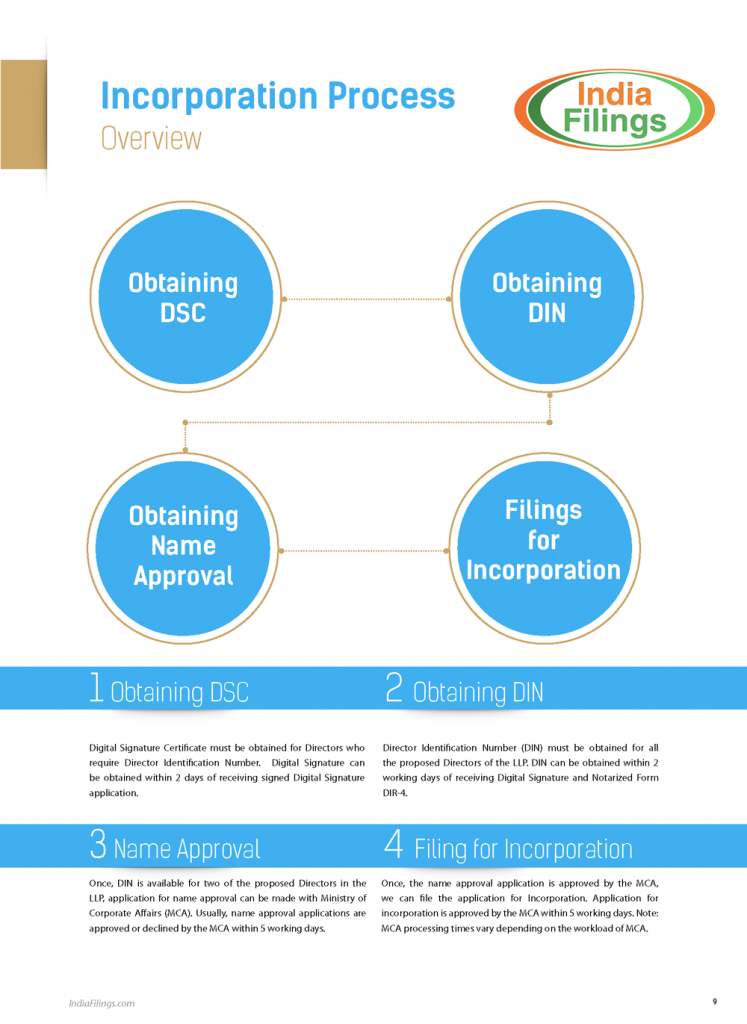
Incorporation-Process-of-a-Limited-Liability-Partnership To incorporate an LLP, a minimum of 2 persons are required. As detailed above, there is no limit on the maximum number of partners in an LLP. The following persons can be partners in an LLP.
- Individuals
- Limited Liability Partnerships
- Companies
- Foreign Limited Liability Partnerships
- Foreign Companies