
IndiaFilings
Expert
Published on: Sep 25, 2026
Foreign Non-Resident Taxpayer - GST Registration
After the rollout of Goods and Services Tax (GST), the Government of India mandated GST registration for all foreign non-resident taxpayers supplying goods or services to residents in India. According to the GST Act, a "non-resident taxable person” is anyone who occasionally undertakes transactions involving the supply of goods or services, but does not have a fixed place of business or residence in India. In this article, we explore the GST registration process for foreign non-resident taxpayers and the essential documents required for obtaining GST registration in India.
Foreign Non-Resident Taxpayer - GST Registration Procedure
All foreign non-resident taxpayers must obtain GST registration at least 5 days prior to commencing business or undertaking supply to residents in India. The following procedure can help non-resident taxpayers secure GST registration in India:
Step 1: Appoint an Authorized Signatory
The application for GST registration as a non-resident taxable person must be signed by an authorized signatory who is a resident of India with a valid PAN. Therefore, it's crucial for foreign non-resident taxpayers to appoint an authorized signatory in India for GST registration and compliance purposes.
Step 2: Provide Authorization to Authorized Signatory
The promoters or officers of the foreign company must prepare and sign a GST Declaration, validating the appointment of an authorized signatory in India and their acceptance of responsibility for complying with GST regulations on behalf of the foreign company.
Step 3: Apply for GST Registration
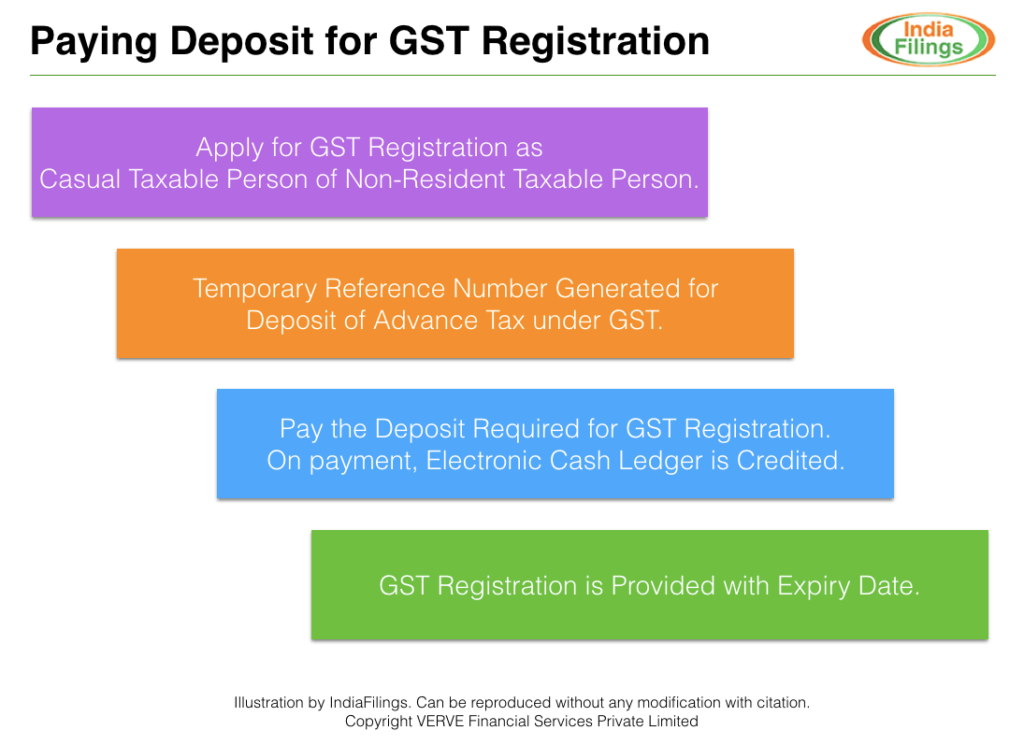
After processing all required documents and completing all steps, the non-resident taxable person should submit the application for GST registration. Upon submission, the Portal provides a temporary reference number for remitting the GST deposit fees.
India Filings can provide assistance with GST registration for foreign non-resident taxpayers under GST.
Step 4: Pay GST Deposit
Non-resident taxable persons are required to remit a deposit for obtaining GST registration. The GST deposit amount depends on the validity period of the GST registration requested and the expected GST liability during that period. Depending on these factors, the GST deposit must be deposited into the notified banks. Once the deposit is remitted, the taxpayer's electronic cash ledger will be credited. This deposit can then be used against any GST payments.
Step 5: GST Registration Certificate Issued
Upon remittance of the GST deposit and submission of the necessary documents, a GST registration certificate is issued. This certificate for foreign non-resident taxpayers and casual taxable persons has a fixed validity period. If a foreign non-resident taxpayer needs to extend this validity, they must submit an application for extension before the registration expires. The applicant must also pay the required tax liability occurred during the extension period.
Documents Required for GST Registration
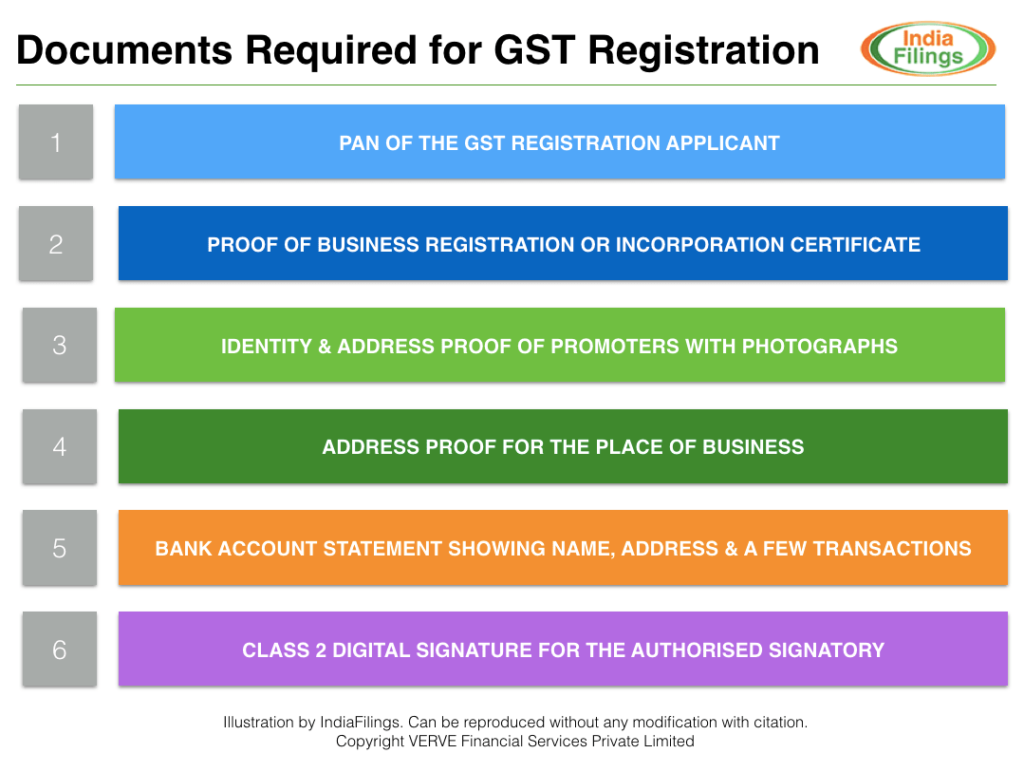
The documents required for GST registration can be classified into five major categories as represented in the following infographic:
PAN or Tax Identification Number of the Applicant
All regular taxpayers with residency in India should obtain a Permanent Account Number (PAN). However, foreign non-resident taxpayers can apply for GST registration, whether incorporated or established outside India, using their tax identification number or a unique number identified by their government. Therefore, PAN is not mandatory for foreign non-resident taxpayers.
Proof of Business Incorporation
To validate the business, taxpayers need to provide proof of business incorporation or a certificate of incorporation from an appropriate authority of their foreign Government.
Identity & Address Proof of Promoters with Photographs
For GST registration, applicants must provide relevant identity and address proof of the business promoters. Foreign nationals must attach a scanned copy of their passport with VISA details along with other documents. For the authorized signatory in India, they need to provide PAN along with an acceptable address proof like a passport, driving license, or voter identity card.
Find a comprehensive list of documents required for GST registration for non-resident taxpayers.
Proof of Address
The taxpayer is required to provide proof of the principal place of business. The following documents are acceptable based on the ownership scenario:
- Own premises – Any document supporting the ownership of the premises, like a Latest Property Tax Receipt, Municipal Khata copy, or Electricity Bill copy.
- Rented or Leased premises – A copy of a valid Rent/Lease Agreement along with a document supporting the ownership of the premises of the Lessor.
- Other scenarios – A Consent Letter along with a document supporting the ownership of the premises of the Consenter, applicable also for shared properties.
Bank Account Statement
Applicants must upload a scanned copy of the first page of the bank passbook, a relevant page of the bank statement, or a cancelled cheque that includes the business or proprietor's name, Bank Account Number, MICR, IFSC, and Branch details.
Class 2 Digital Signature
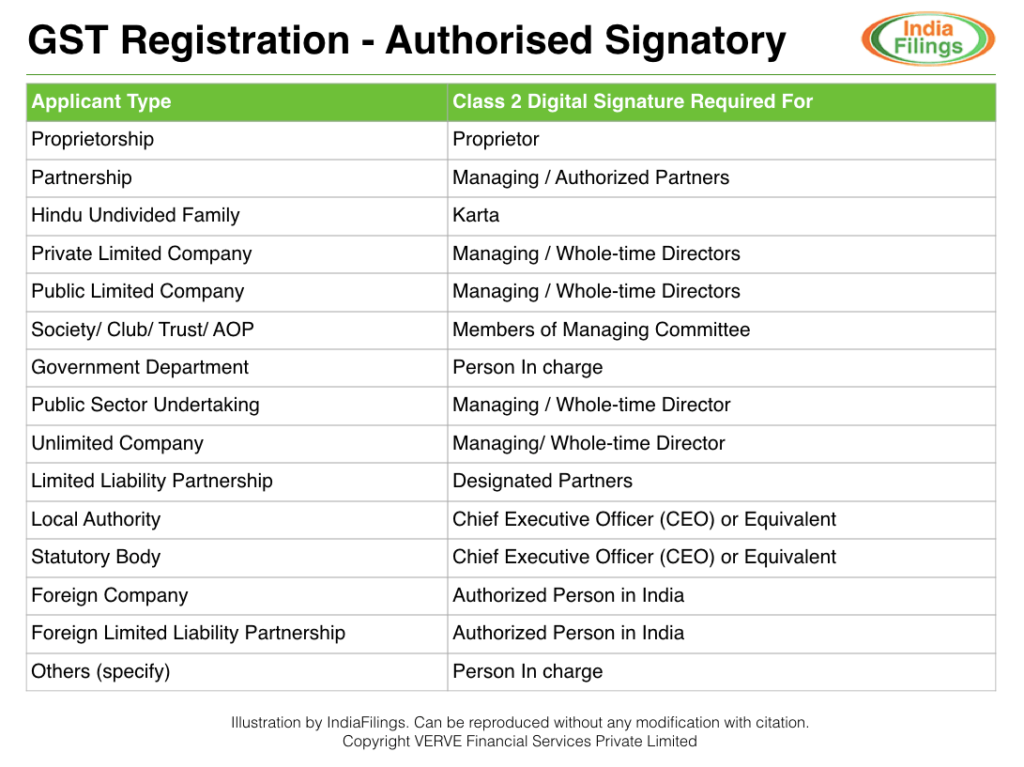
A class 2 digital signature is mandatory for the authorized signatory in India to apply for GST registration.
Discover more about GST registration, including detailed procedures and other related services, on IndiaFilings' GST Portal.