
Marlin Priya
Published on: Jul 30, 2026
Coir Udyami Yojana (CUY)
Coir Udyami Yojana (CUY) is a credit-linked subsidy scheme introduced by the Government of India to establish coir units. Coir industry is an evolving industry in India, especially in the southern parts of the country where numerous factories produce various coir products. The primary role of the Coir Board is to enhance its production and promote the products in the global market. The Coir Board launched the Coir Udyami Yojana scheme to assist micro and small-scale industries in the coir industry.
Objectives of Coir Board
• To incorporate modern technology in Coir Industry for the production and processing of coir and coir products • Update the production and processing technology to improve the productivity and product diversification. • To create employment opportunities in the rural areas of the States /Union Territories producing coconut.
Coir Udyami Yojana Eligibility
Any coir project with a project cost up to 10 lakhs along with the working capital, which does not exceed 25% of total cost is acceptable for this scheme. In addition the following criteria must be fulfilled:
- This scheme can be availed only by the projects that come under coir sector, i.e., projects that manufacture coir fiber products.
- Applicant should be an Indian citizen above 18 years of age.
- There is no income ceiling to set up a project under this scheme.
- Individuals, Companies, Non-Governmental Organizations, Institutions registered under Societies Registration Act 1860, Production Co-operative Societies, Joint Liability Groups and Charitable Trust can apply to benefit from this scheme.
Amount of Subsidy
The scheme offers financial assistance in the following pattern. However, the working capital is not considered for subsidy.
| Rate of Subsidy (of project cost) provided by Government of India |
40% |
| Bank credit |
55% |
| Beneficiary’s contribution for project |
5% |
Coir Udyami Yojana Application Procedure
Filling up the application form involves the following phases.
Phase 1: New Login Registration
Registered users can only login to apply for this scheme. For a new registration, click ‘New Login Registration.’ Provide necessary details.
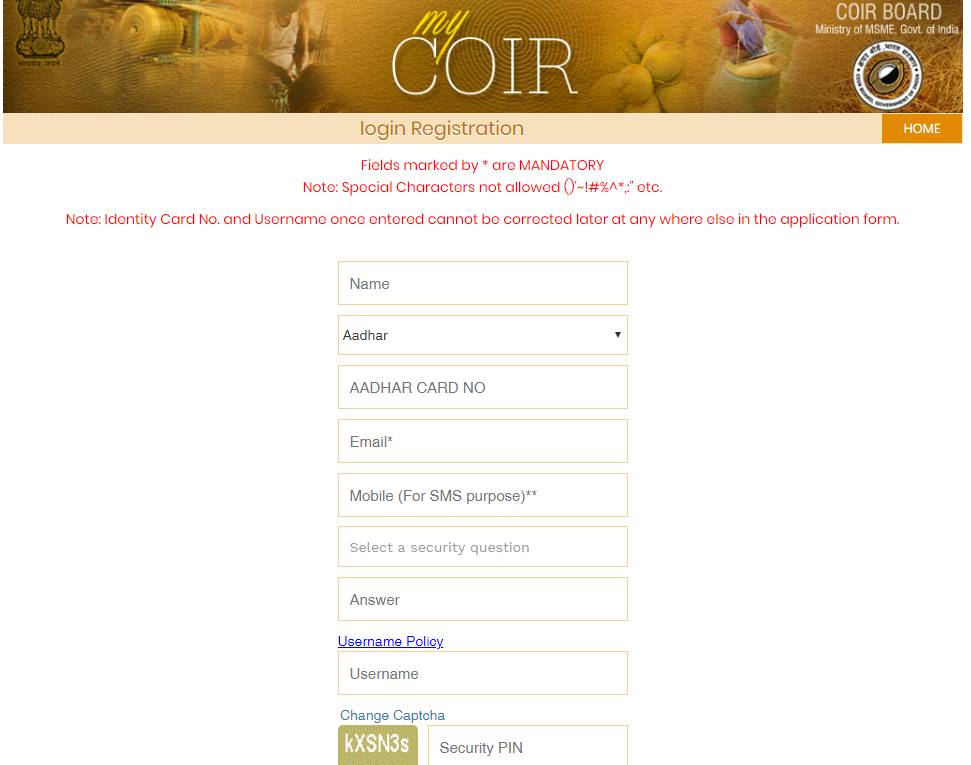
CUY New Registration
Username and password will be intimated by SMS with which one can login to fill the online application form.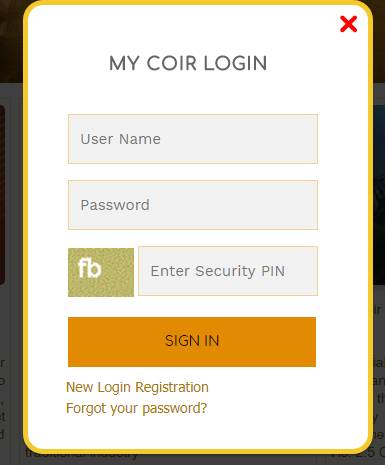
Login for the application form
Phase 2: Beneficiary registration
Common details of the beneficiary are furnished here.
Phase 3: Selection of the Scheme: Coir Udyami Yojana and Submit the Application
Select the scheme and fill in the application form. Submission of the documents will go along with the uploading of scanned documents at appropriate places.
The documents required are mentioned below Beneficiary Registration1. Photograph in JPEG format. 2. Copy of PAN Card 3. MSME Registration Certificate 4. Community Certificate (In case of SC/ST) 5. Company Registration Certificate (If not individual)
Coir Udyami Yojana Scheme1. Training certificate 2. Project Report 3. Title deed 4. Plan & Estimate 5. Machinery Invoice On receiving the application form, the bank shall intimate the beneficiary about the sanction within 60 days. The bank sanctions 95% of the project cost after the beneficiary depositing the 5% contribution. The contribution should be made within 30 days of receiving the sanction letter. All the Scheduled Commercial Banks and all Regional Rural Banks provide this financial assistance. The rate of interest for the loans shall be in equivalence with the base rate. Repayment should be made within 7 years.