

Renu Suresh
Expert
Published on: Jul 30, 2026
Balance Of Payment
Balance of Payment is a statement, which records all the monetary transactions made between the countries during any given period. BOP statement includes all the transactions made by individuals, corporations and the government and helps in monitoring the flow of funds to develop the economy of a nation. BOP statement of a country indicates whether the country has a surplus or a deficit of funds. In this article, we will look at the Balance Of Payment (BOP) in detail.BOP Statement – At a Glance
As described above, BOP statement of a country indicates whether the country has a surplus or a deficit of funds that is when a country’s export is more than its import, its BOP is said to be in surplus. On the other hand, BOP statement designates that a country’s imports are more than its exports. Tracking the transactions under the Balance Of Payment is similar to the double entry system of accounting; this means that all the transaction will have a debit entry and a corresponding credit entry. When all the elements are correctly included in the BOP statement, it should sum up to zero in a perfect scenario; this means the inflows and outflows of funds should balance out.Importance of Balance Of Payment
The importance of the Balance Of Payment statement is described here:- BOP statement of a nation reveals its financial and economic status
- BOP statement can be set as an indicator to determine whether the country’s currency value is appreciating or depreciating
- BOP statement helps the Government to decide on fiscal and trade policies
- It provides crucial information to analyse and understand the economic dealings of a country with other countries
Elements of Balance Of Payment
The Balance Of Payment contains three components such as current account, capital account and financial account. The total of the current account must balance with the total of capital and financial accounts in ideal situations.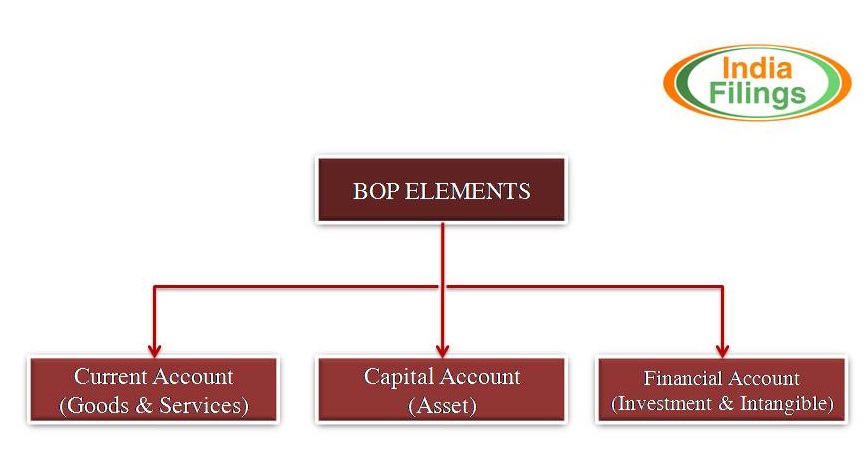 Image 1 Balance Of Payment
Current Account
The current account is used for monitoring the inflow and outflow of goods and services between countries.- Current account covers all the receipts and payments made with respect to raw materials and manufactured goods.
- The current account includes receipts from tourism, transportation, engineering, business services, stocks, and royalties from patents and copyrights.
Trade and Transfers
There are various categories of trade and transfers, which happen across the countries. It could be visible or invisible trading, unilateral transfers or other payments or receipts.- Trading of goods between countries is referred to as visible items, and import/export of services such as banking, information technology is referred to as invisible items.
- The unilateral transfer is referring to money sent as gifts or donations to residents of foreign countries. This can also be private transfers like money sent by relatives to their family located in another country.
Capital Account
All capital transactions between the countries are monitored through the capital account. Capital account includes the purchase and sale of assets (non-financial) like land and properties. The capital account also records the flow of taxes, purchase and sale of fixed assets by migrants moving out to a different country. The deficit or surplus in the current account is managed through the finance from capital account and vice versa. There are three major elements of capital account such as loan & borrowings, investments and foreign exchange reserves.- Loans and borrowings – It includes all types of loans from both the private and public sectors located in foreign countries
- Investments – These are funds invested in the corporate stocks by non-residents
- Foreign exchange reserves – Foreign exchange reserves held by the central bank of a country to monitor and control the exchange rate does impact the capital account