

RENU SURESH
Expert
Published on: Jul 30, 2026
CBIC Extends GSTR-3B Filing Deadline to October 25, 2025
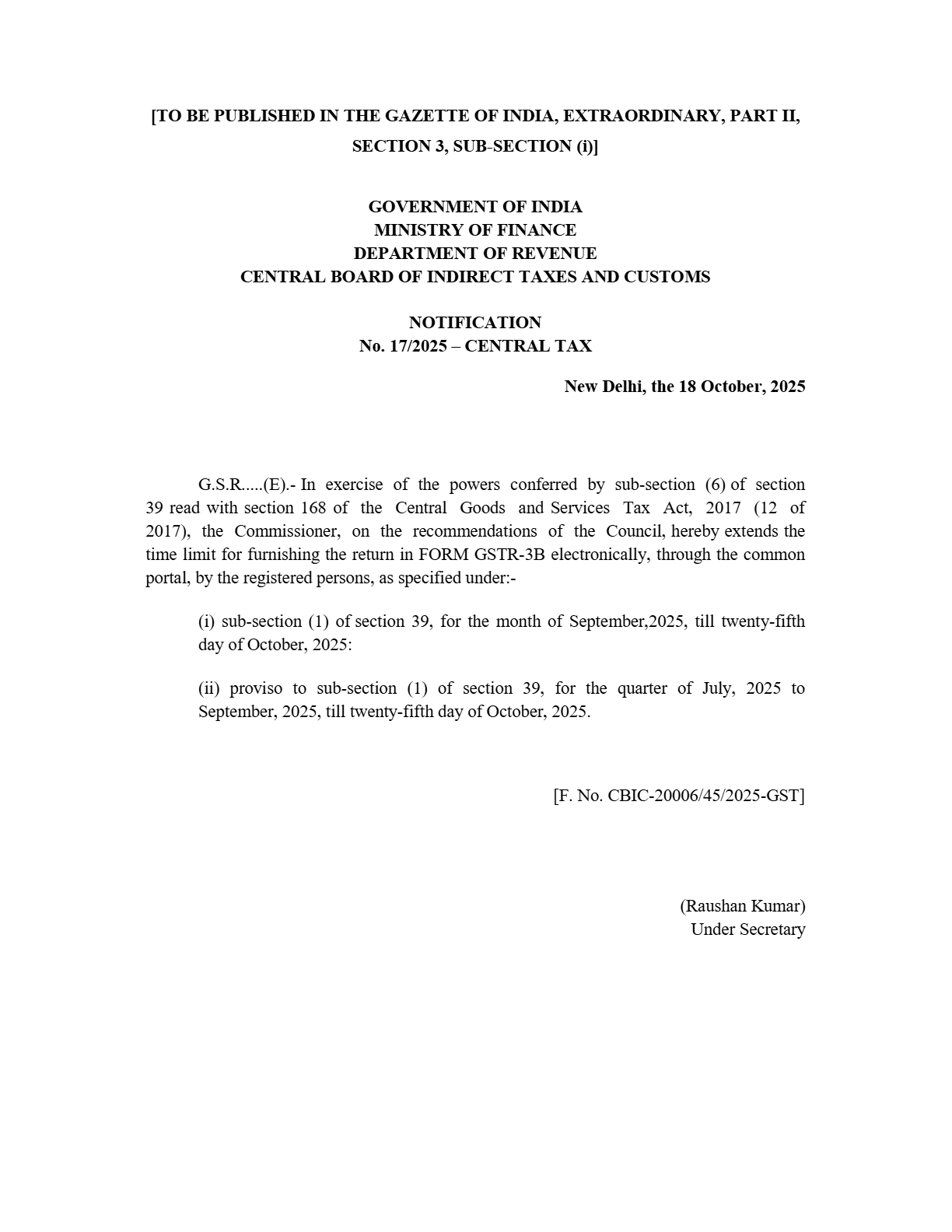
Ministry of Finance has announced an extension of the GSTR-3B filing deadline for the September 2025 tax period. The due date has been extended from October 20, 2025, to October 25, 2025, offering additional time for businesses to comply with the Goods and Services Tax (GST) regulations without rushing during the festive season. This extension also covers quarterly taxpayers filing returns for the July–September 2025 period, ensuring that all GST payers have adequate time to complete their filings accurately.
The announcement comes ahead of Diwali, one of India’s biggest festivals, which often sees a surge in business activities, holiday travel, and public holidays across the country. By extending the deadline, the government aims to ease compliance pressures and allow taxpayers to focus on both their business and festive preparations.
File Your GSTR-3B on time with IndiaFilings Today & Avoid Late Fees!
Applicability of GSTR-3B Due Date Extension
The extension applies to the following categories:
- Regular monthly filers: Businesses that file GSTR-3B every month now have an additional five days to complete their September 2025 return.
- Quarterly filers: Small taxpayers and businesses that follow the quarterly filing schedule for July–September 2025 can also utilize the extended timeline.
It is important to note that this extension does not waive any tax liability. Businesses must still ensure that the GST due is calculated and paid accurately before the extended deadline to avoid interest charges.
What is GSTR-3B?
Before diving into the specifics of the deadline extension, it’s important to understand the form GSTR-3B.
GSTR-3B is a summary return used for the payment of GST. Businesses must file this return every month (or quarter, depending on their registration) to report the details of both their outward and inward supplies. The return is used by businesses to remit the applicable GST to the government.
GSTR-3B serves as a self-assessment return where taxpayers summarize their GST liabilities and input tax credits for a given period. The form is simple and concise, focusing primarily on the GST liability payable and the amount of input tax credit (ITC) that businesses are entitled to claim.
Filing the GSTR-3B is crucial to avoid penalties and interest for non-compliance, as it directly impacts the taxpayer's ability to settle the GST dues and claim eligible credits.
Details of the Extended Deadlines
The last date for filing monthly GSTR-3B for September 2025 has been extended to October 25, 2025, from the original deadline of October 20, 2025.
For taxpayers opting for quarterly filing under the QRMP scheme, the last date for filing GSTR-3B for the July–September 2025 quarter is now October 25, 2025 for all states, providing uniform relief in view of the Diwali festive season.
Key Due Dates to Remember
Here’s a quick reference for taxpayers:
Tax Period | Original Due Date | Extended Due Date | Applicability |
September 2025 | 20 October 2025 | 25 October 2025 | Monthly GSTR-3B filers |
July–September 2025 | 20 October 2025 | 25 October 2025 | Quarterly GSTR-3B filers |
Why Were GSTR-3B Deadlines Extended?
The deadlines for filing GSTR-3B returns have been extended primarily to provide relief to taxpayers and professionals during the festive season. The original due dates for September 2025 and the July–September 2025 quarter coincided with Diwali, one of India’s busiest festivals, leading to potential challenges in timely filing.
Taxpayers often face difficulties in reconciling invoices, calculating Input Tax Credit (ITC), and making GST payments during such periods due to holiday closures, higher transaction volumes, and limited working days. By extending the deadline, the government aims to ease compliance burdens, reduce last-minute errors, and avoid penalties or interest for businesses. The move also ensures that taxpayers have adequate time to review records and file accurate returns, promoting smoother GST compliance nationwide.
How to File GSTR-3B: Step-by-Step Guide
Filing GSTR-3B is a crucial process for all GST-registered taxpayers in India. This monthly or quarterly summary return helps report outward supplies, input tax credit (ITC), and net tax liability. Below is a detailed step-by-step guide to file GSTR-3B efficiently on the GST portal.
Step 1: Log in to the GST Portal
Visit GST Portal and log in using your GST credentials. The homepage displays the return filing status for the last five tax periods.
Step 2: Navigate to the Returns Dashboard
Go to Services > Returns > Returns Dashboard to access the return filing section.
Step 3: Select Financial Year and Period
On the File Returns page, choose the relevant Financial Year, Quarter, and Return Filing Period (Month or Quarter) from the drop-down menus. Click SEARCH to proceed.
Note: Quarterly filers must file GSTR-3B only for the final month of the quarter. For the first two months, the form is not accessible.
Step 4: Prepare Online
Click PREPARE ONLINE under the ‘Monthly Return GSTR-3B’ section. The portal will display the due date for filing.
Step 5: Respond to Preliminary Questions
Answer the preliminary questions by selecting Yes or No. These determine which sections of the GSTR-3B form you need to fill.
- For Nil returns, select “Yes” to the first question and proceed directly to Step 10.
- MSMEs can also use this step to fill a consent form for Mudra Loans or other MSME loans.
Step 6: Enter GSTR-3B Details
Fill in all relevant fields of the GSTR-3B form, including:
- Outward and Inward Supplies: Summarize taxable, exempt, and reverse charge supplies.
- Interstate Supplies: Provide details of supplies made to unregistered persons, composition taxpayers, and UIN holders.
- Input Tax Credit (ITC): Enter eligible, reversed, and ineligible ITC.
- Exempt, Nil, and Non-GST Supplies: Include intra-state and inter-state details.
- Interest and Late Fees: Enter amounts under IGST, CGST, SGST/UTGST, and Cess.
Tip: Use the SYSTEM GENERATED GSTR-3B tab to verify auto-populated data from GSTR-1 and GSTR-2B. Edit if necessary.
Step 7: Save Your Progress
Click SAVE GSTR-3B to store entered data. You can return later to make edits. Once submitted, the data is locked and the ITC and liability ledgers are updated.
Step 8: Preview Draft Return
Click PREVIEW DRAFT GSTR-3B to review all entries before final submission. This helps ensure accuracy.
Step 9: Payment of Tax
Once reviewed, the Payment of Tax section becomes active:
- Check Balance: Verify cash and credit balances in the Electronic Cash Ledger.
- Proceed to Payment: Update liabilities and use available ITC to offset taxes.
- Confirm Payment: Click OFFSET LIABILITY to finalize.
Handling Insufficient Funds:
- Generate a challan via CREATE CHALLAN if funds are insufficient.
- Adjust ledger balances using MAKE PAYMENT/POST CREDIT TO LEDGER if necessary.
Step 10: Declaration and Filing
After verifying all details and ensuring tax payments, check the declaration box and select the Authorized Signatory. File using either:
- Digital Signature Certificate (DSC)
- Electronic Verification Code (EVC)
Step 11: Confirmation
Click PROCEED to submit the return. A confirmation message will appear once the filing is successful. Your GSTR-3B status will be updated to ‘Filed’, and you can view your return via VIEW GSTR-3B.
Penalty for Late Filing of GSTR-3B After the Extended Due Date
Even after an extension, taxpayers must file their GSTR-3B returns on or before the revised due date. Failure to do so attracts penalties, interest, and other compliance issues.
Late Fee
- ₹50 per day for taxpayers with a tax liability.
- ₹20 per day for Nil returns.
- Maximum late fee depends on turnover:
- Up to ₹1.5 crore: ₹2,000
- ₹1.5–5 crore: ₹5,000
- Above ₹5 crore: ₹10,000
Interest on Outstanding Tax
- Interest at 18% per annum is charged on unpaid GST.
- Calculated from the original due date until full payment is made.
Loss of Input Tax Credit (ITC)
- ITC for the month cannot be claimed in subsequent returns if filing is delayed beyond the extended due date.
Restriction on GSTR-1 Filing
- Non-filing of GSTR-3B blocks submission of GSTR-1 for the relevant period.
- For QRMP taxpayers, delayed quarterly GSTR-3B also restricts use of the Invoice Furnishing Facility (IFF).
Stay Compliant with Expert GST Filing Assistance
Don’t risk penalties, interest, or loss of input tax credit by missing the GSTR-3B deadline. IndiaFilings offers professional GST filing services to help you prepare, reconcile, and submit your returns accurately and on time. With expert guidance and step-by-step support, you can focus on growing your business while we handle your GST compliance seamlessly.