
Arnold Thomas
Expert
Published on: Aug 14, 2026
Rebate of State Levies (RoSL)
Government of India (GoI) has approved the Rebate of State Levies (RoSL) scheme to support the textile sector to boost increase the competitiveness among the global market and create new employment opportunities.
Outline of RoSL
In the year 2015, GoI implemented
Merchandise Exports from India (MEIS) and Service Exports from India (SEIS) through Foreign Trade Policy (FTP) to make the export products more productive and competitive among the international market. Since the MEIS scheme for garments and made-ups that offered 4 per cent support for the trade has become unavailable from December 31, GoI introduced Scheme to Rebate of State Levies (RoSL) and Central Embedded Taxes to support the textile sector. This scheme would also replace the pre-GST uniform RoSL rates and Central Taxes for the cost of exports. RoSL plays a vital role for the exporters by providing zero-rated taxation on apparel and made-up products. This scheme would enable the exporters to increase traffic, enhance competitiveness among the global market, and compete against countries such as Sri Lanka, Bangladesh, Cambodia and Vietnam, who enjoy zero taxation. This would also benefit the traders who export to the European Union (EU), India’s largest export market for the apparel sector, facing a tariff variation of 9.6 per cent. GoI has implemented the RoSL scheme on 7th March 2019 to March 31, 2020 through IT-driven Scrip System to prevent delay and ensure swift distribution of products. As apparel and made-ups contribute 56 per cent of the textile industry, implementing zero-rated taxation will boost the productivity and export intensity, leading to significant growth in India’s economy.Objectives of the Scheme
- To increase the export production of apparel and made-ups
- To provide zero-rated export taxes for apparel and made-ups to compete against the global market
- To ensure tax benefits are met to the trading and manufacturing sector for prompt disbursal of products
- To minimise the purchase and manufacturing costs and increase sales and growth in the turnover
- To increase manufacturing units and employment and
- To promote quality process management and support for global marketing
The press release on the scheme is provided below:
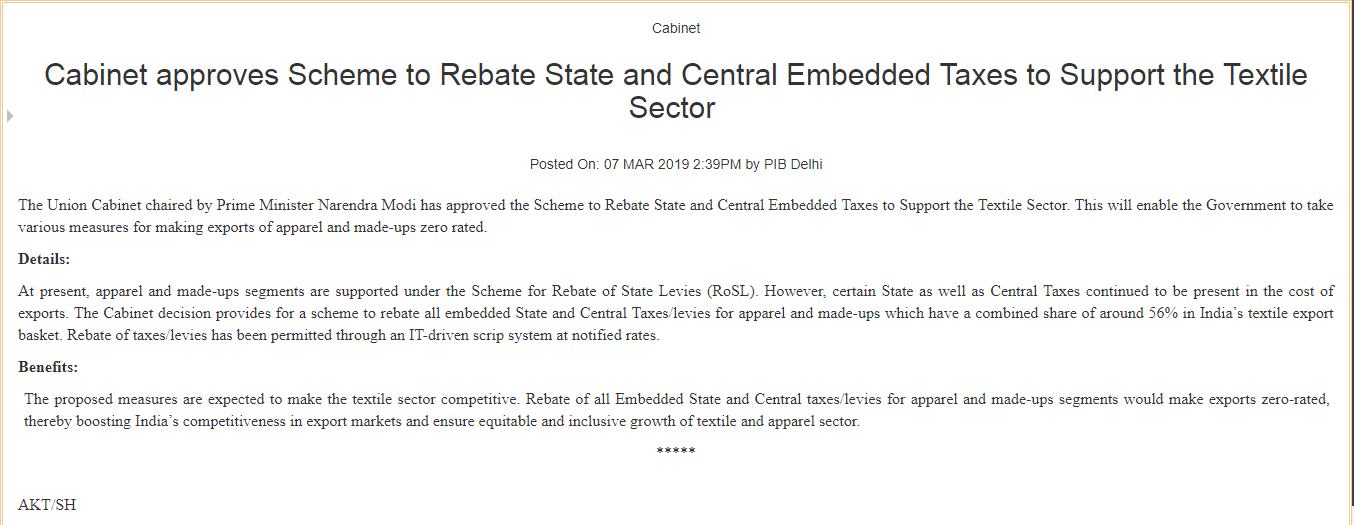 PIB Notification on RoSL
Benefits of the Scheme
- Rate of Central levies on apparel increased from 1.7 per cent to 6.05 per cent
- Rate of Central levies on made-ups increased from 2.2 per cent to 8.2 per cent
- Boosts the transition of business for small and medium garments manufacturers
- Implementation of zero-rated tax helps to decreases the purchase value of the product and increases the profit margin for traders and manufacturers
- Rebates offered by States to stamp duty, petroleum tax, electricity duty and mandi tax embedded in exports shall be extended to the textile industry
- Increases the distribution and sales and helps to meet the demands of the versatile textile market
GoI promotes the following exports materials to increase the productivity of SMEs:
Textile articles:
- Blankets and travelling rugs
- Bed linen, knitted or crocheted, toilet linen and kitchen linen, of terry towelling or similar terry fabrics.
- Curtains (including drapes) and interior blinds; curtain or bed valances.
Furnishing articles:
- Bedspreads, counterpanes, napkins, pillow case and pillow slip, table cloth and table cover, Towels
Tarpaulins, awnings and sun blinds, tents, sails for boats, sailboards or land craft and camping goods
Made up articles:
- Dress patterns such as floorcloths, dishcloths, dusters and similar cleaning cloths, life jackets and lifebelts
To know about 1 for the products and filing,
click here.