
Marlin Priya
Expert
Published on: Jul 30, 2026
Manipur Non-Encumbrance Certificate
Encumbrance denotes the liabilities created on a specific property by its owner. The non-encumbrance certificate serves as evidence of free ownership of the property during any property transactions. It is also issued for mortgaging property for seeking loans or for lease. In this article, we look at the procedure for obtaining a Manipur non-encumbrance certificate in detail.
Importance of Obtaining a Non-Encumbrance Certificate
The non-encumbrance certificate is a significant document to verify that a property does not have any monetary or legal dues such as mortgages or uncleared loans.
- The non-encumbrance certificate is important when buying or selling any land, house, or any other property as it ensures complete ownership title. Hence transferring of property requires an EC.
- Apart from property purchase, non-encumbrance certificate must be furnished when applying for a loan against the property in any banks or financial institutions as it confirms that the property is free from any legal liabilities.
- EC is an important document to get the mutation of property (Khata Registration / Khata Transfer / Patta) done.
- This certificate must be provided to the Village / Panchayat Officer to update the land tax records if the property or land tax is not paid for more than three years.
- The non-encumbrance certificate is an essential document to withdraw PF for a property purchase or house construction.
Attributes of Non-Encumbrance Certificate
A non-encumbrance certificate records the following property-related details.
- The certificate holds the name of the property owner.
- A non- encumbrance certificate contains all the transactions relating to a particular property for a certain period (as required).
- Those transactions and documents that have been registered with the office alone will be reflected in the non- encumbrance certificate. It also consists of any claims or encumbrance on the property.
- The transactions recorded with the sub-registrar’s office records may be; sale deed, sale agreement, partition deed, release deed, gift deed, settlement deed, mortgage deed, mortgage discharge receipt, court attachment orders
- The transactions details will be listed in chronological order for the specified period.
- The certificate will highlight the date and details of the transactions, volume number, book number, document numbers, and names of the parties to the transaction.
- This document provides a complete description of the property as provided in the Sale Deeds
- If the land is purchased on loan, then this certificate will contain details about the mortgage.
Encumbrance Search
Any individual can check for the encumbrance of the property by providing the exact period or date. If an EC is requested for a particular period, the details will be provided for that period alone and not more.
Documents Required for Manipur Non-Encumbrance Certificate
Attach the following documents along with the application form. However, the applicant should also be ready with certain details like the full name as in jamabandi, Patta number, area unit, village number, the period of search etc. either applying offline or online.
- Latest Jamabandi (Patta) copy which is less than 2 months from the date of issue
- Latest land revenue receipt
Fees
The fee depends on the period for which the encumbrance requires. In Manipur, the online service is free. The calculation of encumbrance fee comprises of the following basis:
- For a search period of one year or the first year = Rs.5/- (Five)
- For each remaining year = Rs.2/- (Two)
A fraction of a year is considered to be a year, and the fee is calculated accordingly.
Note: The encumbrance year begins from April 1st of a calendar and closes on March 31st, of the next calendar year.Processing Time
The time taken for the processing of the application is 15-30 days from the date of successful submission of the form excluding the government holidays. Delay in the processing of the application may occur, or even the authorities may reject the application if the applicant fails to select the correct District in the “Please select the district where the form to be processed” field. Since the service will be rendered by the respective authority of the applicant’s District, it is necessary to choose it correctly.
Concerned Department & Authority
The Revenue Department is the relevant department for the issuance of the non-encumbrance certificate in Manipur, and the Registrar or Sub-Registrar is the concerned authority for the same.
Application Procedure for Manipur Non-Encumbrance Certificate
The applicant can request for the non-encumbrance certificate in either offline mode or online mode.
Offline Application Process
Step 1: The citizen desiring to apply for the non-encumbrance certificate should visit his/ her jurisdictional sub-registrar’s office where the particular property has been registered. Step 2: The applicant has to collect the application form and has to fill the necessary details. Step 3: Submit the photocopies of the documents along with the application form. Step 4: On identifying the information to be genuine, the competent authority issues the certificate. The applicant can collect the EC for the property from the same office.Online Application Process
At present, 19 services are available online at the Manipur State Portal. To begin, the applicant must be a registered user of the Manipur State portal to access the E-form for the non-encumbrance certificate.
Registration of State Portal
Step 1: Visit the official website of Manipur State portal that offers online services for the residents of Manipur. Step 2: In case of a new user, click Register on the top left of the login page, which directs to the user registration form.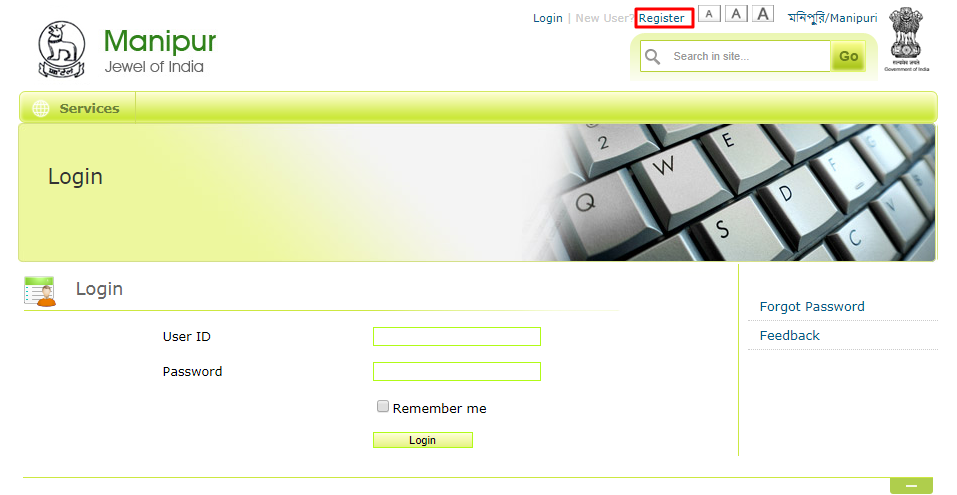 Manipur-Non-Encumbrance-Certificate-Login
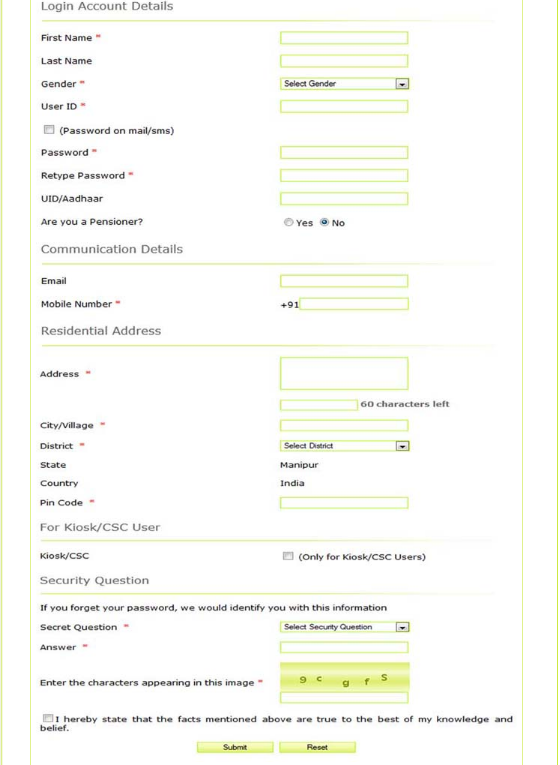
Step 3: Provide essential details, such as Login details, Communication details, Residential details, and security question.
Manipur-Non-Encumbrance-Certificate-Login
Step 3: Provide essential details, such as Login details, Communication details, Residential details, and security question.
 Manipur-Non-Encumbrance-Certificate-User-Registration
Step 4: Enter the captcha and click submit. With the registered username and password, proceed with the application.
Registered user
Step 5: If already a registered user, click, log in. The login page appears. Enter the username and password and click login that redirects to another page.
Step 6: Go to the services tab on the home page. Click on the services tab to avail the list of service. From listed services, the citizen can choose and click on the Non-Encumbrance Certificate link.
Note: To view forms in Manipuri language by clicking on link Manipuri.
Step 7: The applicant can fill e-Form for Non-Encumbrance certificate online as well as offline.
The Non Encumbrance Certificate is available in English and Manipuri (Bengali script) languages, change the portal language to get the same.
Step 8: Click on “Offline” link for filling the form Offline or "Online” link for filling the form Online.
Manipur-Non-Encumbrance-Certificate-User-Registration
Step 4: Enter the captcha and click submit. With the registered username and password, proceed with the application.
Registered user
Step 5: If already a registered user, click, log in. The login page appears. Enter the username and password and click login that redirects to another page.
Step 6: Go to the services tab on the home page. Click on the services tab to avail the list of service. From listed services, the citizen can choose and click on the Non-Encumbrance Certificate link.
Note: To view forms in Manipuri language by clicking on link Manipuri.
Step 7: The applicant can fill e-Form for Non-Encumbrance certificate online as well as offline.
The Non Encumbrance Certificate is available in English and Manipuri (Bengali script) languages, change the portal language to get the same.
Step 8: Click on “Offline” link for filling the form Offline or "Online” link for filling the form Online.
Offline e-form
To fill out the form in Offline mode, download a zip file on clicking the “Offline” button. Unzip the zipped file, and then fill the details in the form.html. In offline mode, the user can save the details and fetch the data whenever required. The candidate can assign a security key to secure the details from editing. Also, the applicant can submit offline forms online. After checking all details, the applicant has to enter the State Portal system by entering the login id and password to submit the form.
Online e-form
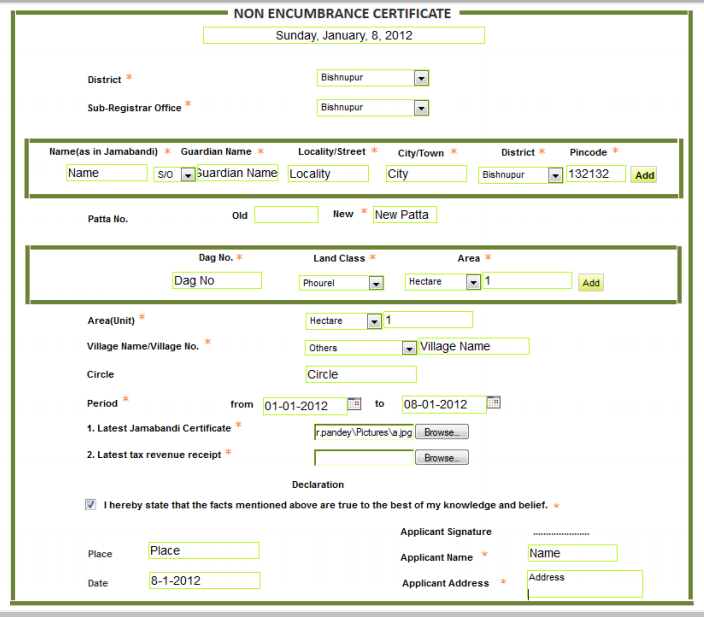
Online e-form allows the applicant to fill the form online at once and submit it after validating it.
 Manipur-Non-Encumbrance-Certificate-e-form
Step 9: After filling the e-form in either mode, the system will generate the transaction id, which can be used for future references or tracking the application status. Any further communication with Department Authorities regarding the e-form requires the transaction id.
Step 10: Besides, the applicant can print the form by clicking the print button on the e-from.
Note: The applicant has to fill all fields marked as * on E-Form. On furnishing, wrong/misleading data by the applicant in the e-form will lead to rejection by the Department Authorities of the concerned District Jurisdiction.
Step 11: On verifying the details and the documents provided, the Registrar will issue the certificate.
The EC is generally provided in the regional language. Also, the applicant can obtain the English translation by paying an additional fee.
If the property does not have any encumbrance during the given period, Form 16 will be issued.
If the property has any encumbrance registered during the given period, in such case the applicant can obtain form No. 15.
Manipur-Non-Encumbrance-Certificate-e-form
Step 9: After filling the e-form in either mode, the system will generate the transaction id, which can be used for future references or tracking the application status. Any further communication with Department Authorities regarding the e-form requires the transaction id.
Step 10: Besides, the applicant can print the form by clicking the print button on the e-from.
Note: The applicant has to fill all fields marked as * on E-Form. On furnishing, wrong/misleading data by the applicant in the e-form will lead to rejection by the Department Authorities of the concerned District Jurisdiction.
Step 11: On verifying the details and the documents provided, the Registrar will issue the certificate.
The EC is generally provided in the regional language. Also, the applicant can obtain the English translation by paying an additional fee.
If the property does not have any encumbrance during the given period, Form 16 will be issued.
If the property has any encumbrance registered during the given period, in such case the applicant can obtain form No. 15.
Nil Encumbrance Certificate (NEC)
If no transactions have taken place within the period, then the will receive a Nil Encumbrance Certificate (NEC), i.e. an encumbrance certificate with no details of the transaction.