

Renu Suresh
Expert
Published on: Aug 19, 2026
Mandatory e-invoicing for Taxpayers Exceeding Turnover of INR 20 Crores
Central Board of Indirect Taxes & Customs (CBIC) has announced that
GST E-invoicing shall be mandatory for taxpayers having aggregate turnover of more than 20 Crores with effect from 1st April 2022 vide a Notification 01/2022-Central Tax dated 24.02.2022. CBIC has lowered the threshold for mandatory issuance of e-invoices under Goods & Services Tax (GST) to INR20 crore from the earlier prescribed limit of INR 50 crore. Know more about GST E-invoicing – Recent AmendmentThe Gist of CBIC Notification
As per the recent notification issued in the e-Gazette of India, e-invoicing will now cover all those taxpayers whose aggregate turnover exceeds INR 20 Crores during any previous financial year. It means businesses with a turnover of INR 20 crore or more will have to issue e-invoices from April 1. If the invoice is not valid, ITC (Input Tax Credit) on the same cannot be availed by the recipient, besides attracting applicable penalties.
E-Invoicing Implementation Phases - Synopsis of amendments
The Government of India implemented e-invoicing in a phased manner.
- In the first phase, CBIC vides a Notification No. 13/2020–Central Tax dated March 21, 2020, announced that taxpayers having a turnover of more than INR 500 crore were required to issue e-invoices from October 1, 2020.
- In the second phase, CBIC vides a Notification No. 88/2020–Central Tax dated November 10, 2020, announced that taxpayers having a turnover of more than INR 100 crore were required to issue e-invoices from January 1, 2021.
- In the third phase, CBIC vides a Notification No. 05/2021–Central Tax dated March 08, 2021, announced that taxpayers with a turnover of more than INR 50 crore must issue e-invoices from April 1, 2021.
- In the fourth phase, Now, the CBIC vide Notification No. 01/2022 – Central Tax dated February 26, 2022, has issued an amendment in Notification 13/2020, to notify such turnover limit from INR 50 crores to INR 20 crores in the following manner:
Meaning of e-invoicing in GST
E-invoicing prescribes a standardized format of the invoice which can be read by a machine. It is a system in which B2B (Business-to-Business) invoices are authenticated electronically by GSTN (Goods & Services Tax Network) for further use on the common GST portal. Under the electronic invoicing system, an identification number will be issued against every invoice by the Invoice Registration Portal (IRP) to be managed by the GSTN.
Advantages of E-invoicing
- e-invoice has many advantages such as auto-reporting of invoices into GST return, auto-generation of the e-way bill (where required).
- e-invoicing will also facilitate standardization and inter-operability leading to reduction of disputes among transacting parties, improved payment cycles, reduction of processing costs and thereby greatly improving overall business efficiency.
Penalty for Non-Generation of E-Invoices
Non-issuance of e-invoice is an offense under GST and thus attracts penal provisions. Below are some of the penalties for non-issuance of invoice or issuance of incorrect invoice:
- Penalty for non-issuance of invoice- 100% of the tax due or Rs.10, 000, whichever is higher.
- The penalty for incorrect invoicing is Rs.25, 000.
If a taxpayer misses the deadline for generating an e-invoice, he or she will face some consequences.
- Taxpayers’ GST returns will not be automatically filled out. The recipient will not pay without a proper e-invoice, since this may jeopardize his or her ability to claim ITC.
- As the data from e-invoices is auto-populated in GSTR and Part-A of the e-way bill, return and e-way bill creation would be impeded. Without a valid e-invoice, the vehicle may be held or seized by GST officers.
Steps to register on the e-invoice portal
As the CBIC has made e-invoicing mandatory for taxpayers whose aggregate turnover exceeds the INR 20 Crores mark, they must now interface their systems with the government’s invoice registration portal to generate an IRN for every B2B invoice and export supplies in a seamless manner. The registered person needs to follow the below steps for obtaining registration on the e-invoice portal- The registered person needs to access the official website of the GST e-Invoices System. Navigate the path Registration and then click on Portal Login.
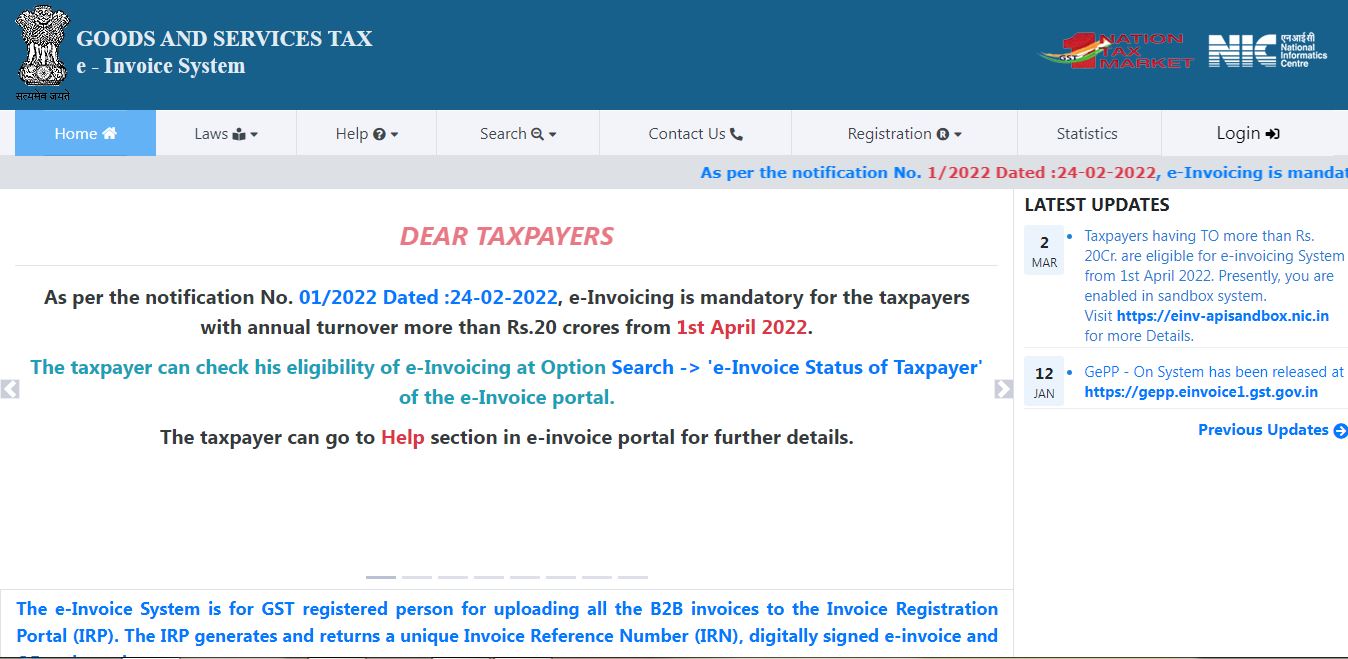 Mandatory e-invoicing for Taxpayers Exceeding Turnover of INR 20 Crores - e-invoice portal Home Page
Enter GSTIN and captcha and click on Go. Following details as registered on the GST portal would be displayed.
Mandatory e-invoicing for Taxpayers Exceeding Turnover of INR 20 Crores - e-invoice portal Home Page
Enter GSTIN and captcha and click on Go. Following details as registered on the GST portal would be displayed.
- Applicant Name
- Trade Name
- Address Line 1
- Address Line 1
- City
- PIN
- State
- Mail ID
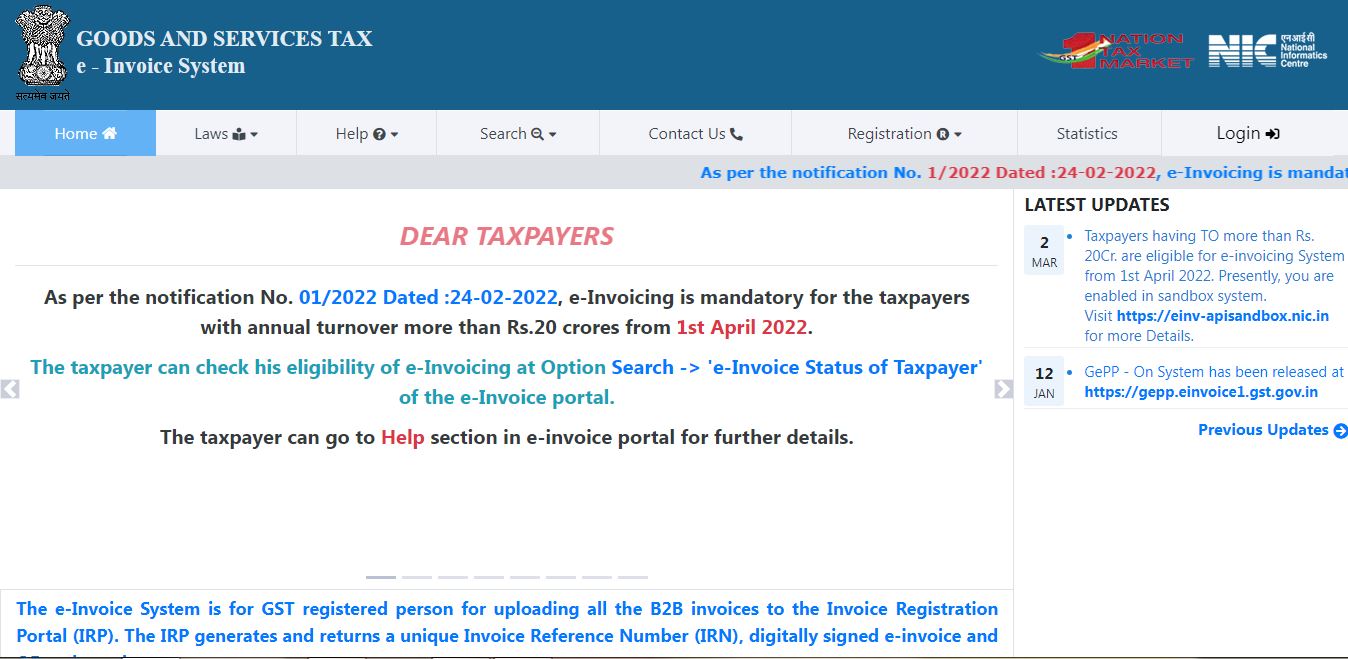 Mandatory e-invoicing for Taxpayers Exceeding Turnover of INR 20 Crores - e-invoice portal Home Page
Click ‘Send OTP’ if the details displayed above are correct. Enter the OTP received on the registered mobile number and click ‘Verify OTP’.
On successful verification of OTP, the applicant will have to select and enter the following details and click on ‘Save’
Mandatory e-invoicing for Taxpayers Exceeding Turnover of INR 20 Crores - e-invoice portal Home Page
Click ‘Send OTP’ if the details displayed above are correct. Enter the OTP received on the registered mobile number and click ‘Verify OTP’.
On successful verification of OTP, the applicant will have to select and enter the following details and click on ‘Save’
- User name
- Password
- Re-enter password