

Renu Suresh
Expert
Published on: Mar 27, 2026
The Lean Startup: Meaning, Benefits, Characteristics, Examples and Lean Startup vs. Traditional Startup
In today's fast-paced, high-risk business environment, the ability to adapt quickly and learn continuously is not just an advantage — it’s a necessity. This is especially true for startups navigating uncertain markets, tight budgets, and ever-changing customer expectations. Traditional business planning methods are often too rigid and slow for these challenges. That’s where the Lean Startup methodology steps in.
The Lean Startup, developed by Eric Ries and popularised globally through his 2011 bestseller of the same name, offers a fundamentally different way of approaching business creation. Rather than betting everything on a perfectly polished product, the Lean Startup approach emphasises experimentation, rapid iteration, and customer feedback as the cornerstones of entrepreneurial success.
For Indian entrepreneurs, especially those launching ventures in resource-constrained or high-growth sectors, the Lean Startup presents a compelling roadmap for reducing risk, saving capital, and building businesses that truly meet customer needs.
What Is a Lean Startup?
A Lean Startup is a business model and development methodology that focuses on building products based on validated demand, rather than relying on untested assumptions. It champions launching with a Minimum Viable Product (MVP) — the most basic version of a product that still delivers value to customers — and then refining it through customer feedback.
Instead of developing a full product, spending months or years in stealth mode, and only then entering the market (hoping for success), the Lean Startup advises launching quickly, learning from real users, and adapting before investing heavily.
This shift represents a fundamental inversion of traditional business logic: instead of building and hoping demand will follow, you identify demand first and build accordingly.
The Core Principles of Lean Startup
The Lean Startup approach rests on several core ideas:
1. Validated Learning
Startups don’t just exist to make products or money. According to Eric Ries, their true purpose is to learn what customers actually want. This is called validated learning — the process of testing hypotheses about your business through experiments, customer feedback, and data.
2. Build-Measure-Learn Feedback Loop
This is the Lean Startup’s primary operational cycle. Entrepreneurs are encouraged to:
- Build an MVP to test a hypothesis,
- Measure customer behaviour and reactions,
- Learn from the data to improve the product or pivot the business model.
This loop is continuous and iterative — the faster it’s executed, the quicker a startup reaches product-market fit.
3. Minimum Viable Product (MVP)
The MVP is not a substandard product, but a functional prototype that allows early adopters to use the product and provide meaningful feedback. An MVP could be as simple as a landing page, a demo video, or even a manual version of a digital service.
4. Pivot or Persevere
After collecting feedback from early users, the startup must decide: Should we pivot (change direction with a revised hypothesis) or persevere (continue refining the current version)? This decision is critical to staying aligned with market demands.
Origins of the Lean Startup Movement
The Lean Startup methodology is deeply rooted in lean manufacturing principles developed by Toyota in Japan. In manufacturing, the goal was to eliminate waste, improve efficiency, and create more value with fewer resources. Eric Ries applied similar principles to startups, where waste comes not from excess inventory, but from building products nobody wants.
By focusing on fast iteration and real-time customer feedback, the Lean Startup framework has helped thousands of startups across the world develop better products and achieve product-market fit faster.
Why the Lean Startup Approach Is Crucial for Indian Entrepreneurs
India is home to one of the fastest-growing startup ecosystems in the world. From fintech and healthtech to agritech and edtech, the diversity of ideas is astounding. But the harsh reality is that most startups still fail within the first 3-5 years. Common reasons include lack of market demand, poor cash flow management, and inadequate product-market fit.
Here’s where the Lean Startup framework becomes a game-changer:
1. Resource Efficiency
Indian startups often operate with limited funding. Unlike Silicon Valley, where capital is more accessible, Indian founders need to stretch every rupee. Lean Startup's focus on MVPs and validated experiments helps conserve capital and avoid building costly features nobody uses.
2. Speed to Market
India's market is incredibly dynamic. Preferences change fast, and competitors emerge quickly. The Lean approach accelerates product development by encouraging rapid prototyping and real-time testing, enabling startups to stay ahead.
3. Data-Driven Culture
In India, decision-making often relies heavily on founder intuition or investor pressure. The Lean Startup replaces guesswork with data-driven insights, ensuring that businesses make decisions based on what the customer actually wants.
4. Customer-Centricity
The methodology ensures that startups are constantly in touch with their customers, collecting feedback, and iterating their products based on real-world usage. This is especially important in India, where user behavior varies widely across regions, income groups, and digital literacy levels.
Lean Startup vs. Traditional Startup Model
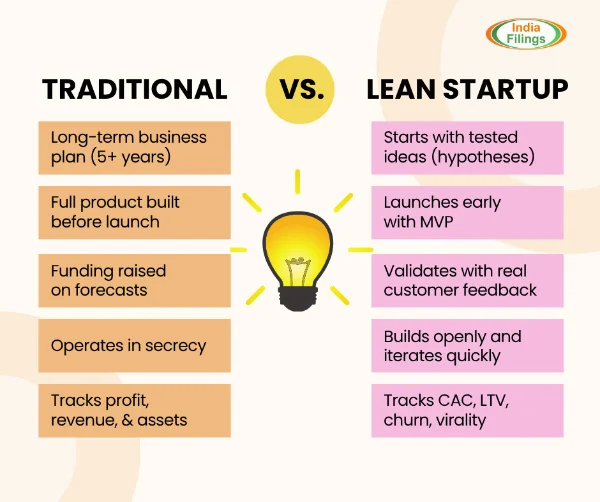
When launching a new business, entrepreneurs often choose between two key approaches: the Lean Startup model and the Traditional Startup model. Each offers a distinct path to building and scaling a company, with different strategies for planning, development, and risk management.
Traditional Startup Approach
- Creates detailed 5-year business plans.
- Builds a complete product before market testing.
- Raises funding based on speculative forecasts.
- Focuses on secrecy and internal development.
- Relies on traditional financial metrics like income statements, balance sheets, and profit margins.
Lean Startup Approach
- Prioritises hypotheses over rigid plans.
- Launches quickly with an MVP.
- Uses real customer feedback for validation.
- Focuses on metrics like customer acquisition cost (CAC), lifetime value (LTV), churn rate, and product virality.
- Embraces failure as a learning opportunity.
In short, traditional startups aim to execute a business plan; Lean Startups aim to discover a viable business model.
Why Lean Startup Matters in India?
India is one of the most dynamic startup ecosystems globally, with over 100 unicorns, thousands of early-stage ventures, and a culture of innovation driven by digital transformation, a growing middle class, and rising investor interest.
However, failure rates remain high, often due to:
- Misreading customer demand.
- Building products that don’t solve real problems.
- Overestimating market size.
- Burning cash too early.
Lean Startup is particularly relevant to India because:
- Budgets are often limited — Lean methods help conserve resources.
- Markets are diverse — Continuous feedback is crucial to localising products.
- Consumer behaviour is rapidly evolving — Speed and agility are critical
- Founders often lack access to world-class R&D, The MVP model allows testing ideas without huge capital expenditure.
By adopting Lean principles, Indian entrepreneurs can reduce waste, accelerate learning, and build sustainable businesses.
Applying Lean Startup: A Step-by-Step Process
Let’s walk through how to apply the Lean Startup method to a hypothetical Indian startup.
Step 1: Define the Problem
Start by identifying a real, validated problem. For example: Working mothers in Indian metros don’t have time to cook healthy meals.”
Step 2: Formulate a Hypothesis
Translate the problem into a testable hypothesis:
“If we offer a healthy meal subscription service with same-day delivery, working mothers in Tier-1 cities will subscribe.”
Step 3: Build an MVP
Develop the simplest product that allows testing the hypothesis:
- A website with a menu
- Google Form to collect orders
- Manual delivery via Swiggy Genie or Dunzo
Step 4: Measure Key Metrics
Track real data:
- How many users visited the site?
- How many signed up?
- What dishes were popular?
- What feedback did you receive?
Step 5: Learn and Iterate
Based on responses:
- Add more family-sized meals
- Offer early morning deliveries
- Introduce meal plans for kids
- Repeat this cycle until a clear product-market fit emerges.
Real-Life Examples of Lean Startups in India
Several Indian startups have successfully embraced the Lean Startup approach — launching with minimal resources, learning from early users, and evolving rapidly to meet market demands. Here are a few standout examples.
Zerodha
India’s largest stock brokerage started with minimal features, targeting tech-savvy retail investors looking for low-cost trading. Instead of spending crores on advertising, they focused on a niche community, used content marketing, and kept iterating their platform based on user feedback. Their MVP approach and focus on simplicity helped them scale sustainably.
UrbanClap (now Urban Company)
Urban Company began with a very narrow focus — connecting customers with service professionals like beauticians or electricians. The founders launched city-by-city, testing pricing models, onboarding experiences, and quality control before expanding. This MVP-based, city-wise expansion strategy reduced risk and improved unit economics.
Razorpay
Started as a simple payment gateway MVP for startups and developers. Listened to user feedback and expanded to become a full-stack fintech platform offering payroll, lending, and banking solutions.
Cure.fit
Launched with a basic health and wellness app, tested with a few studios, and gradually added features like food delivery (Eat.fit), therapy (Mind.fit), and diagnostics. Each new vertical was built and validated separately.
Zomato
Started as Foodiebay, a simple restaurant listing website. Based on user feedback and usage trends, they pivoted to food delivery, then added loyalty programs, cloud kitchens, and more.
Key Metrics for Lean Startups
Traditional financial statements often don’t reflect the health of an early-stage startup. Instead, Lean Startups focus on innovation accounting, which includes:
- Customer Acquisition Cost (CAC): How much it costs to acquire a new customer.
- Lifetime Value (LTV): The expected revenue from a customer over their lifecycle.
- Churn Rate: The percentage of customers who stop using the product.
- Activation Rate: The percentage of users who take a key action (e.g., sign up, place an order).
- Retention Rate: How often customers return or remain active.
These metrics help startups make informed decisions and justify pivots when needed.
Common Misconceptions About the Lean Startup
1. MVP Means a Half-Baked Product
An MVP is not a poorly built or low-quality version of the final product. It must deliver real value while being minimal in scope. It should be good enough to test whether your hypothesis holds true.
2. Lean = Cheap
Being lean doesn’t mean cutting corners. It means optimising resources and learning efficiently. Sometimes, spending on a targeted ad campaign or hiring a UX expert may be the “lean” thing to do if it brings critical insights faster.
3. Pivoting Means Failure
Many founders equate pivoting with giving up. In fact, pivoting is a sign of learning. Whether it’s changing your target audience, business model, or distribution channel, it’s a natural and necessary part of building a successful company.
Challenges in Implementing Lean Startup in India
Challenge 1: Resistance to Rapid Change
Many Indian founders come from traditional business backgrounds where product cycles are long and stable. This makes frequent iteration uncomfortable.
Solution: Encourage a culture of experimentation. Celebrate learnings even from failed experiments.
Challenge 2: Limited Customer Feedback
Especially in B2B or rural markets, getting direct feedback from customers can be hard.
Solution: Use proxy methods — interviews, surveys, and data analytics — to understand behaviour. Incentivise feedback when necessary.
Challenge 3: Investor Expectations
Some investors still expect detailed business plans and projections upfront, rather than MVPs and learning metrics.
Solution: Educate investors on the Lean Startup process. Share real-time data and learning insights instead of just projections.
Lean Startup in Large Organisations
The Lean Startup method is not limited to small companies or startups. Several large corporations have embraced it to improve innovation and reduce risk.
- GE: Used Lean Startup principles to develop a battery for mobile phone towers in remote parts of Africa and India.
- Qualcomm and Intuit: Adopted Lean experimentation in product innovation labs to keep pace with startups.
By creating internal incubators, these companies test new ideas quickly without the red tape of traditional product development cycles.
Lean Startup in Education and Government
Today, business schools across India, including IIMs and ISB, incorporate Lean Startup principles into their entrepreneurship curriculum. Meanwhile, government-backed initiatives like Startup India and Atal Innovation Mission are encouraging founders to adopt modern innovation methodologies like Lean, Agile, and Design Thinking.
Tools and Platforms to Support the Lean Startup Process
To implement the Lean Startup approach effectively, founders can leverage a host of digital tools:
- MVP Builders
- Customer Feedback
- Analytics
- A/B Testing
- Project Management
Key Takeaways
- Lean Startup is a mindset and methodology that focuses on building businesses through rapid experimentation and customer feedback.
- It helps startups fail fast and learn quickly, reducing the risk of investing time and money into unwanted products.
- Unlike traditional business models, Lean Startup prioritises flexibility, validated learning, and agility over static planning.
- Indian entrepreneurs can greatly benefit from the Lean approach due to resource constraints, dynamic market conditions, and evolving customer behaviours.
- MVPs, metrics like CAC and churn rate, and iterative product development form the backbone of this method.
Final Thoughts
The Lean Startup approach redefines what it means to be a successful entrepreneur. It moves away from static business plans and overconfidence in vision and pushes founders to engage with their market early and often.
In a country as diverse, digital, and opportunity-rich as India, embracing Lean Startup methods can be the key to building businesses that last, not by accident, but by design.
If you're an aspiring entrepreneur, startup founder, or innovator, don't wait to be perfect — launch, learn, and improve. That’s the Lean Startup way.
Turn Your Idea into a Lean, Scalable Business - With IndiaFilings by Your Side
Ready to bring your startup vision to life the smart way? At IndiaFilings, we help aspiring entrepreneurs implement Lean Startup principles right from the ground up, from company registration and legal compliance to building your MVP and validating your idea. Don’t waste time or capital on guesswork. Launch fast, learn continuously, and scale confidently with expert support at every stage.
Get started with IndiaFilings today — Let’s build your startup the lean way!