IndiaFilings

Expert

Published on: Jun 24, 2026

Income Tax Deduction for Medical Treatment

Taxpayers can make use of the deductions provided by the

Income Tax Act to those who are suffering from certain medical complications. The Act allows a deduction for expenses incurred by a taxpayer for medical treatment of the diseases which are specified under Section 80DDB. In this article, we provide an overview of Section 80DDB.

Section 80DDB

The deduction under this section is allowed from the gross total income of an individual assessee for medical expenses incurred during the financial year for medical treatment of specified diseases. The deduction can be claimed for the taxpayer or a person who is a dependent member of the family of the taxpayer. Dependent means the spouse, children, parents, brothers and sisters of the individual, to the extent they are dependant wholly or mainly on the taxpayer for support and maintenance.

Amount of Deduction under Section 80DDB

The maximum deduction provided under this section shall be Rs.80,000 or amount spent, whichever is less for super senior citizens (above 80 years of age). The maximum deduction for senior citizens (above 60 years of age) is Rs.60,000 or amount spent, whichever is less. The maximum deduction for regular taxpayers under Section 80DDB is Rs.40,000 or amount spent, whichever is less.
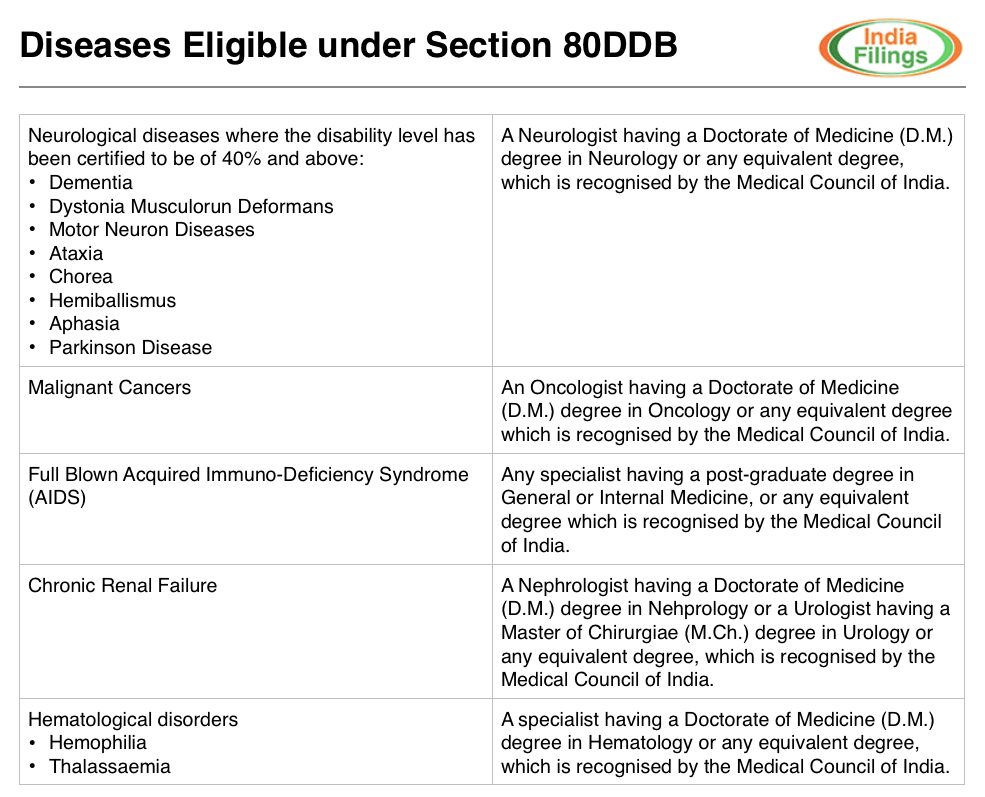
Diseases-Eligible-for-Deduction-under-Section-80DDB Diseases Eligible for Deduction under Section 80DDB

Eligible Deduction under Section 80DDB

For a deduction to be eligible under this section, the taxpayer must obtain a prescription containing the following details from an authorised medical practitioner:

  • Name of Patient
  • Age of Patient
  • Name of disease or ailment
  • Name, address, registration number and qualification of the medical professional issuing the prescription

Treatment Received from Government Hospital

If the taxpayer received the treatment in a government hospital, the prescription can be issued by any specialist working full-time in that hospital and having a post-graduate degree in General or Internal Medicine or any equivalent degree, which is recognised by the Medical Council of India. The prescription should also contain the name and address of the government hospital.

Learn about the concept of Income Tax Deduction for Educational Loan!
Back to Learn

Frequently Asked Questions

Common questions about Income Tax Deduction for Medical Treatment in India.

The maximum deduction allowed under Section 80DDB varies based on the age of the taxpayer. For super senior citizens (above 80 years of age), the maximum deduction is Rs. 80,000 or the actual amount spent, whichever is less. For senior citizens (above 60 years of age), the maximum deduction is Rs. 60,000 or the actual amount spent, whichever is less. For regular taxpayers, the maximum deduction is Rs. 40,000 or the actual amount spent, whichever is less.
The deduction under Section 80DDB can be claimed by an individual taxpayer for medical expenses incurred for their own treatment or for the treatment of a dependent family member. Dependent members include the spouse, children, parents, brothers, and sisters who are wholly or mainly dependent on the taxpayer for support and maintenance.
The deduction under Section 80DDB can be claimed for medical expenses incurred for the treatment of specific diseases mentioned in the Income Tax Act. Some of the eligible diseases include cancer, HIV/AIDS, neurological diseases, chronic renal failure, and several other life-threatening or chronic conditions.
To claim the deduction under Section 80DDB, the taxpayer must obtain a prescription from an authorized medical practitioner. The prescription should include the name of the patient, age, name of the disease or ailment, name, address, registration number, and qualification of the medical professional, and the treatment received.
Yes, the deduction under Section 80DDB can be claimed for treatment received in a government hospital. In such cases, the prescription can be issued by a specialist working full-time in the government hospital and having a post-graduate degree in General or Internal Medicine or an equivalent degree recognized by the Medical Council of India.
The deduction under Section 80DDB can be claimed for medical expenses incurred during the financial year for which the tax return is being filed. There is no specific time limit mentioned in the Income Tax Act for claiming this deduction.
Yes, the deduction under Section 80DDB can be claimed for medical expenses incurred for the treatment of pre-existing medical conditions, provided that the disease is listed as eligible under this section and the required documentation is obtained.
No, the deduction under Section 80DDB is specifically intended for medical expenses incurred for the treatment of specified diseases or ailments. Preventive medical treatments or check-ups are generally not eligible for this deduction.
Yes, the deduction under Section 80DDB can be claimed for medical expenses incurred abroad, provided that the treatment is for an eligible disease and the required documentation is obtained from a qualified medical practitioner.
No, there is no specific limit mentioned in the Income Tax Act on the number of years for which the deduction under Section 80DDB can be claimed. The deduction can be claimed every year as long as the medical expenses are incurred for the treatment of an eligible disease and the necessary documentation is provided.