
IndiaFilings
Published on: Jul 30, 2026
How to Get Halal Certification in India
Halal Certificate is obtained majorly food and food-related products, Which is needed in Islamic countries. Halal is a term from the Quran that means "permitted" or "lawful." Therefore, Halal is used for food and other consumables that are permissible for consumption and used by Muslims, based on Islamic law, the Shariah. Halal promotes cleanliness in all aspects of a person, and halal foods ensure that food consumed by a person in their daily lives is clean, hygienic, and not detrimental to their health or well-being. A halal certification ensures that the food product is safe for consumption. With rising awareness about Halal foods, more and more businesses are seeking Halal Certification for their products, premises, restaurants, etc. This article looks at the procedure for obtaining Halal Certification in India.
Halal Certification
Halal Certification Bodies in India provide halal Certification. There are various Halal Bodies, and a few of the Halal Bodies in India are listed below:
- Halal India Private Limited
- Halal Certification Services India Private Limited
- Jamiat Ulama-E-Maharashtra - a State unit of Jamiat Ulama-E-Hind
- Jamiat Ulama-i-Hind Halal Trust
Businesses wishing to obtain Halal Certification in India can approach any of the above Certification Bodies for obtaining Halal Certification. While providing Halal Certification, a competent authority audits and ensures that the business:
- Neither is nor consists of or contains any part or matter of an animal that Shariah prohibits a Muslim from consuming or that has not been slaughtered following Shariah.
- It does not contain anything which is considered to be impure according to Shariah.
- Has not been prepared, processed, or manufactured using an instrument that was not free from anything impure according to Shariah; and
- Has not in the course of preparation, processing, or storage been in contact with or proximity to any food that fails to satisfy paragraph (a) (b) or (c) or anything that is considered to be impure according to Hukum Shariah.
Types of Halal Certification
Based on the business's nature, the Halal Certification type varies. Most frequently, Halal Certification is obtained for places like restaurants, hotels, slaughtering houses, and packaging and labeling materials to ensure they are suitable to be visited/used by Muslim consumers. However, Halal Certification is not limited to only food production. Non-alcohol beverages, raw materials needed in food processing, pharmaceutical, health care products, traditional herbal products, cosmetics, personal care products, cleaning products, and daily consumable products can also obtain a Halal Certificate. Therefore, obtain Halal Certification from Halal Certification Bodies - broadly under the following schemes:
- Food, Beverage, and Catering Scheme
- Restaurant Scheme
- Industrial Scheme
- Abattoir Scheme
- Warehouse or Storage Scheme
- Product Endorsement Scheme
Halal Certification Procedure
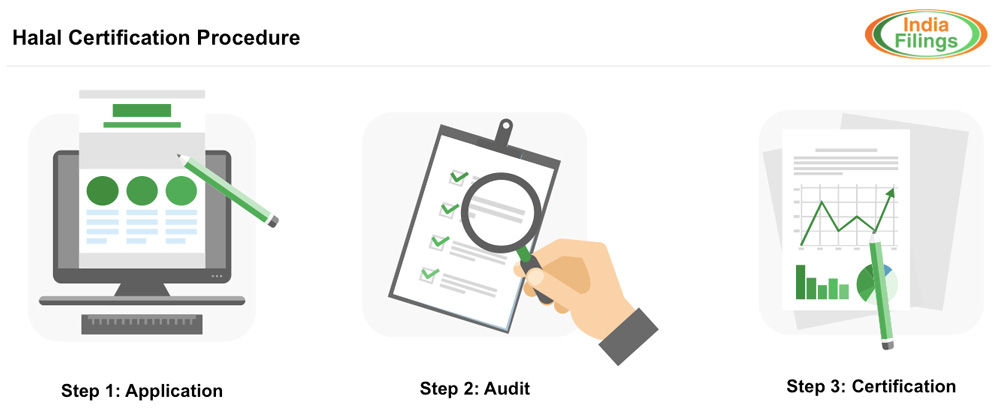
Halal Certification Procedure
Step 1: Application
The business wishing to obtain Halal Certification must apply to one of the Certification Bodies. The company needs to be aware of Halal Certification requirements at this stage and ensure that it complies with Halal requirements, systems requirements, and staffing requirements.
Step 2: Audit
Once the application information is verified, Auditors (usually one Shariah Auditor and one Technical Auditor) will visit the business for inspection. The Auditors will confirm the following areas are acceptable for Halal Certification:
- Documentation
- Processing, handling, and product distribution
- Storage, display, and product serving
- Cleanliness, sanitary, and food safety
- The overall aspects of the premises
- Tools, apparatus, and machines
- Packaging and labeling
During the audit, the business might have to provide criteria for acceptance of raw materials (ingredients), a certificate of analysis, and a Halal certificate of individual components. Once the audit is completed, both parties will prepare and sign an audit report.
Step 3: Certification
Once the Halal audit is complete, a Technical Committee will review the documents submitted by the business and the audit report submitted by the Auditors. If the audit report is satisfactory and the company and products satisfy the Halal certification criteria, then the Halal Certification Body issues the Halal Certificate.
Benefits of Halal Certification
Obtaining Halal Certification has various advantages and could provide an edge for business amongst competitors. The following are some of the major significant benefits of obtaining Halal Certification for a business:
- Make the business or product marketable to over 2 billion people worldwide.
- Use of the Halal logo
- Enhance the marketability of the product in Muslim countries
- Improve the quality of the food or product or hygienic systems
- Improve the quality of the food or product
For more information about Halal Certification, contact an IndiaFilings.com Business Advisor
Related Guides
What is Halal Certification in India? 10 Things You Need to Know