
IndiaFilings
Expert
Published on: Aug 28, 2026
How to Calculate GST?
After implementing Goods and Services Tax (GST), many Entrepreneurs seek assistance on how to calculate GST payment in a transaction. In this article, let us cover all aspects of calculating GST in a business transaction. To calculate GST, the following aspects in a transaction must be considered in a logical, step by step manner.
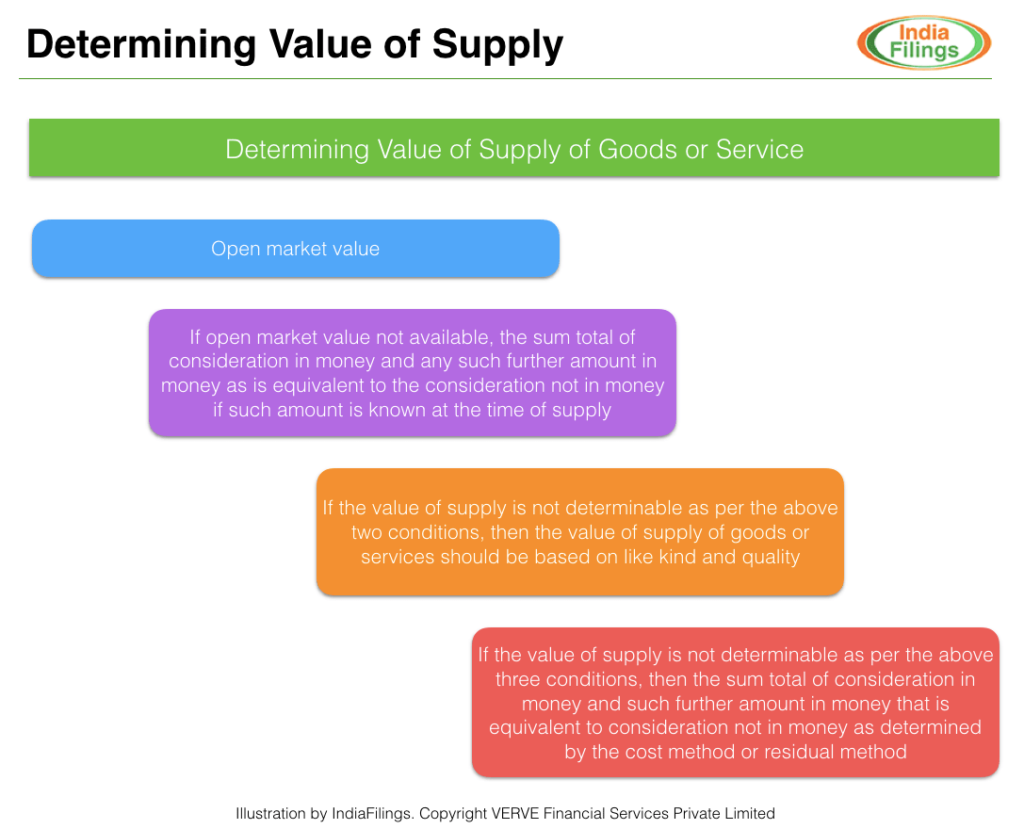 Determining Value of Supply under GST
Step 1: Find the GST Rate Applicable for the Goods or Service
The first step in calculating GST is to find the GST Rate applicable for the Goods or Service under the GST Act. Over the past month, the GST Council has conveyed GST rates for almost all goods and services in India.
Find HSN Code or SAC Code
To find GST Rate, the individual must first make a distinction between the type of supply supplied, i.e., is it a good or service. If the supply is a good, then its important to interpolate with the HSN Code applicable for the Good. HSN Code is an international system for classifying all types of goods in international transactions. The concerned individual shall verify the SAC Code, whether the SAC Code relates to the service when a transaction involves the supply of a service. SAC Code stands for Service Accounting Codes and used for classifying all the services under GST.
Determine the GST Rate applicable for the HSN or SAC Code
Once the HSN or SAC Code is determined for the supply, then the GST Rate for the HSN Code or SAC code can be easily interpolated. GST is levied under 5 different slab rates at NIL, 5%, 12%, 18% and 28% for both goods and services. Hence, the GST rate applicable for the Goods or Service would be any of the slab rates. Find the
1 using the Calculator.Step 2: Determine the Applicability of IGST or CGST and SGST
Once the GST rate is determined, then the applicability of IGST or CGST and SGST must be determined. To determine if IGST or CGST and SGST would be applicable, the individuals should have to determine the place of supply. In most cases, the place of supply of goods or services would be the address where the goods were delivered or the service was provided. For some types of transactions involving e-commerce or OIDAR services, the determination of place of supply is a more complex issue.
Inter-State Supply
If goods or services are provided between two states, i.e., from one state to another, then IGST or Integrated Goods and Services Tax would be applicable on the transaction. Whenever any supplier is involved in providing inter-state supply, GST registration is mandatory.
Intra-State Supply
If the individual provides the goods or service within the same state, then CGST or Central Goods and Services Tax and SGST or State Goods and Service Tax would be applicable.
Calculating IGST, CGST and SGST
If IGST is applicable and the supply is inter-state, then the entire GST applicable for the HSN or SAC code must be accounted for under IGST. If CGST and SGST is applicable and the supply is intra-state, then the GST applicable for the HSN or SAC code must be divided between CGST and SGST. The calculation for IGST, CGST or SGST is only for classification purposes for crediting the tax revenue to the state of consumption. The GST tax rate would remain same and there would be no double-taxation.
Step 3: Determine if GST is Chargeable on Reverse Charge Basis
Normally under GST, the supplier of the goods or service is liable to collect tax from the recipient and remit the same with the Government. However, the recipient shall become liable if the services provided to the user notified as
reverse charge services. Hence, the user and the service provider should know whether the transaction involves reverse charge under GST.Step 4: Enrolling under GST Composition Scheme by Suppliers
Typically, GST compliance requires the supplier to maintain extensive accounts, records and file 3 GST filing a month. However, many SMEs in India would find GST compliance tough and would require a simpler mechanism. Such businesses having a turnover of less than Rs.75 lakhs, can enrol under the GST Composition Scheme and pay a flat GST based on their aggregate turnover. Suppliers enrolled under GST composition scheme should provide proper documents detailing the recognition as composition Suppliers and hence not eligible to collect tax. Hence, before the transaction, the user should verify if the supplier had enrolled under GST Composition Scheme.
Step 5: Determine Type of Transaction
Under GST, transactions can be broadly specified under the following three categories:
- Business to Business,
- For Business to Consumer - Value of supply more than Rs.2.5 lakh,
- Business to Consumer - Value of supply less than Rs.2.5 lakh.
For a supply to be termed as a B2B transaction under GST and made available for GST input tax credit, both the supplier and the recipient of the goods or service must have a GSTIN. GSTIN is provided when a business obtains GST registration.
Do you need GST Registration? Easily find out using this guide. In a B2C transaction under GST, the recipient of the goods or service would not be eligible for receiving the input tax credit. However, in a B2C transaction the recipient need not provide details of his/her GSTIN or GST registration. However, if the transaction value is more than Rs.2.5 lakhs, the recipient would have to furnish details like name, address and other details to determine the place of supply.How to Remove GST from the total amount with an Example?
To remove GST from the total amount, use the formula:
GST Amount = Total Amount – [Total Amount x {100 / (100 + GST%)}] Net Price (Without GST) = Total Amount – GST Amount Example: Let’s consider the total amount of a dining bill is ₹5,900, including 18% GST. Calculate the GST Amount: GST Amount = ₹5,900 – [₹5,900 x {100 / (100 + 18)}] = ₹5,900 – [₹5,900 x (100 / 118)] = ₹5,900 – ₹5,000 = ₹900 Calculate the Net Price (Without GST): Net Price = ₹5,900 – ₹900 = ₹5,000 Thus, the price without GST is ₹5,000, and the GST amount is ₹900.