Renu Suresh

Expert

Published on: Jul 1, 2026

Haryana Property Registration

All transactions that involve the sale of immovable property should be registered in India to ensure the transfer of clean title to the owner. The registration of a property consists of the preparation of documents and paying the applicable stamp duty registration charges for the sale deed to be legally recorded at the Sub-registrar’s office. In this article, we look at the procedure for Haryana Property Registration with stamp duty charges.

Purpose of Property Registration (Deed Registration)

Transfer of immovable property can only be effected by way of registration. Registration of a document of transfer of immovable property provides the following benefits:
  • By registering property, the document of transfer will be a permanent public record
  • Any person can inspect a public record, and a certified copy can be obtained from the office of Sub-Registrar
  • Registration of a document is giving information to the general public that the owner has transferred the immovable property to the buyer.
  • If a person plans to buy an immovable property, he can verify the record-index available in the Sub-Registrar office. He can verify in whose name the last transfer deed has been registered.

Documents Required for Property Registration

For registering property, the following documents must be submitted to the Registrar.
  • Proof of ownership
    • Certified copy of original old sale deed or assessment of MC or Mutation
  • Proof of identification
    • Ration Card, Voter ID, Driving License, Aadhaar Card, PAN Card or Identity Card
  • Verification of GPA from where it has been registered in case it has been registered out of state only
  • NOC
  • ID Proof of two witness parties
  • Map plan and description of immovable property
  • Digital photograph of property (building or plot)
  • In the case of release deed: Mutation of virasat for identification of the ancestral property.

Stamp Duty in Haryana

Stamp duty is a legal tax payable in full and acts as a proof for any sale or purchase of a property. Rates of stamp duty of various transactions in Haryana are tabulated here:
 

Transaction

Rate of stamp duty
Rural area

Urban area

Conveyance Deed, Sale Deed or Certificate

of Sale.

      5%

7% (Including 2% of Municipality duty

2% exemption of S.D. on instruments

of sale executed in favour of women in

rural or urban)

Gift Deed, Mortgage Deed with Possession

  3%   5%

Mortgage Deed without Possession, Settlement Deed, Partition Deed

1.5%


1.5%

Special Power of Attorney

Rs. 100

Rs. 100

General Power of Attorney Rs. 300

Rs. 300

Exchange of Property

5%

7%

Affidavit

Rs. 10

Rs. 10

Security Bond, Release of Ancestral, Property, Surrender of the lease.

Rs. 15

Rs. 15

Partnership Deed

Rs. 22.5

Rs. 22.5

Trust Deed

Rs. 45

Rs. 45

Adoption Deed

Rs. 37.50

Rs. 37.50

Equitable Mortgage or deposit of title deed, pawn or pledge

0.2445% if such loan is repayable on demand or in more than three months. 0.12225% if such loan is repayable in not more than three months.

Calculate Stamp Duty on Jamabandi

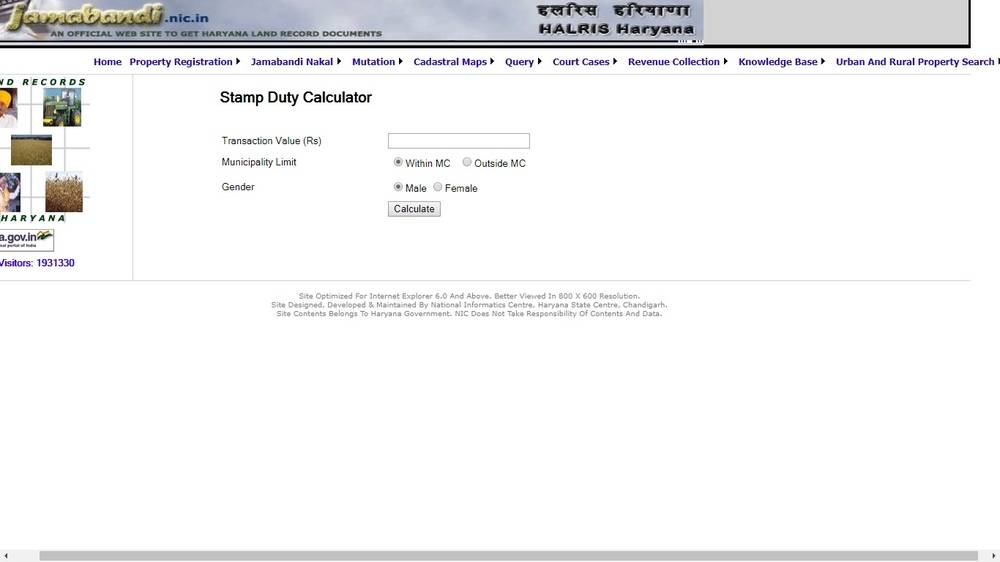
The user can calculate stamp duty for a property transaction on the Jamabandi website by following the steps below: Step 1: To view the applicable stamp duties visit the stamp duty page of Jamabandi web portal Image-1-Haryana-Property-Registration Image 1 Haryana Property Registration Step 2: Enter transaction value in rupee Step 3: The user has to select municipality and gender Step 4: Then click on calculate. Amount of stamp duty and registration fee will be shown. Image-2-Haryana-Property-Registration Image 2 Haryana Property Registration

Procure E-Stamp Online

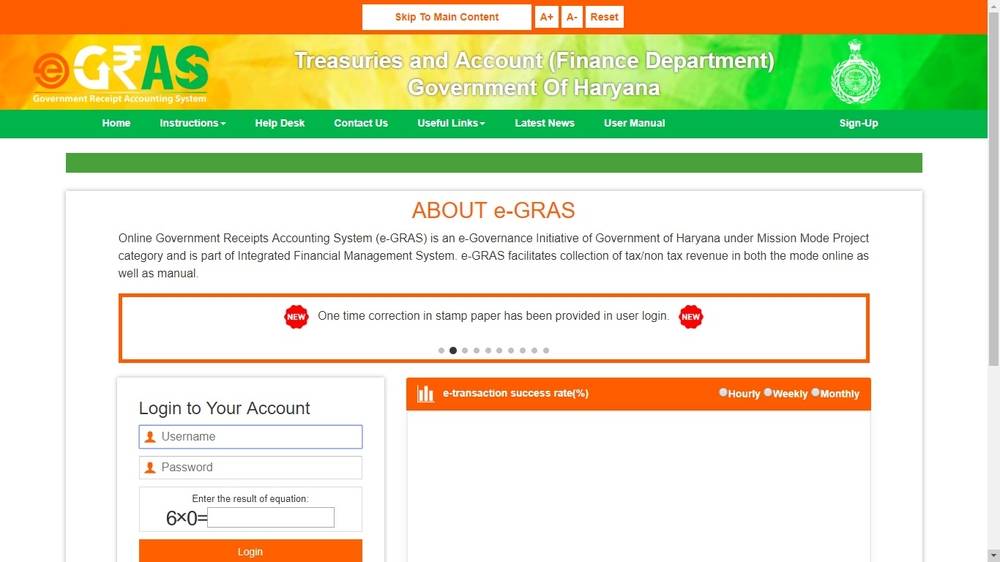
After viewing the applicable fee, the user needs to procure an E-Stamp online for registration. Visit e-Gras web portal. Login into the portal and make the necessary steps to obtain E-Stamp. Image-3-Haryana-Property-Registration Image 3 Haryana Property Registration

Deed Registration Appointment Slots Availability Checking

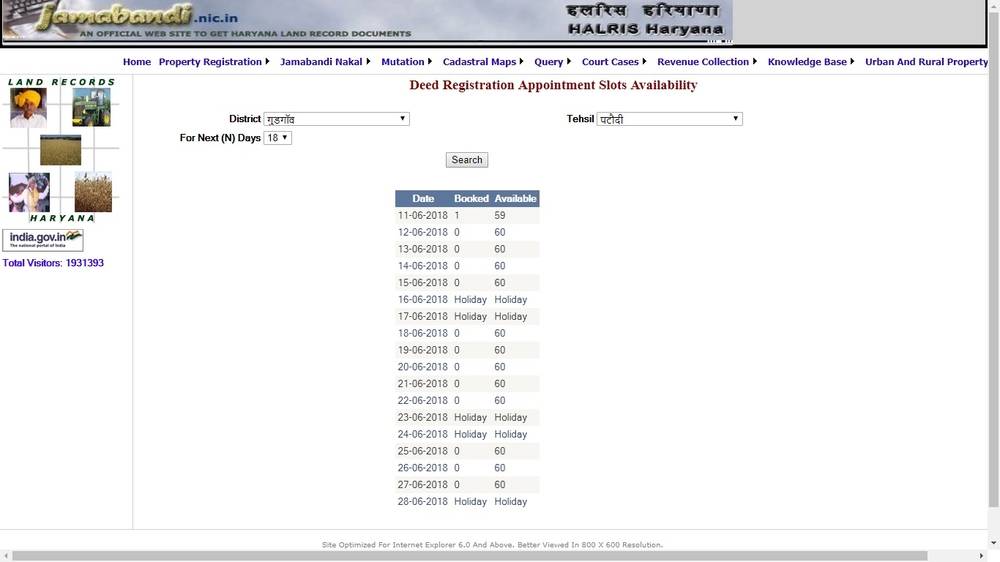
The need to take an e-appointment before registration of property. Step 1: To check available slots for an appointment, visit the Jamabandi portal. Image-4-Haryana-Property-Registration Image 4 Haryana Property Registration Step 2: The user has to select the district name, Tehsil and enter the date. Step 3: Now available slots will be displayed Image-5-Haryana-Property-Registration Image 5 Haryana Property Registration Step 4: The user can now make e- appointments for registration. At the time of appointment, the E-Stamp details are to be entered on the appointment slip. After taking the e-appointment, the user can visit the sub Tehsil office or the SRO office with the required documents listed above.aa

Procedure for Registering a Deed

Haryana property deed registration guidelines are provided below: Step 1: Visit the Jamabandi website to download the desired deed. Sample Copy of the sale deed is here. Step 2: Fill all details in the deed. Note: The deeds are available in both format PDF and Word. The word format can be edited on a computer. Deeds in PDF format can be printed, and necessary fields can be filled. Registered deed writers can also prepare deeds in respective Tehsil. Step 3: Visit the Sub Registrar office on the requisite date and time. Registration clerk forwards deeds to Sub-Registrar. Step 4: Once the Sub-Registrar marked the deed, it will be fetched into the HARIS and deed data, and the photograph of the buyer will be recorded in the system. HALRIS- Haryana Land Record Integrated System where the database of land records for the entire state of Haryana is maintained. Once the deeds are registered, the entries are mapped HALRIS. Step 5: While Registering in HARIS, the desk officer will update the seller or buyer details and the E- Stamp number to update the transaction fees. Once the details are entered, the real-time photograph is captured. Step6: Once the deed is registered in HARIS, the SRO officer will regularize the deed by obtaining the Biometrics of the buyer and seller. Step 7:  After regularizing the deed, the registry of the land is printed with pictures of the seller, buyer, and witnesses along with signatures. Step 8: The registered copy of the deed is provided to the parties, and the Tehsil office also uploads the same on the Jamabandi web portal.

View Registered Deed

Step 9: The user can view the registered deed online by visiting the Jamabandi website. Step 10: Go to the Jamabandi Select “view registered deed” option from the drop-down menu under the property registration menu. Image-6-Haryana-Property-Registration Image 6 Haryana Property Registration Step 11: The user has to enter the following details.
  • Tehsil
  • Registry number
  • Registry date
  • Deed name
Step 12: Enter the captcha and click on search. The user can now see the details of the registered deed.
Back to Learn

Frequently Asked Questions

Common questions about Haryana Property Registration: Procedures and Stamp Duty.

Registering a property in Haryana serves as a permanent public record of the transfer of immovable property from the seller to the buyer. It provides legal validity to the transaction and helps establish the rightful ownership of the property.
To register a property in Haryana, you need to submit proof of ownership (such as the certified copy of the old sale deed or assessment), identification proofs (Ration Card, Voter ID, Driving License, Aadhaar Card, PAN Card, etc.), a map plan and description of the property, digital photographs of the property, and other documents like NOC, mutation, or release deed, depending on the type of transaction.
The stamp duty for property registration in Haryana is calculated based on the transaction type (sale, gift, mortgage, etc.) and the location of the property (rural or urban area). For instance, for a conveyance deed or sale deed, the stamp duty is 5% in rural areas and 7% in urban areas.
Yes, you can calculate the stamp duty online before registering a property in Haryana. The Jamabandi web portal has a dedicated stamp duty page where you can enter the transaction value, select the municipality and gender, and it will calculate the stamp duty and registration fee.
You can procure an e-stamp for property registration in Haryana by visiting the e-Gras web portal, logging in, and following the necessary steps to obtain the e-stamp online. The e-stamp details will be required during the appointment for registration.
Yes, it is necessary to take an e-appointment before registering a property in Haryana. You can check the available slots for appointments on the Jamabandi web portal by selecting the district, tehsil, and date.
The process of registering a deed for property in Haryana involves downloading the desired deed from the Jamabandi website, filling in all the details, visiting the Sub-Registrar's office on the appointed date and time, submitting the required documents and e-stamp, and getting the deed registered in the HALRIS (Haryana Land Record Integrated System) with biometric verification and photographs.
You can view a registered deed for a property in Haryana by visiting the Jamabandi web portal, selecting the "View Registered Deed" option, and entering the relevant details like tehsil, registry number, registry date, and deed name.
HALRIS (Haryana Land Record Integrated System) is the centralized database where the land records for the entire state of Haryana are maintained. During property registration, the deed details, photographs, and biometric data of the parties involved are recorded in HALRIS, and the registered deed is mapped to this system.
Yes, there is a 2% exemption on stamp duty on instruments of sale executed in favor of women in both rural and urban areas of Haryana. This exemption applies to conveyance deeds, sale deeds, or certificates of sale.