
IndiaFilings
Expert
Published on: Aug 13, 2026
GST Suvidha Provider (GSP)
The GST Regime in India is backed by the
Goods and Services Tax Network (GSTN), a centralised IT infrastructure to handle all aspects of GST administration in India. The Government of India (GoI) established Goods and Services Tax Network (GSTN) as not for profit, Section 8 company and incorporated on March 28, 2013. In the GSTN, the Government of India holds 24.5% equity and all States of the Indian Union, including NCT of Delhi and Puducherry, and the Empowered Committee of State Finance Ministers (EC), together hold another 24.5%. Balance 51% equity is with non-Government financial institutions. GSTN primarily provides IT infrastructure and services to the Central and State Governments, taxpayers and other stakeholders. To enable easy adoption of GST, GSTN has created a framework for providing GST Suvidha Provider (GSP) Licenses. In this article, let us look at GST Suvidha Providers or GSPs in detail.GST Suvidha Providers (GSPs)
To access the GSTN or GST System, GSTN provides GST Suvidha Provider License or GSP License to third parties who satisfy the eligibility criteria. GSPs would be able to create third-party applications and allow application service providers (ASPs) to create an application in any interface, i.e., desktop, mobile, etc., with the ability to interact with the GST system. All third party applications must be designed to connect with the GST system via secure GST System APIs. Thus the GSPs together with the ASPs are envisaged to provide innovative and convenient methods to taxpayers and other stakeholders in interacting with the GST Systems from registration of entity to uploading of invoice details to filing of returns.
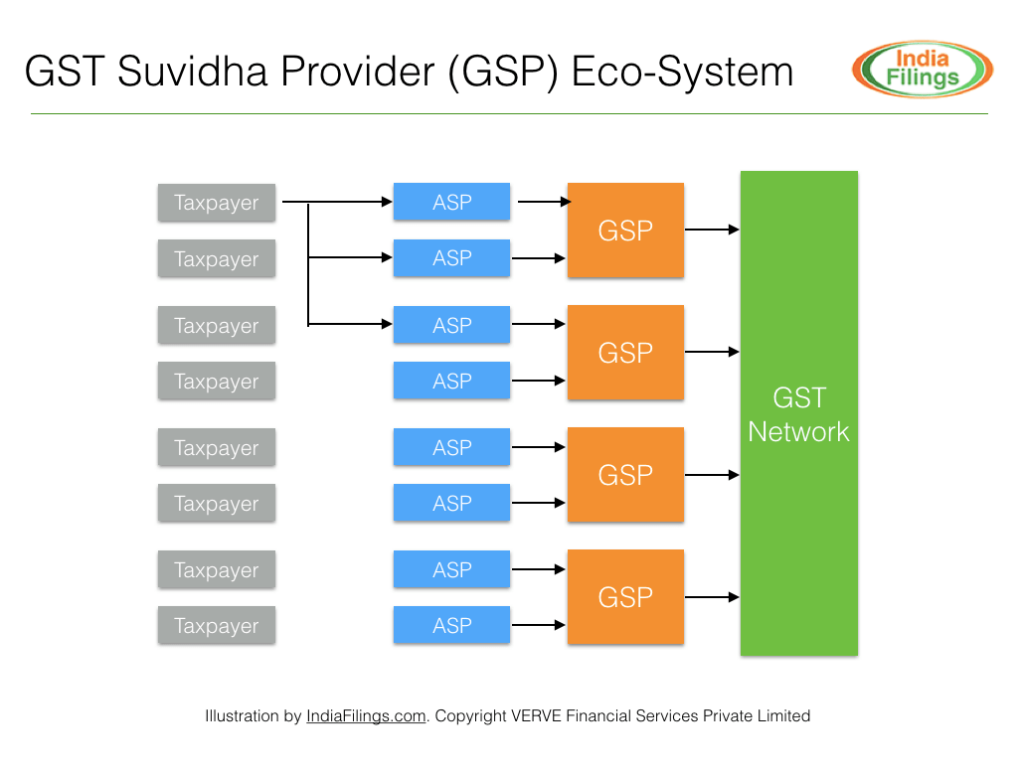 GST Suvidha Provider (GSP) Eco-System
As shown in the illustration above, GSP providers are allowed to create GST application themselves or allow third-party application developers to access the GSTN through them. Also, taxpayers are free to choose Application Providers or GSP of his/her choice, irrespective and independent to the other. Thus a taxpayer can choose a set of services from one GSP and the rest from other GSPs. For example, a taxpayer can obtain GST registration through one GSP or ASP, while filing GST return through another GSP or ASP.
GST Suvidha Provider (GSP) Eco-System
As shown in the illustration above, GSP providers are allowed to create GST application themselves or allow third-party application developers to access the GSTN through them. Also, taxpayers are free to choose Application Providers or GSP of his/her choice, irrespective and independent to the other. Thus a taxpayer can choose a set of services from one GSP and the rest from other GSPs. For example, a taxpayer can obtain GST registration through one GSP or ASP, while filing GST return through another GSP or ASP.
GST Suvidha Provider (GSP) License - Eligibility Criteria
Companies registered in India in the Information Technology, Information Technology Enabled Services, Banking, Financial Services and Insurance sector are eligible for a GSP license. All GST Suvidha Provider applicants must meet strict eligibility criteria. GSP applicants meeting the eligibility will be required to sign a contract with GSTN to become an authorised GSP. After signing the contract, the GST Suvidha Provider gets a unique license key for accessing the GST system.
GSP License: Batch 1 - Eligibility Criteria
The first set of GST Suvidha Providers shall meet the following standards for obtaining GSP license:
Financial Strength
- Paid-up or Raised capital of at least Rs.5 crores and
- Average turnover of at least 10 Crores during the last 3 financial years
Demonstration of Capabilities
- Invoice upload by taxpayers
- GST Return #1 and #2 preparation and filing
- Reconciliation of downloaded GSTR2 with Purchase Register
- Multiple GSTIN Ids mapped to a single user account
- Multiple roles mapped to single GSTIN
- E-sign / DSC integration for the signing of returns
- UI / UX
- Mobile interface
- Alert generation to taxpayers
- Security design
Technical Capabilities
- Backend infrastructure, such as servers, databases etc., required specifically for the purpose of GSP work shall be based in the territory of India,
- IT Infrastructure owned or outsourced to carry out a minimum of 1 Lakh GST transaction per month,
- Data Privacy policy to protect beneficiary privacy, and
- Data security measures as per the IT Act.
GSP License: Batch 2 - Eligibility Criteria
Following the onboarding of the First Batch of GST Suvidha Providers, the GSTN relaxed the eligibility criteria and invited the second batch. The following details the revised eligibility criteria:
Financial Strength
- Paid-up or Raised capital of at least Rs.2 crores and
- Average turnover of at least 5 Crores during the last 3 financial years (2014-15, 2015-16, 2016-17)
- For the Financial year (FY) 2016-17, the taxpayer may quote unaudited results, duly authenticated by the Company Secretary to follow up the audited and signed balance sheets. The taxpayer shall also share the relevant page of audited balance sheet of the earlier years.
Demonstration of Capabilities
- Invoice upload by taxpayers
- GST Return #1 and #2 preparation and filing
- Reconciliation of downloaded GSTR2 with Purchase Register
- Multiple GSTIN Ids mapped to a single user account
- Multiple roles mapped to single GSTIN
- E-sign / DSC integration for the signing of returns
- UI / UX
- Mobile interface
- Alert generation to taxpayers
- Security design
- Technical Capability of GSP (Handling Large Load, Experience in handling large application, Managing Sizable Application Infrastructure, Experience in developing complex application etc.)
Technical Capabilities
- Backend infrastructure such as servers, databases and others required specifically for the purpose of GSP work shall be based in the territory of India,
- IT Infrastructure owned or outsourced to carry out a minimum of 1 Lakh GST transaction per month,
- Data Privacy policy to protect beneficiary privacy, and
- Data security measures as per the IT Act.