
Athreya
Expert
Published on: Aug 14, 2026
GST eWay Bill Portal Blocked
The Government of India has introduced a restriction on the generation of
e-way bills. The restriction applies to assessees who have defaulted in filing GSTR-3B for two months. With effect from 01.12.2019, assessees who have not filed GSTR-3B for two months in succession will not be able to generate an e-way bill. For example, assessees who have not filed GSTR-3B for December and January will be blocked from generating an e-way bill from February onwards. The e-way bill generation portal will not allow the GSTIN of defaulting assessees to be submitted on the online platform. When the assessee is disabled from generating the e-way bill, this is called ‘blocking’ of the e-way bill. An e-way bill is a document which authenticates the movements of goods. An e-way bill should be issued whenever there is a conveyance of goods for more than Rs.50,000. The e-way bill is an indication that the movement of goods is taking place with the knowledge of the government. The government has introduced the blocking to reduce instances of tax-evasion and to ensure better accountability. The blocked e-way bill platform can be released by filing the pending GSTR-3B returns. Release of a blocked e-way bill platform is known as ‘unblocking’.Applicability
The blocking is done irrespective of whether the assessee is a supplier, recipient or transporter. Once the GSTIN of the assessee is blocked, the generation of the e-way bill is not possible until the pending GSTR-3B returns are filed. When a GSTIN is blocked, the e-way portal will not accept the GSTIN. In such cases, the GSTIN will be rejected in all the fields on the portal. Thus, the three parties, supplier, recipient and transporter, will not be able to generate an e-way bill with the defaulting party’s GSTIN. The e-way bills which are already generated are not affected by the blocking. Further, the assessee is allowed to update the details of the transporter in the e-way bills that are already generated. However, if the transporter is also blocked, updating of transporter details is not possible.
Unblocking
For unblocking the e-way bill facility, at least fifty per cent of the pending GSTR-3B returns should be filed. Unblocking is possible only if there is no instance of ‘consecutive default’. Consecutive default means failure to file GSTR-3B two times continuously. Therefore, to unblock, the assessee should ensure that there is no consecutive default. Thus, the rule of ‘no consecutive default’ introduced by the government implies that at least half of the pending returns should be filed. After filing the relevant GSTR-3B returns, on a subsequent day, the e-way bill facility will be unblocked. If the assessee wants to unblock the e-way bill immediately after filing GSTR-3B, the following procedure should be followed:
- Access the e-way bill website and click on ‘Search’. Then click on ‘Update Block Status’.
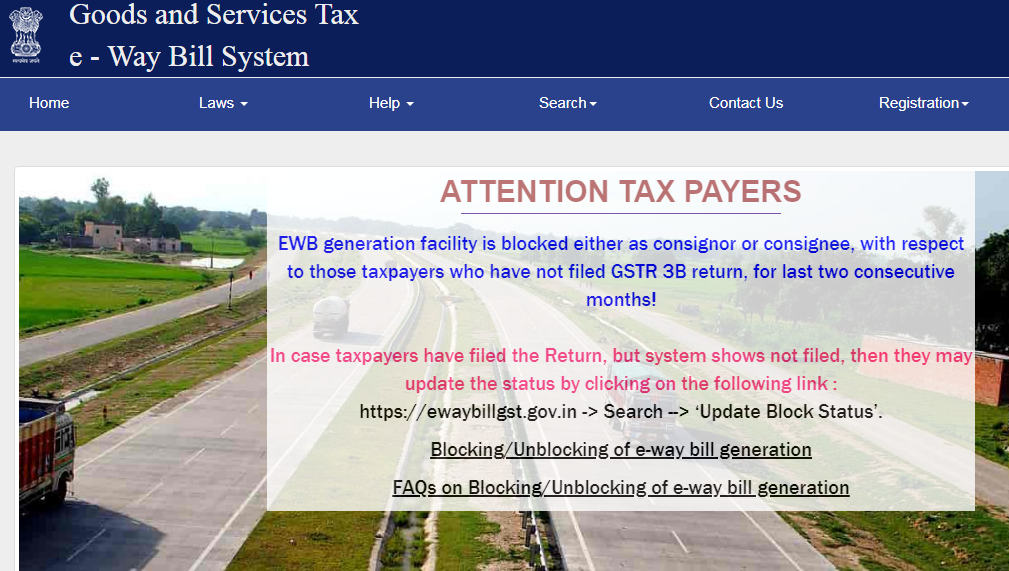 GST E-Way Bill Portal
 - Enter the GSTIN of the assessee and complete the captcha procedure. See the status of the e-way bill facility. If the status is shown as ‘Blocked’, click ‘Update’.