IndiaFilings

Expert

Published on: Jul 30, 2026

Gst Bill Of Entry

GST implementation on 1st July, 2017 will significantly change the procedure for import of goods into India.

IGST applicable on imports along with GST Compensation Cess. Further, input tax credit is also provided on the IGST charged during import. Hence, to tax all imports and provide input tax credit, GST registration would be mandatory for all importers.

Bill of Entry

Bill of Entry is a document filed by importers or customs clearance agents with the Customs Department. On arrival of good or before arrival of goods, bill of entry can be filed along with the requisite documents to initiate the customs clearance formalities. Once a bill of entry is filed, the goods are examined and assessed by proper officer of Customs. Basics customs duty, IGST and GST Compensation Cess must then be paid by the importer to clear the goods through customs. If bill of entry is not filed within 30 days of arrival of goods at a customs station, then the cargo can be auctioned by the authorities. A request for extension for filing of bill of entry can also be filed by importers within 30 days of the goods arriving in India, under special cases.

HSN Code for GST

GST uses HSN code for classification of goods and levy of tax. Since HSN code is already used by the Customs Department and is an internationally accepted methodology for tracking goods in the course of international trade.

Changes to Bill of Entry under GST

Once GST is implemented, the bill of entry format would change as GSTIN of the importer must be mentioned on the document. In case GSTIN is not available, provisional GSTIN can be used. Based on the GSTIN, input tax credit would be provided to the importer for IGST and GST Compensation Cess paid during import. However, input tax credit would not be provided for the basic customs duty paid on the import.

Bill of Entry Format - Warehousing

The new Gst Bill Of Entry format for warehousing is as under: Bill of Entry - For Warehousing

Bill of Entry Format - Home Consumption

The new Gst Bill Of Entry format for home consumption is as under:
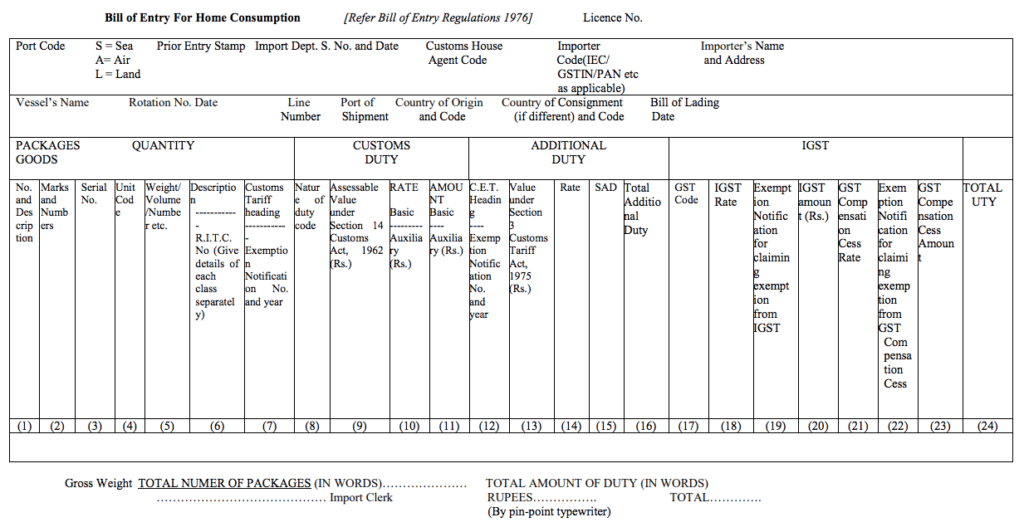
Bill of Entry - For Home Consumption Bill of Entry - For Home Consumption

Bill of Entry Format - Ex-Bond Clearance

The new Gst Bill Of Entry format for ex-bond clearance is as under
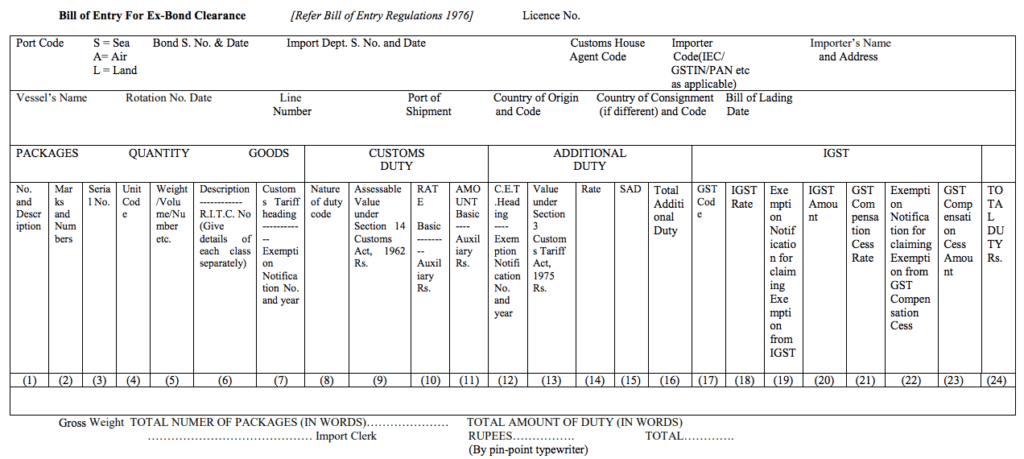
Bill of Entry - Ex Bond ClearanceBill of Entry - Ex Bond Clearance
Back to Learn

Frequently Asked Questions

Common questions about GST Bill of Entry for Import of Goods in India.

A Bill of Entry is a document filed by importers or customs clearance agents with the Customs Department. It is required to initiate customs clearance formalities for goods being imported into India. Under GST, the Bill of Entry format has been modified to include the importer's GSTIN for claiming input tax credit on IGST and GST Compensation Cess paid during import.
Yes, GST registration would be mandatory for all importers to claim input tax credit on IGST and GST Compensation Cess paid during import. The importer's GSTIN needs to be mentioned on the Bill of Entry for claiming the input tax credit.
A Bill of Entry must be filed within 30 days of the arrival of goods at a customs station. If it is not filed within this time frame, the cargo can be auctioned by the authorities. However, importers can request an extension for filing the Bill of Entry within the 30-day period under special cases.
The HSN (Harmonized System of Nomenclature) code is used for the classification of goods and the levy of tax under GST. Since it is already used by the Customs Department and is an internationally accepted methodology, the HSN code is mentioned on the Bill of Entry for the purpose of tracking goods in the course of international trade.
No, input tax credit cannot be claimed on the basic customs duty paid during import. Input tax credit is provided only for the IGST (Integrated Goods and Services Tax) and GST Compensation Cess paid on the imported goods.
The new GST Bill of Entry formats differ based on the purpose of import. The format for warehousing is used when goods are imported and stored in a warehouse, the home consumption format is for goods imported for domestic use, and the ex-bond clearance format is for clearing goods from a warehouse for domestic consumption.
Yes, if the importer does not have a regular GSTIN at the time of filing the Bill of Entry, a provisional GSTIN can be used. This allows the importer to claim input tax credit on IGST and GST Compensation Cess paid during import.
The components of tax paid during import under GST are Basic Customs Duty, IGST (Integrated Goods and Services Tax), and GST Compensation Cess. While input tax credit can be claimed on IGST and GST Compensation Cess, it cannot be claimed on the Basic Customs Duty.
Under GST, the importer or customs clearance agent files a Bill of Entry with the Customs Department, mentioning the importer's GSTIN. The goods are then examined and assessed by the proper officer of Customs. The importer must pay the Basic Customs Duty, IGST, and GST Compensation Cess to clear the goods through customs. Input tax credit is provided on IGST and GST Compensation Cess based on the GSTIN mentioned on the Bill of Entry.
If the Bill of Entry is not filed within 30 days of the arrival of goods at a customs station, the cargo can be auctioned by the authorities. However, importers can request an extension for filing the Bill of Entry within the 30-day period under special cases, subject to approval.