
IndiaFilings
Expert
Published on: Jul 30, 2026
GST Advantages for Startups and Small Businesses
The Lok Sabha passed the Goods and Services, Tax-GST Bill, on 6th May 2015. The advantages of GST are the ease of doing business and tax structure. The concept of GST mooted and evolved in India for over a decade now. With the GST Bill passing the Lok Sabha, it is now slated to be presented to the Rajya Sabha. Once cleared by the Rajya Sabha, the Bill would set in motion the rollout of GST in April 2016. The passing of the bill shall transform India's indirect taxation system. In this article, let us review some of the major advantages of GST. In addition, the article also covers the implementation of GST in India for startups and small businesses.
https://twitter.com/IndiaFilings/status/595887073963290624
GST Overview
Goods and Services Tax (GST ) acts as a value-added tax. It applies to all points in the supply chain with credit allowed for any tax paid on inputs for making the supply. Therefore, the end consumer shall bear the tax as the last person/entity in the supply chain. The expectation of introducing GST in India shall result in major simplification of the indirect tax structure. The tax structure applies to both Centre as well as State levels. Furthermore, it shall also replace multiple layers of complex taxation that currently exist in India.
GST will Improve Ease of Starting a Business in India
Any individual/entity establishing a new business in India shall apply for VAT registration. The individual/entity can apply from the State's Sales Tax department for VAT registration. But each State processes VAT with different procedures and fees. Hence, businesses may find it difficult to operate in multiple States. Further many might also have difficulties in obtaining and maintaining compliance with VAT regulations.
With the implementation of GST in India, the procedure for GST registration shall become centralised and also standardised. It shall remain similar to the service tax registration. Under the GST regime, the business would no longer have to obtain multiple VAT registration. As a single GST registration applies across India. Therefore, the procedure for obtaining GST registration would also become standardised. Thereby improving the ease of starting a new business in India without any difficulties.
Integration of Multiple Taxes in GST
Currently, the State Government implements the VAT for the goods and products availed. However, the services are taxed under the service tax regimen as implemented by the Central Government. As State Government implements the VAT each of the State has different VAT rates. Further, it also differs in VAT regulations and VAT procedures leading to complications. In addition to VAT and Service Tax, the businesses must comply with other various other tax regulations. Other taxes include Central Sales Tax (CST), Additional Customs Duty, Purchase Tax, Luxury Tax and others.
Under the GST regime, many of the taxes in existence today shall become subsumed and made into one tax. The following taxes are proposed to be subsumed under GST:
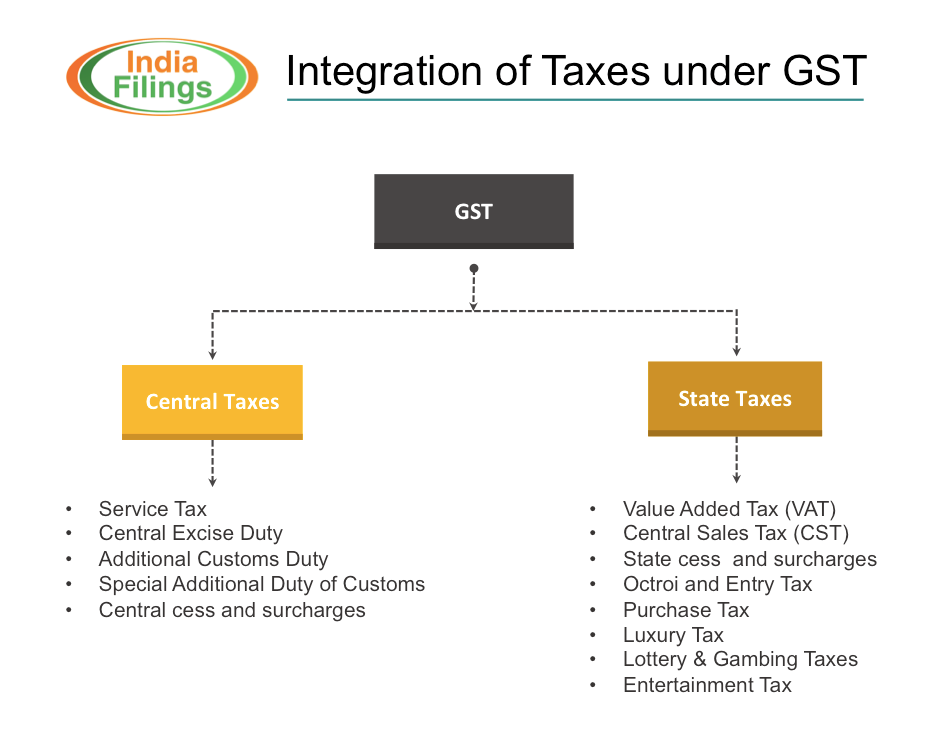 Integration of taxes under GST
Central Taxes subsumed under GST
- Central Excise Duty (including additional excise duties)
- Service tax
- Additional customs duty (CVD)
- Special Additional Duty of Customs (SAD)
- Central surcharges and cesses
State Government Taxes subsumed under GST
- Value Added Tax
- Central Sales Tax
- Octroi and Entry Tax
- Purchase Tax
- Luxury Tax
- Taxes on lottery, betting & gambling
- State cesses and surcharges
- Entertainment tax
GST Exemption for Startups and Small Businesses
Currently, VAT registration and VAT payment remain mandatory for all the business operating within and between states. It also applies when the annual turnover crosses Rs.5 lakh in some States and Rs.10 lakh in other States. The multiple VAT legislation enacted by each State created confusion and complexities. Hence GST focuses on reducing complexities. Thus, after GST enrollment, businesses shall not apply for GST if the turnover results in less than Rs.10 lakh p.a. These business entities shall not collect GST either.
Further, businesses with an annual sales turnover of Rs.10 lakhs to Rs.50 lakhs may have to pay GST only at a lower rate. Therefore, after GST, thousands of startups and small businesses currently having an annual sales turnover from Rs.5 lakh to Rs.10 lakh would be out of the tax net providing relief to them from collection and filing of GST returns.
GST will Improve Ease of Doing Business in India
Currently, businesses like restaurants or computer sales and service - which sell goods and provide services as a package have to comply with both VAT and Service Tax regulations. This creates complexity for the business and they have to calculate taxes for the transaction based on different rates for different items. With the introduction of GST, the distinction between Goods and Services will be gone - thereby making compliance easier. Further, invoicing will be easier for businesses as only one rate would be adopted.
To know more about GST in India, visit IndiaFilings.com