
IndiaFilings
Expert
Published on: Jul 30, 2026
ESOP in Private Limited Company
The popularity of Employee Stock Options in India has grown in recent times with the emergence of a vibrant startup ecosystem in India. Today, high-performance employees expect more than just a salary from their employers and this change in mindset has been leveraged by startups to attract and retain good talent. Employee Stock Option Plans (ESOP) or Employee Stock Option Schemes (ESOS) are great tools to build a talented team which is critical for success in business today. In this article, we look at the basics of Employee Stock Options in Private Limited Company.
Employee Stock Option Plan (ESOP)
Employee Stock Option Plan (ESOP) is the option provided to employees of a company to purchase the shares of the company at a future date at pre-determined prices. ESOPs, give the employee a right to purchase the share, but not an obligation, to buy a certain amount of shares in the company at a predetermined price for a certain number of years.
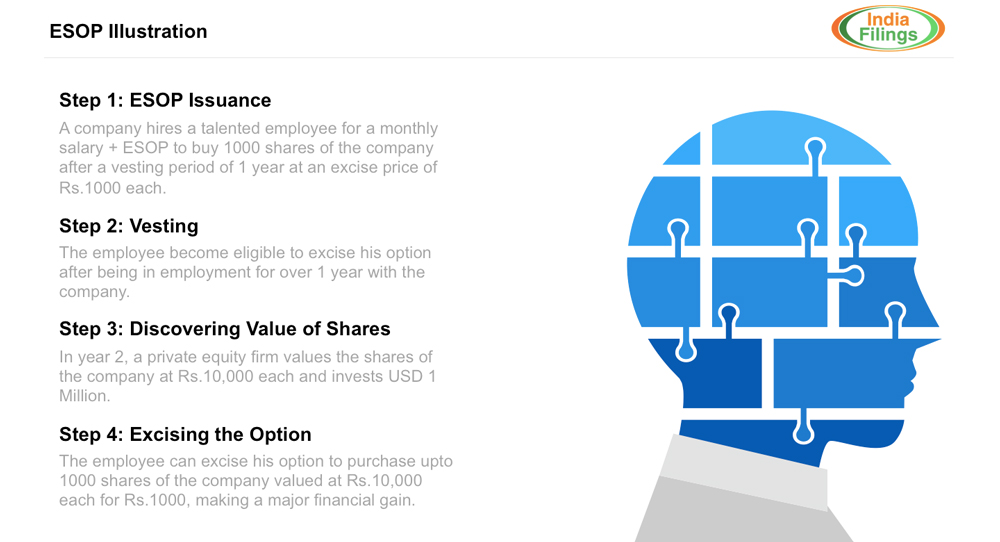 ESOP Illustration
It is important to keep these three important points in mind while planning for an ESOP:
ESOP Illustration
It is important to keep these three important points in mind while planning for an ESOP:
- ESOP gives the employee an option or right to buy the shares of the company at a pre-determined price. It is NOT an obligation. Therefore, if the shares of the company are valued at less than the option excise price, then the employee need not excise the right to buy the shares of the company.
- ESOP has an ESOP excise price - the pre-determined price at which the shares of the company can be purchased by an employee at a future date.
- ESOPs have a Vesting Period and Vesting Percentage. The vesting period is the amount of time the employee needs to work with the company to be eligible for the ESOP.
- ESOPs have an excise period - the pre-determined period within which the option must be excised by the employee.
Why ESOP are Important?
Offering ESOPs continue to be a great way for startups to recruit high performers on their teams. The idea behind providing ESOPs to employees is to align the interest of the employee(s) with the interest of the shareholders of the company. Shareholders show their interests in maximizing the value of their shares by improving the financial and operational performance of the company. Therefore by providing ESOPs to employees, they are also rewarded when the stock price increases thereby making the shareholder and employee(s) strive towards the same goal.
Offering ESOP in Private Limited Company
The following rules are applicable for offering ESOP in a Private Limited Company in India:
- ESOP can be provided to employees, as defined below:
- A permanent employee of the company who has been working in India or outside India; or
- A Director of the company, whether a whole-time director or not, but excluding independent director; or
- An employee in India or outside India, or of a holding company of the company or an associate company.
- ESOP cannot be offered to an employee who is a promoter or a person belonging to the promoter group or a Director who either himself or through his relatives or through any body corporate, directly or indirectly, holds more than 10% of the outstanding equity shares of the company.
- The shareholders of the company must approve the ESOP plan on passing a special resolution with an explanatory statement.
- The company granting the ESOP will have the option to determine the exercise price of the ESOP.
- The must be a minimum period of one year between the grant of option and vesting of the option.
- The option granted to employees is not transferable to any other person.
- Each year the Board of Directors in the Directors Report must report the details of the ESOP plan.
- The company must maintain an ESOP Register and maintain information about the option granted to employees.