

RENU SURESH
Expert
Published on: Aug 12, 2026
Employment Agreement : Meaning, Key Clauses, Types, Drafting Steps & Template
An employment agreement, often referred to as an employment contract, is an essential document for businesses across all sectors. It sets clear expectations for employees regarding their roles, responsibilities, and workplace conduct, while also helping employers minimise potential legal risks related to employment.
Before creating an employment agreement for your business, it’s important to understand its purpose, significance, and key components. Below, we explain what an employment agreement is, why it matters, and how to draft one effectively, including a sample employment agreement template to guide you through the process.
What is an Employment Agreement?
An employment agreement is a legally binding document signed by both the employee and the employer (or a labour union), outlining the rights, responsibilities, and obligations of each party throughout the employment period. This agreement helps ensure mutual understanding and sets clear expectations for the working relationship.
A typical employment agreement includes:
- Duration of employment (if applicable)
- Salary or wages
- General job duties and responsibilities
- Work schedule
- Employee benefits
- Confidentiality clauses
- Non-compete provisions
- Severance terms (if applicable)
- Termination conditions
Employment Agreements are usually signed after the job offer has been accepted and before the employee begins work, often on or before the first day of employment.
Why is an Employment Agreement Important?
A well-drafted employment agreement provides clear advantages for both employers and employees. Here's why it's important:
- Clarifies Job Responsibilities: It clearly outlines the duties and expectations associated with the role, preventing misunderstandings.
- Defines Legal Rights: Both parties understand their rights, obligations, and the terms under which the employment is governed.
- Provides Job Security: Employees gain a sense of stability knowing the terms of their role, compensation, and termination procedures.
- Protects Business Interests: Confidentiality, non-disclosure, and non-compete clauses help safeguard proprietary information and prevent unfair competition.
Overall, an employment agreement establishes a solid legal foundation for a professional relationship built on mutual understanding and accountability.
Benefits of Employment Agreements
Creating an employment agreement for each new hire offers several advantages for both employers and employees. Here are some key benefits:
- Employment Agreements are legally binding, providing clarity and protection for both parties. This reduces the likelihood of future legal disputes.
- They clearly define what is expected of employees, as well as the consequences of failing to meet those expectations.
- The section outlining paid time off (PTO) helps manage overtime and holiday pay, giving employers greater control and helping employees understand their entitlements upfront—ultimately saving the business time and money.
If your business handles sensitive or proprietary information, a confidentiality clause within the agreement can prevent employees from disclosing or misusing that information.
Who Needs an Employment Agreement?
Employment Agreements are essential for many roles and situations, helping establish clarity and legal protection for both employers and employees. Here's who typically needs one:
- Employers, HR Managers, and Recruiters: These professionals should provide Employment Agreements to new hires, internal transfers, or employees taking on new roles.
- Senior-Level Employees: Executive or high-level roles often involve negotiated agreements reviewed by legal counsel on both sides to define compensation, duties, confidentiality, and exit terms.
- Unionized Employees: Contracts are critical for both public sector employees (e.g., teachers) and private sector union members (e.g., manufacturing workers), often as part of collective bargaining agreements.
Additionally, an employment agreement is especially useful when:
- The employee holds sensitive or confidential information.
- The employee’s role is critical or the individual would be hard to replace due to experience or specialized skills.
- The employer wants to clearly define expectations, compensation, or post-employment restrictions like non-compete clauses.
While not every job legally requires an agreement, having one in place helps prevent misunderstandings and strengthens the working relationship.
Main Clauses and Terms of an Employment Agreement
Here are the Main Clauses and Terms of an Employment Agreement
Parties
Identifies both the employer and the employee who are entering into the agreement. Both must sign for the contract to be valid.
Location of Work
Specifies the physical or remote location where the employee will perform their duties.
Effective Date
The date the agreement becomes effective, typically the employee's joining date.
Working Hours and Job Timings
Clearly defines the daily/weekly work hours, shift details, and expectations regarding overtime.
Job Description
Outlines the employee's key responsibilities, tasks, department, reporting manager, and reference to the offer letter if applicable.
Legal Policy / Leave Policy
States the annual entitlement to paid leaves, public holidays, and the company’s leave management rules.
Probationary Period
Defines the duration and terms of probation. Usually not exceeding 6 months or half of the contract duration for fixed-term roles.
Remuneration
Details the employee's gross salary, any deductions (e.g. tax, insurance), and the payment schedule/method.
Notice Period
Specifies the required notice duration for resignation or termination and whether compensation is due in case of early termination without cause.
Arbitration Clause
Provides for the resolution of disputes through arbitration before legal proceedings, ensuring both parties agree on how disputes will be handled.
Duration of Employment
Indicates whether the job is permanent, contractual, or for a fixed term. Renewability may also be mentioned.
Termination Clause
Defines conditions under which either party may terminate the agreement, including misconduct, performance, or business needs.
Non-disclosure and Confidentiality
Prevents employees from disclosing sensitive company information to outsiders or competitors during and after employment.
Intellectual Property Rights (IPR)
Clarifies that any creations, inventions, or business data developed using the company’s resources belong to the employer.
Jurisdiction and Governing Law
Identifies the court and legal system that will resolve disputes. This is important due to variations in employment laws across different states.
Non-Competition Clause
Prohibits the employee from joining competitors or starting a similar business for a specified time after leaving the company.
Also read: Employee agreement clauses and validityTypes of Employment Contracts in India
In India, employment agreements help establish a formal relationship between an employer and an employee. These agreements define the terms of employment, rights, and obligations of both parties. While Indian labour laws don’t mandate Employment Agreements in every case, they are highly recommended for legal clarity and protection.
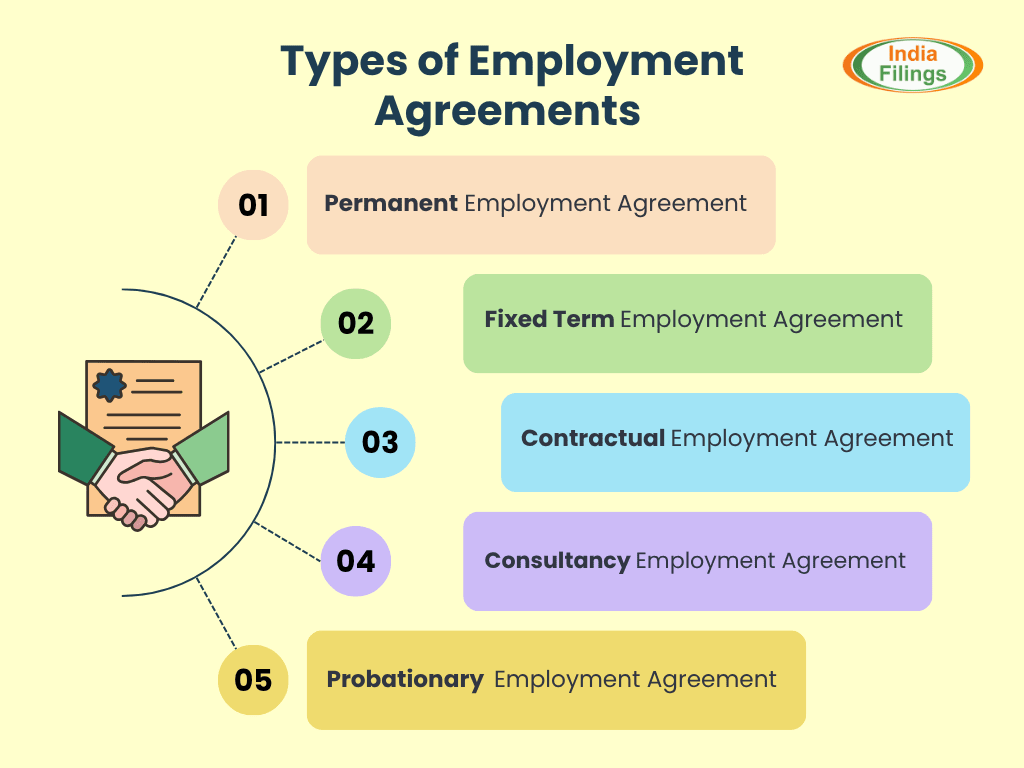
1. Permanent Employment Agreement
- Used when hiring employees for full-time, long-term roles.
- Includes salary, benefits, working hours, leave policies, termination clauses, etc.
- Offers job security and clarity on duties and entitlements.
2. Fixed-Term Employment Agreement
- Suitable for project-based or time-bound work.
- Clearly states the start and end date of employment.
- Benefits such as wages, leaves, and working conditions should match those of permanent employees (as per labour law).
- No separate termination notice is needed when the contract expires.
3. Temporary/Contractual Employment Agreement
- Used when hiring for short durations or specific tasks.
- Often through third-party contractors or agencies.
- The employee may not be entitled to the same benefits as permanent staff unless stated in the agreement.
4. Consultancy Agreement
- For hiring independent professionals or freelancers.
- Not considered an employer-employee relationship.
- Focuses on deliverables, payment terms, confidentiality, and liability.
- No PF, ESI, or other statutory benefits are applicable.
5. Probationary Employment Agreement
- Applicable when an employee is on probation (usually 3–6 months).
- Clearly mentions the probation duration, salary, and conditions for confirmation.
- Easier to terminate employment during this period if performance is unsatisfactory.
Importance of Choosing the Right Agreement
The type of employment agreement chosen should match the nature of the job. Key factors include:
- Duration of employment
- Role and responsibilities
- Legal benefits and entitlements
- Risk and liability management
Having a clear, written employment agreement in India is not only a good HR practice but also helps reduce disputes and ensures compliance with labour laws like the Shops and Establishments Act, Factories Act, and Industrial Disputes Act.
Also read: Important Terms in Employment Contract
Is a Written Agreement Necessary?
While an employment agreement does not always have to be in writing to be legally valid, having one in writing is highly recommended. A written agreement offers clear documentation of the terms both the employer and employee have agreed upon, which helps prevent misunderstandings and disputes.
Benefits of a Written Employment Agreement:
- Provides structure for the hiring process and workplace expectations.
- Clarifies rights and responsibilities for both parties.
- Offers legal protection in the event of a disagreement or termination.
- Gives employees a sense of stability and job security.
Potential Drawbacks:
- Reduces flexibility, making it harder to modify terms without renegotiation.
- May limit future negotiation, especially if conditions change.
- Can have legal consequences if either party breaches the terms.
In summary, while not strictly required by law in every case, a written employment agreement is strongly advisable for ensuring clarity, accountability, and protection for both the employer and the employee.
How to Write an Employment Agreement: Step-by-Step Procedure
Follow these steps to help you draft a clear and comprehensive employment agreement:
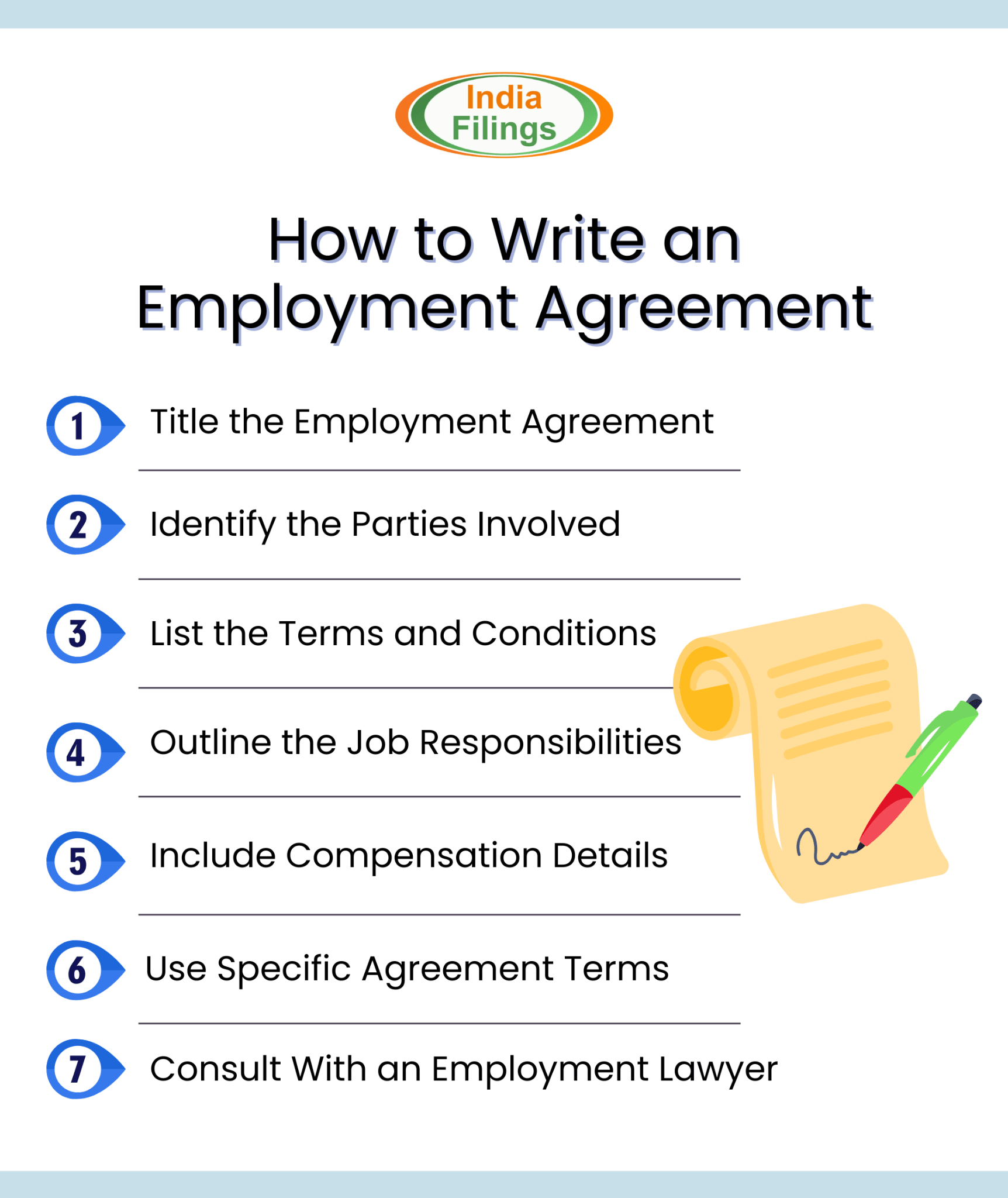
Step 1: Title the Employment Agreement
Start by giving your document a clear title so it’s immediately identifiable. Common options include “Employment Agreement” or “[Your Company Name] Employment Agreement.”
Step 2: Identify the Parties Involved
Clearly state the names of the parties entering into the agreement. Include the full legal name of your business and the employee being hired.
Example: This Employment Agreement is entered into by and between Atlas Corp. (“the Employer”) and Samuel Johnson (“the Employee”).
Step 3. List the Terms and Conditions.
Outline the specific terms and conditions of employment clearly in the agreement.
Some of these minimum terms are governed by federal and state laws, including regulations around working hours, minimum wage, and severance. Since these laws vary by jurisdiction, it’s important to review the relevant legal requirements in your state or locality.
Beyond legal obligations, you can set additional terms specific to your company. These may include:
Employee benefits (e.g., health insurance, retirement plans)
- Sick leave and vacation policies
- Work schedule and expected hours
- Dress code or appearance standards
- Remote work or hybrid arrangements
- Disciplinary procedures
Clearly defining these details ensures that expectations are aligned from the start and helps prevent future misunderstandings.
Step 4. Outline the Job Responsibilities
Clearly define the employee’s main duties to help them understand exactly what’s expected in their role. This not only sets expectations but also serves as a reference for performance evaluations later on.
For a more detailed approach, you can break down each responsibility by percentage to reflect the time or focus it requires. For example, if you’re hiring a Customer Service Representative, you might structure the responsibilities like this:
- 70% – Responding to customer inquiries, complaints, and support requests
- 20% – Coordinating with managers to enhance the overall customer experience
- 10% – Maintaining cleanliness and organisation on the sales floor
Providing this breakdown ensures transparency and helps the employee prioritise their tasks effectively.
Step 5. Include Compensation Details
Clearly outline the employee’s pay structure in the employment agreement to prevent any confusion about wages, especially in the first few pay periods. This section should include:
- Base salary or hourly wage and the frequency of payment (e.g., weekly, bi-weekly, monthly)
- Overtime policies, including how and when overtime pay is calculated
- Paid and unpaid holidays, specifying which days are considered paid time offPayment method, such as direct deposit or paper check
- Bonuses or incentives, including performance-based or annual bonuses, if applicable
Being transparent about compensation builds trust and helps avoid disputes over pay down the line.
Step 8. Use Specific Agreement Terms
Make sure your employment agreement includes clear and specific legal terms. These commonly include:
- Effective date – when the agreement begins
- Type of employment – full-time, part-time, temporary, or contract-based
- Notice period – how much notice either party must give to terminate the agreement
- Termination conditions – the grounds and process for ending employment
- Dispute resolution – steps for resolving conflicts (e.g., arbitration or mediation)
- Applicable law – which state’s or country’s laws govern the agreement
- Severability clause – ensures that if one part of the agreement is invalid, the rest remains enforceable
Step 7. Consult With an Employment Lawyer
Once you’ve drafted your employment agreement, it’s essential to have it reviewed by a qualified employment lawyer. Legal counsel can ensure your agreement complies with local labour laws and helps minimise potential legal risks. This step can save your business time, money, and future disputes.
Employment Agreement Template
This employment agreement, dated [Date], is entered into by and between [Company Name] and [Employee Name] of [City, State]. This agreement outlines the terms and conditions of employment and is governed by the laws of [State or District].
IN CONSIDERATION of mutual promises and obligations, the parties agree as follows:
1. Employment
The employee agrees to perform the duties and responsibilities set forth in this agreement and in their job description. The employee also agrees to comply with all company policies, procedures, and standards.
2. Position
The employee shall serve as [Position Title] and shall carry out all essential job functions and responsibilities associated with this role. Additional duties may be assigned by the employer as reasonably required within the scope of the employee's position.
3. Compensation
The employee shall be compensated at a rate of [Dollar Amount] [per hour/per year], subject to all applicable tax withholdings and deductions. Payment shall be made in accordance with the company’s standard payroll schedule.
4. Benefits
The employee will be eligible for the following benefits: [List of Benefits], which shall become available [immediately/after a probationary period of X days], in accordance with company policy.
5. Paid Time Off (PTO)
Upon completion of the probationary period, the employee will be entitled to:
- Vacation Leave: [Length of Vacation Time]
- Sick Leave: [Length of Sick Time]
- Bereavement Leave: [Length of Bereavement Time]
All leave is subject to company policies and procedures.
6. Termination
This employment relationship may be terminated by either party at any time, with or without cause, by providing written notice in accordance with the company’s notice period requirement. Final compensation will be provided in compliance with applicable labor laws.
The employment agreement template is attached for your reference.
Conclusion
An employment agreement is more than a formality—it’s a vital tool for establishing clarity, ensuring legal compliance, and fostering a healthy employer-employee relationship. Whether you’re hiring for a short project or a permanent role, having a written agreement ensures transparency and reduces the risk of future disputes.
Digital Tools for Employment Contract Management
Managing employment contracts effectively is not just about drafting strong agreements—it’s also about maintaining compliance, ensuring timely execution, and securely storing documentation. As businesses grow, these administrative tasks can become time-consuming and complex. To simplify and streamline this process, leveraging digital solutions is becoming increasingly essential.
Simplify Employment Contracts with LEDGERS
Drafting and managing employment contracts can be time-consuming and prone to legal and procedural delays. LEDGERS Employment Contract Software, developed by IndiaFilings, streamlines the entire process from creation to compliance.
Why Choose LEDGERS?
- Effortless Contract Creation: Easily create, edit, and manage employment contracts without needing legal expertise.
- eSigning & eStamping: Execute contracts quickly with built-in electronic signing and stamping features that are legally valid and compliant in India.
- Cloud Storage: All signed contracts are stored securely in the cloud for up to 8 years—perfect for audits, legal proof, and HR compliance.
- Legal Compliance: LEDGERS helps ensure contracts are aligned with Indian labour laws and documentation standards.
- Automated Notifications: Get alerts for renewals, expiries, and deadlines to stay ahead.
- System Integration: Integrates with your existing HR and payroll software for a seamless workflow.
- User-Friendly Interface: Designed to be intuitive for HR teams and business owners alike.
Whether you're a small business or a growing enterprise, LEDGERS makes employment contract management fast, secure, and legally compliant.
Frequently Asked Questions
1.Can an employment agreement be enforced in India?
The Indian Contracts Act makes no mention of an employment agreement. Nonetheless, it is allowed in India as long as it does not place any undue restrictions on the employee. According to Section 27 of the Indian Contracts Act, an agreement in restraint of commerce is void only to the extent that it restrains trade. As a result, there is no absolute restriction, and it is only meant to apply to partial limits. The employer has an exclusive right to the employee's services for the term of employment.
2.Is there any law that regulates employment?
The appropriate Shops and Establishment Act governs employment practices such as leaves, maternity leaves, working hours, and so forth. The Factories Act of 1948, the Maternity Benefit Act of 1961, the Payment of Gratuity Act of 1972, and other pertinent laws govern many elements of employment.
3.Is it necessary to get an agreement of employment notarised?
Although an employment agreement does not need to be notarized by a public notary, stamp duty must be paid on it. Because stamp duty rates fluctuate from state to state, they can be found in the schedule of the applicable Stamp Act.
4. Can Employment Agreements be executed electronically in India?
Yes, Employment Agreements can be executed electronically using digital signatures, provided they comply with the Information Technology Act, 2000. Tools like LEDGERS also offer legally compliant eSigning and eStamping features.
5. What happens if an employment agreement conflicts with labour laws?
If any clause in the employment agreement contradicts Indian labour laws, that clause will be considered void, and the applicable statutory provision will prevail.
6. Can Employment Agreements include performance-based incentives or KPIs?
Yes, Employment Agreements can specify performance metrics, bonus structures, and Key Performance Indicators (KPIs) to set expectations and reward achievements.
7. How often should Employment Agreements be reviewed or updated?
Employment Agreements should be reviewed annually or when there are significant changes in company policy, employment law, or the employee’s role/responsibilities.
8. Can the same agreement template be used for all employees?
While a standard template can be used as a base, it should be customised for different roles (e.g., executives vs. interns) to reflect specific responsibilities, compensation, and legal nuances.