
Bennisha
Published on: Aug 11, 2026
Drug License in Andhra Pradesh
The Drugs and Cosmetics Act, 1940 deals with all aspects relating to
Drug Licensein India. The provisions for Ayurvedic and Unani drugs were also later included in the Act. In this article, we look at the procedure for obtaining drug license in Andhra Pradesh in detail.
Need for the License
A drug license is a legal permit that is granted to carry out a business pertaining to drugs or cosmetics. The act covers all kinds of cosmetics including allopathic, homoeopathic, ayurvedic or Unani drugs. If a consumer suffers any side effects after using a particular drug/ medicine, the seller or the manufacturer of the drug will be held responsible. The concerned person may even have to undergo a trial in the court as per the rules laid by the Indian Penal Code (IPC).
Drug Controlling Authority
The objective of the Drugs Control Administration is to ensure, that the drugs available to people are manufactured passing the required standards, purity and strength. It is mandatory that the containers in which the drugs are manufactured mention the name of the drug and its manufacturer. The Drugs Control Administration monitors the manufacture, sale and distribution of the drugs in the State.
Implementation of the Acts
The Drug Control Administration implements the following acts in Andhra Pradesh.
The Drugs and Cosmetics Act 1940 and Rules 1945
This act is implemented to provide safe, efficacious and qualitative medicines to customers who purchase drugs and cosmetics.
The Drugs and Magic Remedies Act, 1954 and Rules, 1955
This act is implemented to prevent cheating of drugs and diseases through false claims and advertisements.
Drugs (Prices Control) Order, 2013 r/w Essential Commodities Act, 1955
This act is implemented to ensure that the drugs are sold at prices fixed by NPPA.
The A.P Narcotic Drugs and Psychotropic Substances Rules, 1986
This act is implemented to grant NDPS-1 & NDPS-2 licenses and to grant transport permits for NDPS drugs.
Administrative Functions
The Drugs and Control Administration has various functions that are broadly classified into two. They are
Enforcement Wing
The Enforcement Wing performs the various executive functions in the State.
Laboratory Wing
The Laboratory Wing performs the test and analysis of various drugs and cosmetics samples that are sent for analysis. This wing is also in charge to issue the Certificate of test and analysis.
Classification of Drug License
Drug licenses can be classified into two categories.
Manufacturing License
A manufacturing license is essential in order to manufacture allopathic or homoeopathic drugs and cosmetics. This license is issued only to the recognized industrial areas of Delhi.
Sale License
A sale license is classified into two types. They are
- Retail Drug License
- Wholesale Drug License
Documents Required
Given below are the documents that are required to apply for a retail license.
- Statutory Form 19
- State of Hyderabad fee challan of Rs.1,500
- Declaration made by the proprietor/ partner/ director/ competent people.
- Residential address proof.
- Attested copy of partnership deed made on Rs. 500 stamp paper.
- Memorandum and Articles of Association.
- Copy of list of Directors downloaded from the ROC website that is attested by the company secretary or the Managing Director
- Special declaration made by the registered pharmacist on Rs. 20 non-judicial stamp paper.
- Attested copy of Registered Pharmacist certificate, affixed with the photograph and signature of the applicant or the original has to be submitted to the Drugs Inspector at the time of inspection for approval.
- Building declaration attested but the Gazetted officer.
- Attested photocopy of the document mentioning the proof of ownership of the building owner for the premises to be licensed.
Application Procedure
There are two different application procedure to obtain a sale license and a manufacturing license.
Sale Licenses
Step 1: Log on to the websiteThe applicant has to log on to the official website.
Step 2: Click on Online Sales Licensing SystemThe applicant has to click on 'Online Sales Licensing System' option.
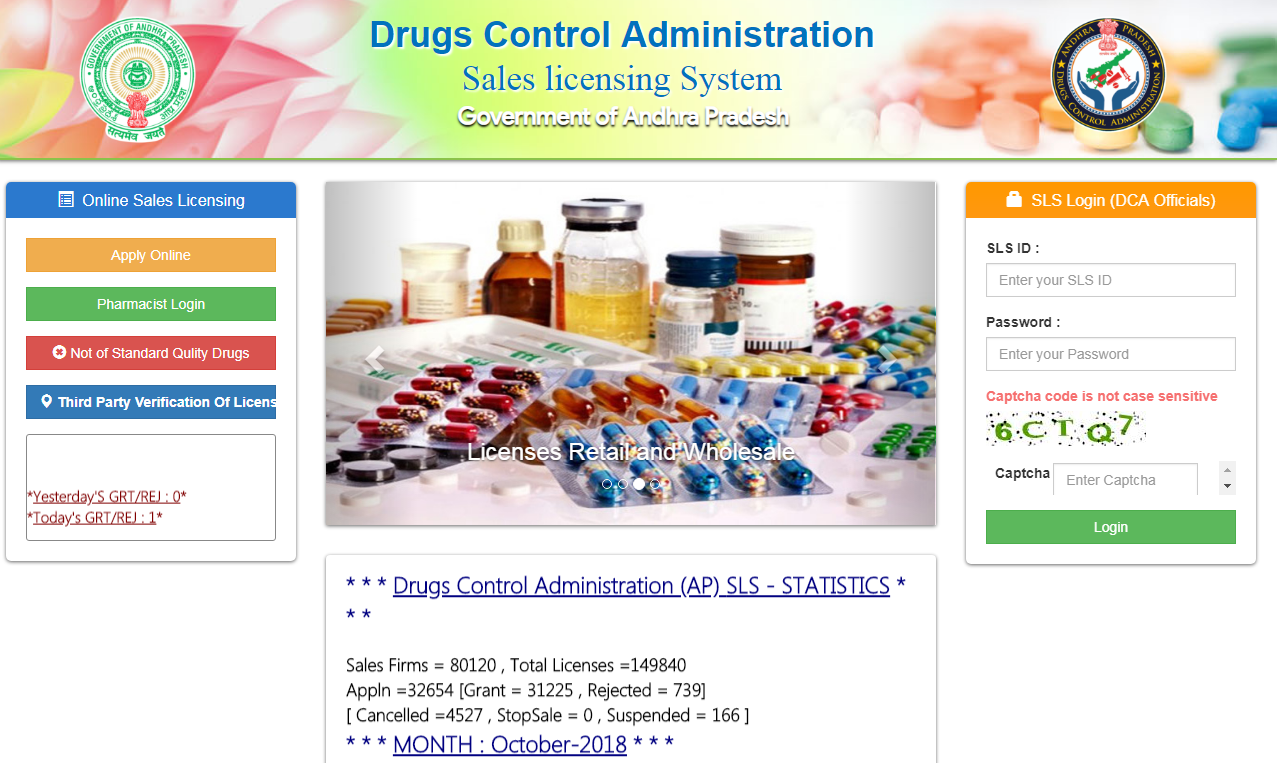
Online Portal
Step 3: Click on Online RegisterThe applicant has to click on 'Online Registration' for User Registration.
Step 4: Click on Apply OnlineThe applicant has to click on 'Apply Online' for a fresh and existing license.
Step 5: Checking the Required DocumentsThe required documents and the checklist for grant and change of premises for retails and the wholesale application appears on the screen.
Step 6: Enter the DetailsThe applicant has to enter the details including registered pharmacist, competent person and constitution.
Step 7: Fee PaymentThe applicant has to pay the required fee online.
Step 8: Receiving AcknowledgementOnce fee payment is done, the applicant receives an acknowledgement.
Step 9: Inspection and VerificationThe application is automatically sent to the concerned Drugs Inspector for inspection and verification. Given below are the aspects that are inspected to grant a license.
- The area of the outlet to verify the statutory limits.
- The storage facility that is used to stock drugs including cold storage such as racks, refrigerator, etc.
- Details of the Pharmacist and the Constitution.
Once all the inspection and verification is successfully completed, the application including the remarks and inspection is forwarded to the Assistant Director by the Drug Inspector.
Step 11: Digital Signed LicenseThe Assistant Director verifies the details online and then generates a Digitally Signed License to the applicant.
Step 12: Notifying the ApplicantThe applicant is notified about the license by sending an email. Step 13: Downloading the License The applicant can now download the approved license by logging in to the online portal.
Manufacturing Licenses
Step 1: Visit the official websiteThe applicant has to log on the official website
Step 2: Select Bulk Drugs PharmaceuticalsThe applicant has to select the sector as 'Bulk Drugs Pharmaceuticals' after providing the Common Application Form (CAF).
Step 3: Enter the DetailsThe applicant has to furnish details like Investment and Land, Plant and Machinery details etc.
Step 4: Submit the CAFOn submitting the CAF, the 'License to Manufacture Drugs' appears in the user dashboard.
Step 5: Click on License to Manufacture DrugsThe applicant has to click on the 'License to Manufacture Drugs' clearance. Upon clicking this option, the applicant has to furnish the details are mentioned in Form 24, 27 and the required affidavits.
Step 6: Fee PaymentThe applicant has to pay the required fee online.
Step 7: Receiving AcknowledgementOnce fee payment is done, the applicant receives an acknowledgement.
Step 8: Director of Drug Control AdministrationThe application is automatically sent to the login of the Director of Drug Control Administration department.
Step 9: Forwarding the ApplicationThe applicant then forwards the application to the respective IPO and the Drug Inspector verifies and inspects the application.
Step 10: Verification of the PremisesThe applicant inspects the application and also verifies the premises where the drug is manufactured. Given below are the aspects that are inspected to grant a license.
- General Requirements such as location, building, water system and disposal of waste.
- Warehouse area.
- Production area to monitor the uniform flow and logical sequence of operations.
- Ancillary areas for changing, storing and washing clothes.
- Quality control areas for physio-chemical, biological, microbiological analysis.
- Personnel with required qualifications and experience.
- Health, Clothing and Sanitation of the workers.
The Drug Inspector forwards the report online to the Assistant Director of the concerned department. The report is then verified by the Assistant Director and forwards it to the Deputy Director for approval.
Step 12: Forwarding to the Joint DirectorThe Deputy Director verifies the application and sends it to the Joint Director for approval.
Step 13: Forwarding for Final approvalOnce the Joint Director verifies the application, forwards it to the Director for final approval of the manufacturing license.
Step 14: Receiving the Auto-IntimationAfter verifying all the details, the Director approves the manufacturing license application. The applicant is notified by an auto-intimation once the manufacturing license is approved.
License Renewal
Here are the documents that are required to renew a retail and wholesale license.
- Statutory Form 19
- State of Hyderabad fee challan of Rs.1,500
- Declaration made by the proprietor/partner/ director/ competent people/ pharmacist
- Affidavit made by R.P/ C.P on Rs. 20 stamp paper
- Attested copy of registered pharmacist certificate affixed with the latest photograph and signature of the candidate
- Original drug license
- Copy of list of Directors downloaded from ROC website that is attested by the company secretary or the Managing Director