
IndiaFilings
Expert
Published on: Jul 30, 2026
Documents Required for GST Registration
All persons classified as taxable person under GST are required to obtain GST registration and begin filing GST monthly returns from the month of September 2017. In this article, we look at the list of documents required for GST registration in India.
Who Should Obtain GST Registration?
Any persons or entity providing a taxable supply of goods to persons in India with an annual aggregate turnover of more than Rs.40 lakh must obtain GST registration. In some special category states like Assam, Nagaland, Manipur and North-Eastern state, the aggregate turnover criteria reduced to Rs.20 lakh. Persons providing services need to register if their aggregate turnover exceeds Rs.20 lakh (for normal category states) and Rs.10 lakh (for special category states). Other than the aggregate turnover criteria, a person may obtain GST registration, if they undertake inter-state supply of goods or services or an existing VAT or service tax or central excise registration.
List of all criteria for obtaining GST registration is available here.GST Registration - Documents Required for Regular Taxpayers
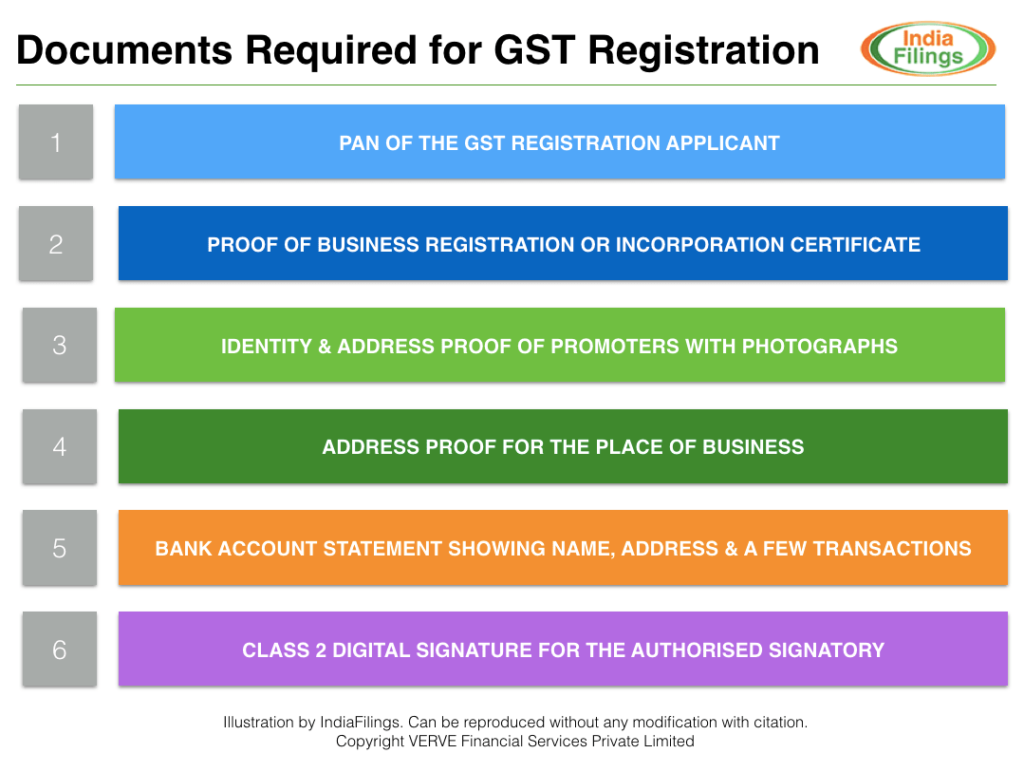 Documents Required for GST Registration
The following documents must be submitted by regular taxpayers applying for GST registration.
Documents Required for GST Registration
The following documents must be submitted by regular taxpayers applying for GST registration.
PAN Card of the Business or Applicant
All regular taxpayers shall submit the following documents when applying for GST registration. The taxpayer shall provide the details of the PAN when registering for GST; hence, all the businesses will link with PAN for taxation and legal purposes.
Identity and Address Proof along with Photographs
The following persons shall submit their identity proof and address proof along with photographs. For identity proof, documents like PAN, passport, driving license, Aadhaar card or voters identity card can be submitted. For address proof, documents like passport, driving license, Aadhaar card, voters identity card and ration card can be submitted.
- Proprietary Concern – Proprietor
- Partnership Firm or LLP – Managing, Authorized, Designated Partners (Should submit the personal details of all partners along with photos of ten Managing Partners)
- Hindu Undivided Family - Karta
- Company – Managing Director, Directors and the Authorized Person
- Trust – Managing Trustee, Trustees and Authorized Person
- Association of Persons or Body of Individuals –Members of Managing Committee (personal details of all members are to be submitted, but photos of only ten members including that of Chairman are to be submitted)
- Local Authority – CEO or his equivalent
- Statutory Body – CEO or his equivalent
- Others – Person(s) in Charge
Business Registration Document
For registration, the individuals should submit the proof of business for all types of entities. For proprietorships, there is no requirement for submitting this document, as the proprietor and proprietorship are considered the same legal entity. However, in the case of a partnership firm, the taxpayer shall submit the partnership deed. In the case of LLP or Company, the incorporation certificate from
MCA must be submitted. For other types of entities like society, trust, club, government department or body of individuals, registration certificate can be provided.Address Proof for Place of Business
The concerned individual shall provide the address proof for all the places of business mentioned for GST registration. The following documents are acceptable as address proof for GST registration.
For Own premises
Any document in support of the ownership of the premises like the latest property tax receipt or Municipal Khata copy or copy of Electricity Bill.
For Rented or Leased Premises
A copy of the valid rental agreement with any document in support of the ownership of the premises of the Lessor like Latest Property Tax Receipt or Municipal Khata copy or copy of Electricity Bill. If a rental agreement or
lease deed is not available, then an affidavit to that effect along with any document in support of the possession of the premises like copy of an electricity bill is acceptable.SEZ Premises
If the applicant operates his or her principal business in an SEZ or the applicant registered as an SEZ, the applicant shall upload all the required documents as provided by the Government.
All Other Cases
For all other cases, a copy of the consent letter of the owner of the premises with any document in support of the ownership of the premises of the Consenter like Municipal Khata copy or Electricity Bill copy. For shared properties also, the same documents can be uploaded.
Bank Account Proof
Scanned copy of the first page of bank passbook or the relevant page of bank statement or scanned copy of a cancelled cheque containing the name of the Proprietor or Business entity, Bank Account No., MICR, IFSC and Branch details including code.
Digital Signature
All application for GST registration must be digitally signed with a Class 2 Digital Signature. Hence, it is important that the digital signature is obtained for the following person who is authorized to sign the GST registration application before beginning the application process. (
Know more about Digital Signature Requirement for GST) A valid Class 2 Digital Signature is required for the following person as per the illustration below: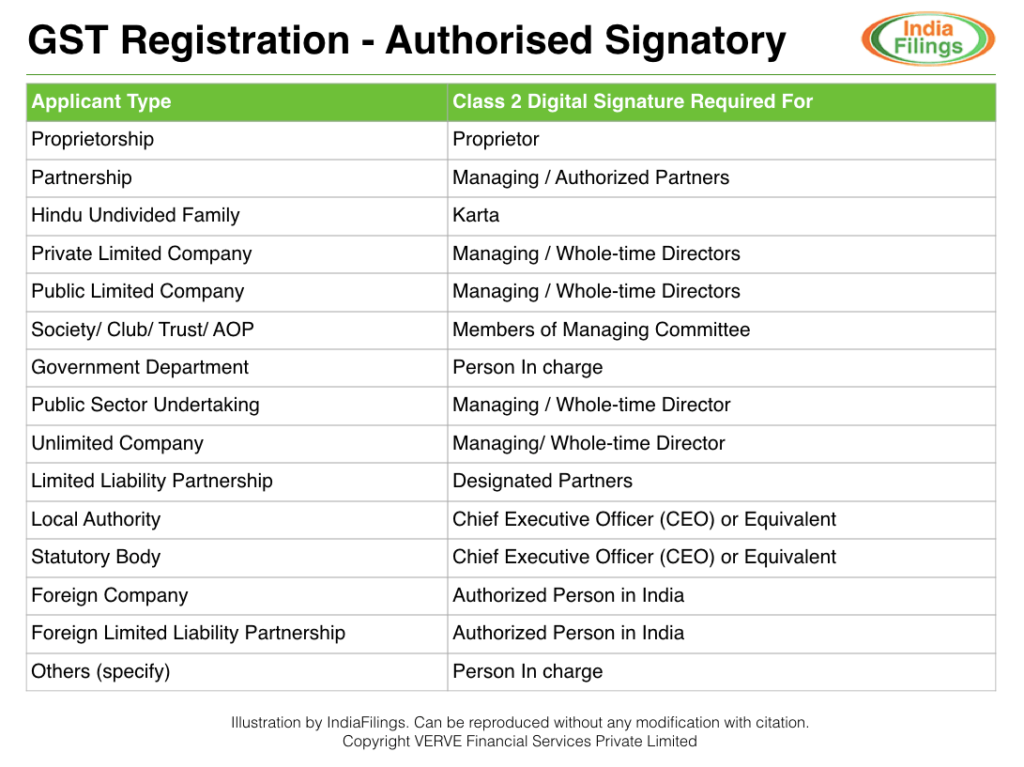 GST Registration - Authorized Signatory
Click here to register GST.