
Arnold Thomas
Expert
Published on: Aug 14, 2026
Digital Sky Platform
Remotely Piloted Aircraft Systems (RPAS) or Drones are futuristic and augment human capabilities. They could help farmers in applying fertiliser, or helping energy companies monitor their infrastructure, enabling emergency response teams (ERT) to quickly map the extent of damage after natural disasters. In future, drones could deliver packages, streamline agriculture management, reinvent human mobility (like air taxis), and even save lives (air ambulances). Therefore, Digital Sky envisages a seamless and secure technology and regulatory framework to integrate this new technology into the Indian airspace. The Digital Sky platform was launched to start registration of drones, pilots, and operators for online permission.
Digital Sky enables an approach to enforcement of safety and security guidelines by ensuring that an RPAS does not take-off without signed digital permission. The permissions are obtained via Digital Sky Service Providers (DSPs), flight logs and performance reports which are routed back to the relevant authorities via the DSPs. The Digital Sky can be extended in the future to carry out autonomous flights, automated RPAS traffic control, air taxis, air ambulances, etc.
Mission & Vision of Digital Sky
- The mission of Digital Sky is to create a completely digital, paperless, and humanless process, thus fast-forwarding to a future of on-demand seamless permissions for RPAS, operators, and pilots.
- The vision is to create a digital infrastructure that will support safe, efficient, and secure access to Indian airspace for millions of RPAS.
Methodology of Digital Sky
The Civil Aviation Regulations (CAR) has defined guidelines for safe flying of RPAS in India. The CAR guideline was drafted based on the suggestions from the RPAS operators, remote pilots/users and manufacturers/OEM for safe operations and effective use of airspace - also, the guidelines are imported to the Digital Sky Platform. Any RPAS will not be permitted to fly without permission under the policy of NoPermission-No-Takeoff (NPNT). The Digital Sky Platform also implements 'no permission, no take-off’ (NPNT) – a system of software-based self-enforcement to minimise deviations from the CAR. Hence, the potential drone owners are requested to buy NPNT-compliant RPAS. The Digital Sky platform is accepting the registration of users/operators, Unmanned Aerial Operator’s Permit (UAOP) and Unique Identification Numbers (UIN).
Registration of User/Operator
There are four different profile; a user/operator can opt for:
- Remote Pilot Profile - Registering as an individual as Pilot
- Individual Operator Profile - Registering as an Operator of RPAS
- Operator Profile - Registering as an Operator for any Organisation
- Manufacturer Profile - Registering as Manufacturer
The details of Name, address, phone number are required for registration as provided in the screen capture below.
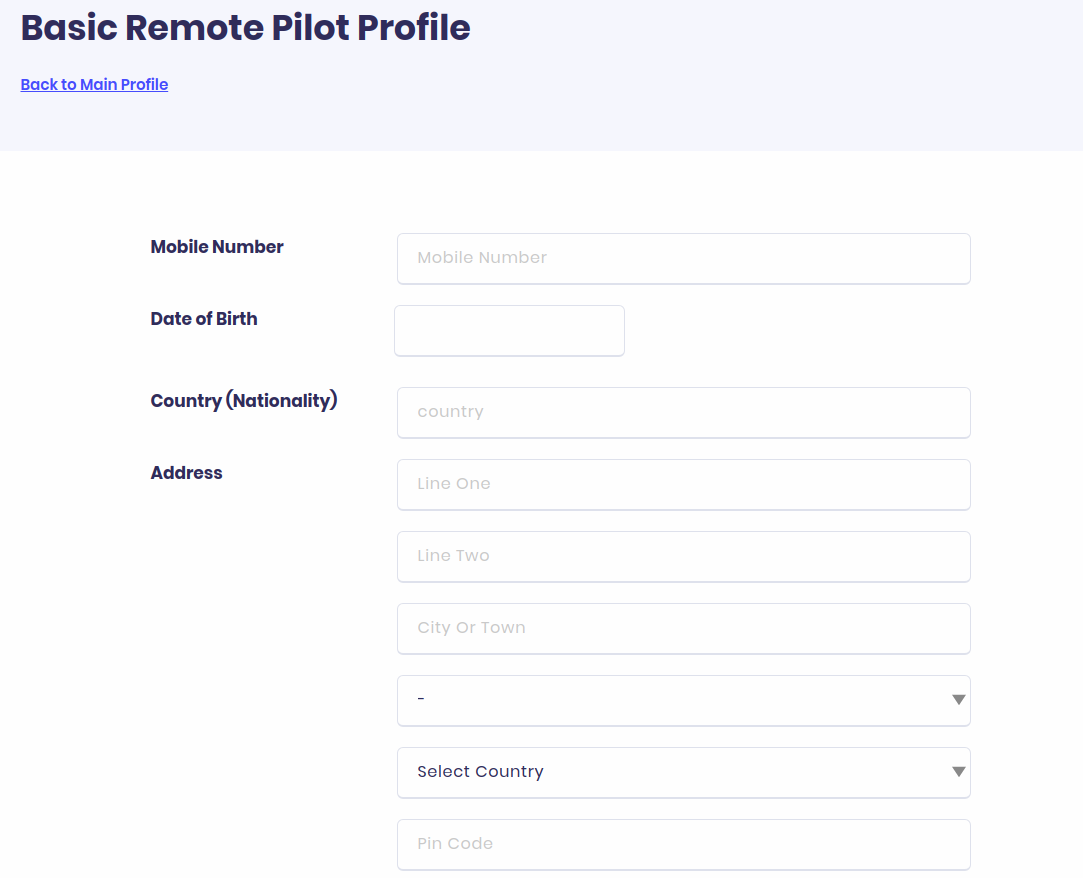 User Details
The selection of profile can be done after registration using the below window:
User Details
The selection of profile can be done after registration using the below window:
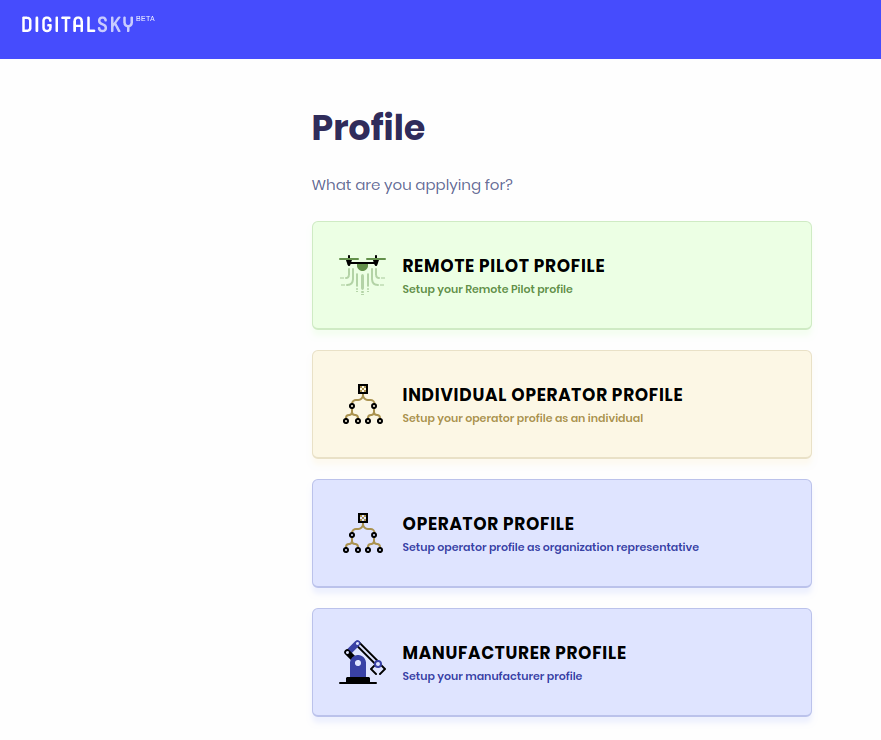 Selection of Profile
When the user opts for "Operator Profile" or "Manufacturer profile", the below window will appear in the platform:
Selection of Profile
When the user opts for "Operator Profile" or "Manufacturer profile", the below window will appear in the platform:
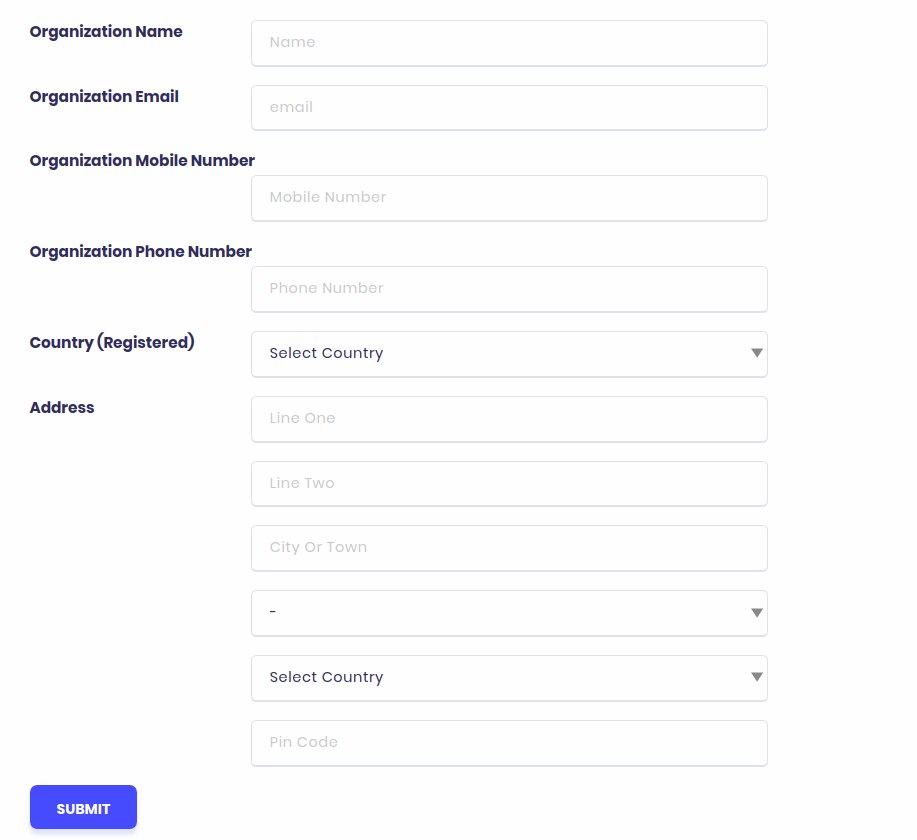 Registration of User/Operator
Registration of RPAS
There are five different categories of registration of RPAS in Digital Sky, namely:
- NANO - Less than or equal to 250 grams
- MICRO - More than 250 grams and less than or equal to 2 Kg
- SMALL - More than 2 Kg and less than or equal to 25 Kg
- MEDIUM - More than 25 Kg and less than or equal to 150 Kg
- LARGE - More than 150 Kg
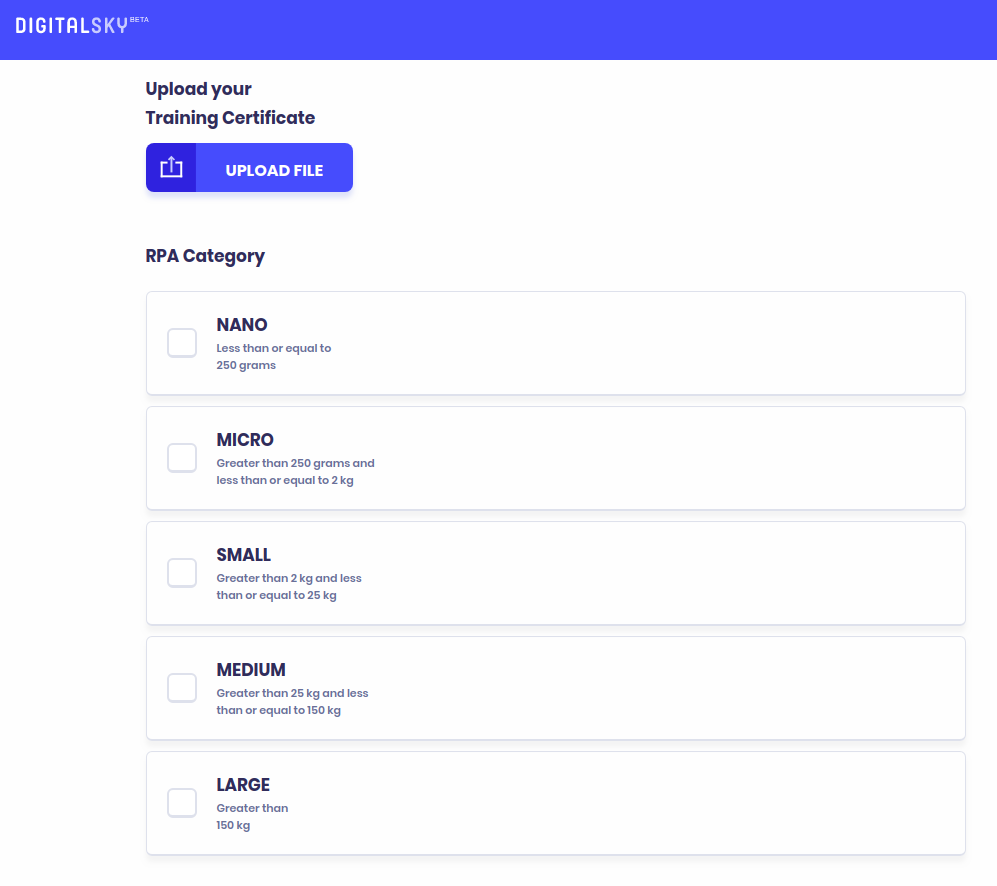 Selecting RPAS
Nano drones can be operated legally without registering on the Digital Sky Portal, but local police authorities should be informed. For micro, small, medium and large categories, operators and pilots should register and get required access on the Digital Sky Portal.
Selecting RPAS
Nano drones can be operated legally without registering on the Digital Sky Portal, but local police authorities should be informed. For micro, small, medium and large categories, operators and pilots should register and get required access on the Digital Sky Portal.
While registering for RPAS, there is a separate window categorising the nature of RPAS as mentioned below:
- Apply for Local RPA
- Apply to Import RPA
- Apply for UAOP license
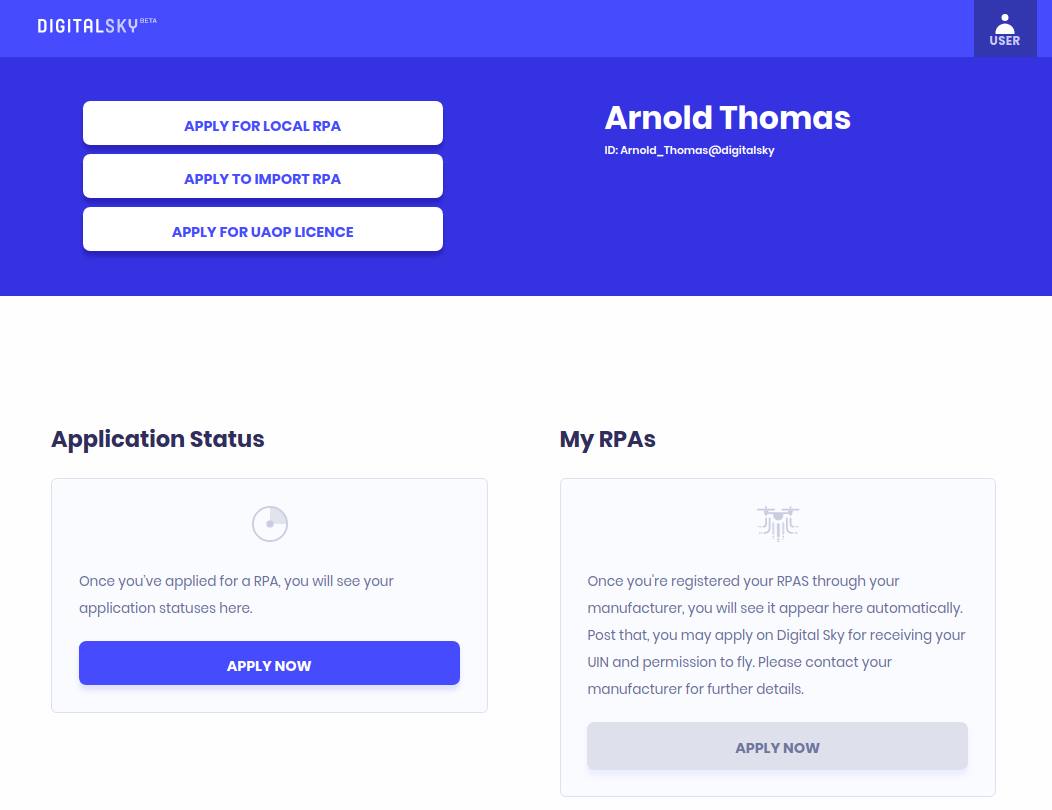 Applying for RPAS
STEP-1: On accessing the "Apply for Local RPA" or "Apply to Import RPA", the details of the registered user (based on login) appears.
STEP-2: Presently, the Civil Aviation Ministry allows only 3 models of RPAS, and they are:
Applying for RPAS
STEP-1: On accessing the "Apply for Local RPA" or "Apply to Import RPA", the details of the registered user (based on login) appears.
STEP-2: Presently, the Civil Aviation Ministry allows only 3 models of RPAS, and they are:
- LookOut VTOL RPAS
- Patang
- A200
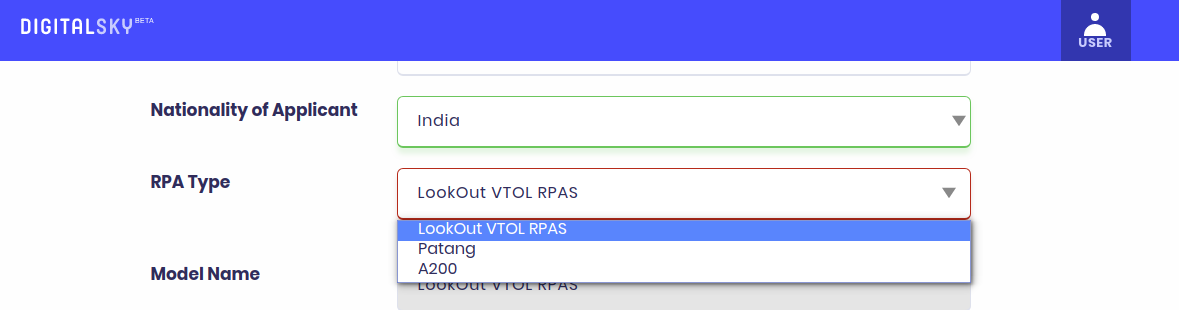 Details of RPA
When the user opts for a model, the details get prefilled based on the information by synchronising the details of manufacturers.
STEP-3: The details on purpose and mode of payment to be filled in.
On submission, the user will be notified by an acknowledgement and the application can be tracked in the portal. Once the application is verified by the Ministry of Civil Aviation, the Unique Identification Number (UIN) will be provided.
Apply for UAOP license
To apply for "Unmanned Aerial Operator’s Permit (UAOP)", the details of Program document, Insurance, Permission from Landowner, Standard Operating Procedure (SOP), Receipts through Bharat Kosh are needed as provided in the below screen capture.
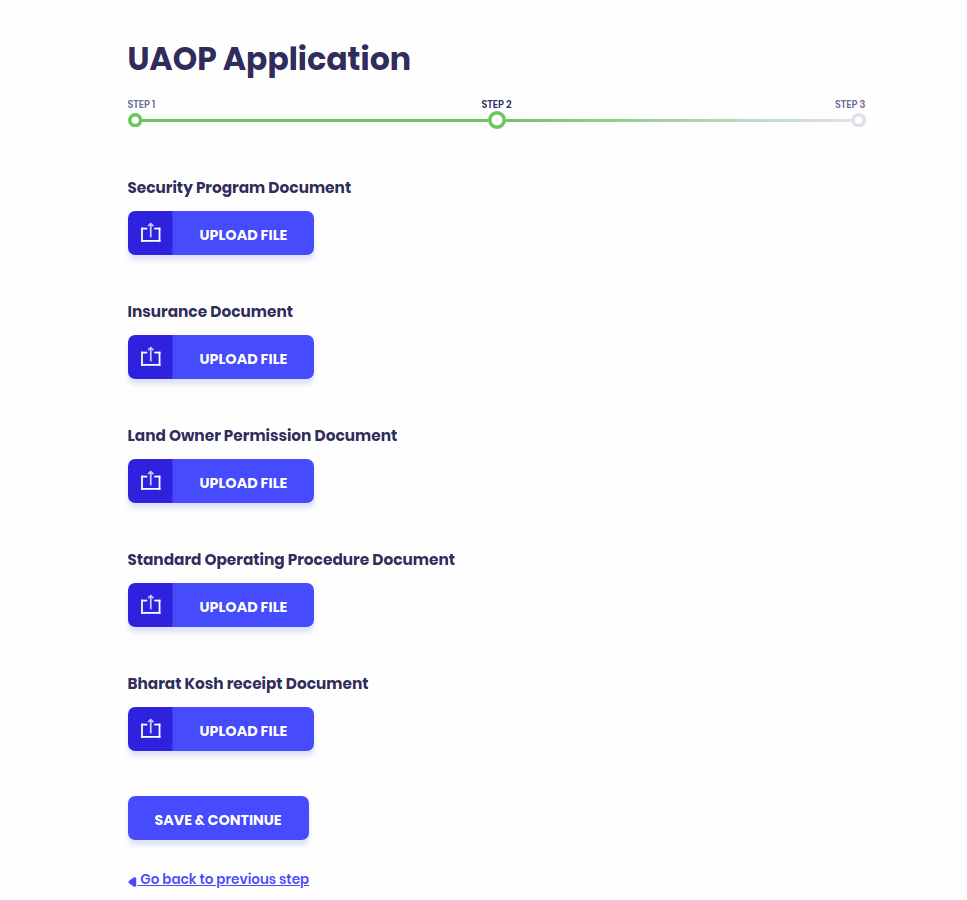 UAOP Application
Fee Structure for UIN & UAOP
- For UIN: INR 1,000
- For fresh UAOP: INR 25,000
- For Renewal of UAOP: INR 10,000
User will be prompted for payment through payment Gateway in the Digital Sky Platform. Alternatively, the link for paying the fees is /. The user has to provide the transaction reference number and should upload a copy of the payment in Digital Sky Platform at the time of applying.
RPAS operators or remote pilots have to file a flight plan to get permissions to fly. To fly in the ‘green zones’, the operator had to intimate the time and location of the flight via the portal or the App. Prior permissions are required for flying in ‘yellow zones’ and for ‘red zones’, the flights are not allowed. The ministry is under finalising the location of the restricted zones which will be announced soon.
The Digital Sky Platform is launched to evolve with the evolving needs of this rapidly changing industry. The operator and user can expect that the new & simplified procedures of flying with concern on national security aspects as well. Furthermore, it is envisioned that the Digital Sky Service Providers (DSPs) will work with Application Program Interfaces (APIs) for extending the functionality of the Digital Sky Platform.