
Isha Purohit
Expert
Published on: Aug 21, 2026
Cost Inflation Index (CII) for FY 2023-24
The Cost Inflation Index (CII) is vital in calculating long-term capital gains tax in India. It is designed to account for the impact of inflation on the cost of acquiring an asset, allowing for an adjusted purchase price for tax purposes. Each year, the Central Board of Direct Taxes (CBDT) releases the CII values, and for the fiscal year 2023-24, a specific value of 348 has been set. This article discusses the Cost Inflation Index (CII) for FY 2023-24 and various concepts relating to the same.Cost Inflation Index
The Cost Inflation Index acts as a benchmark for determining the indexed cost of acquisition and improvement, which are critical in calculating the taxable capital gains from the sale of various assets, including real estate, bonds, and equity-oriented mutual funds. By indexing the purchase price, the CII helps to adjust for the effects of inflation on the asset's value over time, resulting in a more accurate representation of the actual gains realized. CII plays a crucial role in alleviating the tax burden on individuals and entities by adjusting the purchase price of an asset to account for inflation. This adjustment leads to a reduction in taxable capital gains and subsequently lowers the tax liability. This benefit is particularly advantageous for assets held over an extended period, as inflation can significantly impact the actual gains realized upon sale. For the fiscal year 2023-24, the CBDT has set the CII at 348. This means that for assets acquired before the financial year 2001-02, the purchase price should be multiplied by the CII of 348 to arrive at the indexed cost of acquisition. Similarly, CII is also used to calculate the indexed cost of improvement if significant renovations or enhancements were made to the asset during its ownership period.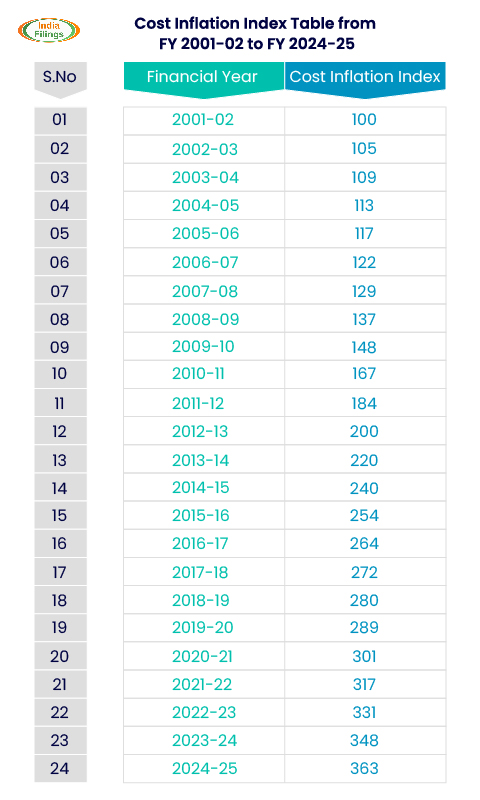
Calculating Indexed Cost of Acquisition
To calculate the indexed cost of acquisition, one must multiply the original purchase price of an asset by the CII of the year in which it was acquired and the CII of the year of sale. The resulting indexed cost of acquisition reflects the inflation-adjusted purchase price. It forms the basis for determining taxable 1Calculating Indexed Cost of Improvement
In cases where significant renovations or improvements were made to an asset during its ownership period, the indexed cost of improvement must also be determined. Similar to calculating the indexed cost of acquisition, the CII is applied to the cost of improvements made to arrive at the indexed cost of improvement. This ensures that the gains attributed to the enhancements are adjusted for inflation.Significance of CII in Long-Term Capital Gains
The Cost Inflation Index (CII) plays a crucial role in calculating India's long-term capital gains tax. It allows for the adjustment of the purchase price of an asset to account for inflation, ensuring that the taxable gains accurately reflect the real gains made. By indexing the cost of acquisition and improvement, the CII reduces the tax liability by considering the erosion in the asset's value over time due to inflation. This indexation benefit encourages long-term investments, promotes fairness in tax assessments, simplifies tax calculations, and supports economic growth. The CII is a valuable tool for ensuring more equitable and accurate taxation of long-term capital gains, benefiting taxpayers and the overall economy.Concept of Base Year in Cost Inflation Index
In the context of the CII, the base year is a reference point against which the inflationary changes in the cost of assets are measured. It serves as a benchmark for indexing the purchase price of an asset and determining its adjusted value for tax purposes. The government typically fixes the base year or the tax authorities and remains unchanged for a certain period of time. The base year for the CII in India is 2001-02. The CII value for the base year is defined as 100. All subsequent CII values are calculated relative to this base year value. Using the base year as a starting point, the CII captures the changes in the cost of assets due to inflation over time. Each year, the CII value is revised and updated to reflect the inflationary impact on asset prices. The CII values for the subsequent financial years are derived by considering the inflation rates and economic factors prevalent during those periods. The base year concept in the CII allows for the adjustment of the purchase price of an asset to account for inflation since the base year. This enables taxpayers to calculate the indexed cost of acquisition and improvement by multiplying the original purchase price by the CII values of the year of acquisition and the year of sale or improvement.CII for various financial years
CII for various financial years is available for reference from the table below.
| Financial Year | Cost Inflation Index (CII) |
|---|---|
| 2001-02 | 100 |
| 2002-03 | 105 |
| 2003-04 | 109 |
| 2004-05 | 113 |
| 2005-06 | 117 |
| 2006-07 | 122 |
| 2007-08 | 129 |
| 2008-09 | 137 |
| 2009-10 | 148 |
| 2010-11 | 167 |
| 2011-12 | 184 |
| 2012-13 | 200 |
| 2013-14 | 220 |
| 2014-15 | 240 |
| 2015-16 | 254 |
| 2016-17 | 264 |
| 2017-18 | 272 |
| 2018-19 | 280 |
| 2019-20 | 289 |
| 2020-21 | 301 |
| 2021-22 | 317 |
| 2022-23 | 331 |
| 2023-24 | 348 |