
Femi Jebrina
Expert
Published on: Aug 14, 2026
Companies Rules - Restriction on Number of Layers
The Government of India (GoI) introduced the Companies Restriction on Number of Layers Rules in the year 2017. These rules were set to restrict the number of layers of subsidiaries of a holding company. The objective of the rule is to restrict the illegal fund flow among the companies. This article deals with the company rules regarding the restriction of the number of layers.
Provisions of the Rules
Every company in India cannot have more than two
Indian subsidiaries. The rules provide a facility where such provisions of the rules do not affect the company from obtaining a company incorporated outside India. It does not affect even with the subsidiaries that are more than two layers according to the law of that country. The rules also provide provisions on computing the number of layers. Whereas, it does not take into account one layer consisting of more than one fully owned subsidiary.Non-Applicability
The provisions of these company rules regarding the restriction on the number of layers are not applicable for the following:
- A banking company as under the Banking Regulation Act,1949. However, this relates to any company that can transact the business of the banking
- The non-banking financial company as under the Reserve Bank of India Act, 1934. The companies which register itself with the Reserve Bank of India and the Reserve Bank of India considers such companies as a systematically important one
- An Insurance company which takes the business of insurance. Such Insurance companies under the Insurance Act, 1938 and the Insurance Regulatory Development Authority Act, 1999
- A Government company as under The Companies Act, 2013
Companies with Excess Number of Layers
The companies which have the excess of the number of layers of subsidiaries must do the following:
- The company should file the return to the Registrar in Form CRL-1. They should disclose the specified details
- There should not be any additional layer of subsidiaries
- If the company reduces the number of layers after the commencement of the rules, then the company cannot have beyond the number of layers after reduction or beyond the maximum number of layers this rule allows.
Penalty
If the company does not oblige to the rules, then the company and the officers in default will be punishable. The company may have to pay an amount of Rs.10,000 as fine. If the company continues to default, then it will have to pay Rs.1,000 every day until it obliges to the rules.
Necessary Details
Form CRL-1 requires the following details:
- Name of the company
- Corporate Identity Number (CIN) of the company
- Layer wise details of the subsidiary like the name of the subsidiary, CIN of the subsidiary company, name of holding company, CIN of holding company and the percentage of shares which each company hold
Declaration
The Director of the company should sign the declaration. The Director should sign digitally. It should also regard to the Digital Signature Certificates. Furthermore, there should also be the
Director Identification Number of the Director signing the declaration. The Form CRL-1 is below for reference: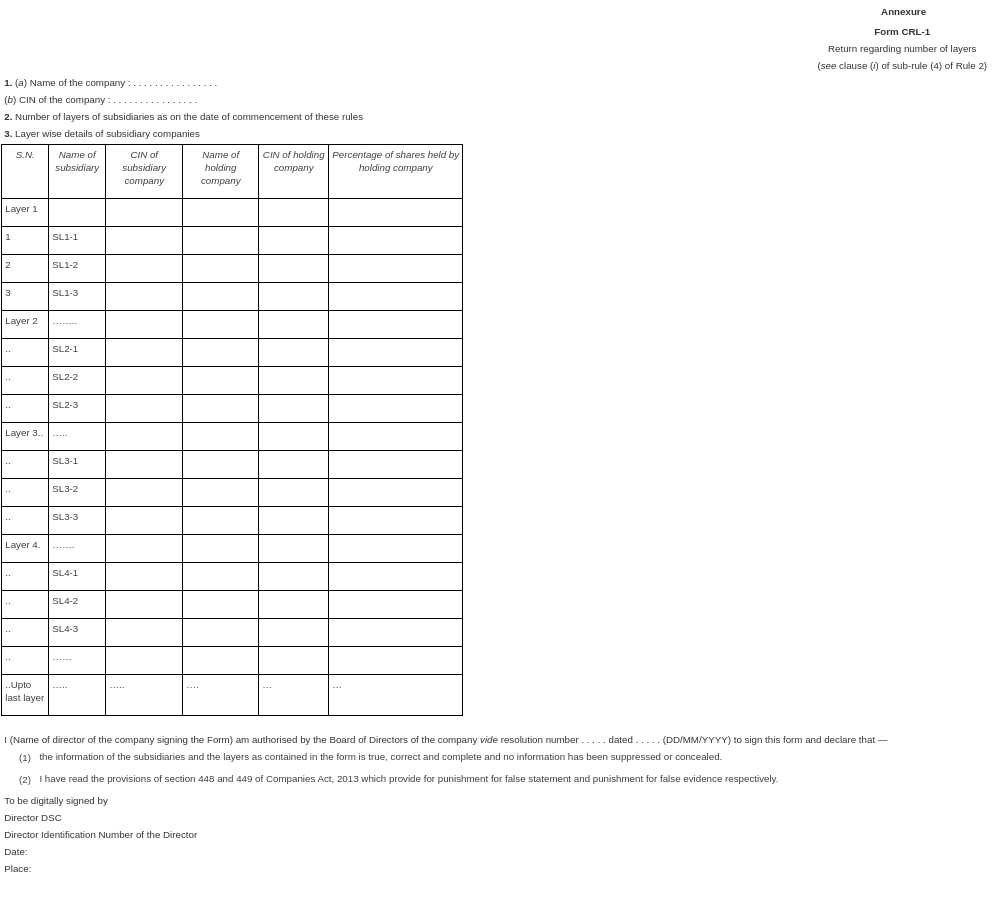 Form CRL-1