
IndiaFilings
Expert
Published on: Sep 25, 2026
Calculating Value of Supply under GST
The value of supply is a critical aspect of GST compliance in India, as it determines the amount of GST payable for each transaction. According to the GST Act, the value of a supply of goods or services is based on the transaction value, which is the price actually paid or payable. This value applies where the supplier and recipient are not related, and the price is the sole consideration for the supply. In this article, we explore how to calculate the value of supply under GST.
Value of Supply Components
Under GST, the value of supply must encompass any taxes, duties, cesses, fees, and charges levied under any law, except for IGST, CSGT, and SGST, if charged separately by the supplier. Additionally, the value of supply must include:
- Any amount the supplier is liable to pay in relation to the supply, incurred by the recipient but not included in the price.
- Incidental expenses, such as commissions and packing, charged by the supplier before the delivery of goods or supply of services.
- Interest, late fees, or penalties for delayed payment.
- Subsidies linked directly to the price, excluding those provided by the Central or State Governments.
Discounts Excluded from Value of Supply
Discounts given at any time before or after the supply are not included in the value of supply, even if documented on the invoice. This rule implies that the input tax credit (ITC) is not attributable to discounts noted on invoices.
Calculating Value for Supply: Partial Money Consideration
When the consideration is not wholly in money, the value includes this non-monetary component. The GST evaluation involves the following methods:
Open Market Value
If available, the open market value of goods or services should be used as the value of supply, ensuring accurate GST calculations even if the monetary transaction is lower.
Total Consideration Received
If the open market value is unavailable, sum the monetary consideration and the non-monetary consideration to calculate the total value of the supply.
For more specific guidance, consider consulting on online GST filing with IndiaFilings.
Like Kind and Quality
When previous methods are infeasible, applying the value of similar goods or services of like kind and quality can serve as a benchmark for valuation.
Total Consideration
Calculate the total consideration by adding the monetary amount to the equivalent of non-monetary considerations when no other methods apply.
Value of Supply Using Cost Method
When supply value cannot be determined using aforementioned methods, it can be calculated at 110% of the cost of production, manufacturing, acquisition of goods, or provision of services.
Residual Method for Value of Supply
If all else fails, calculate the value using reasonable means consistent with the principles and general provisions of Section 15 of the GST Act. Service providers may use this method directly in some cases, as an alternative to the cost method.
For more details on the process, visit our page on GSTR-1 filing.
Valuing Supply Between Related Entities
Transactions between related parties require specific methods for accurate value determination:
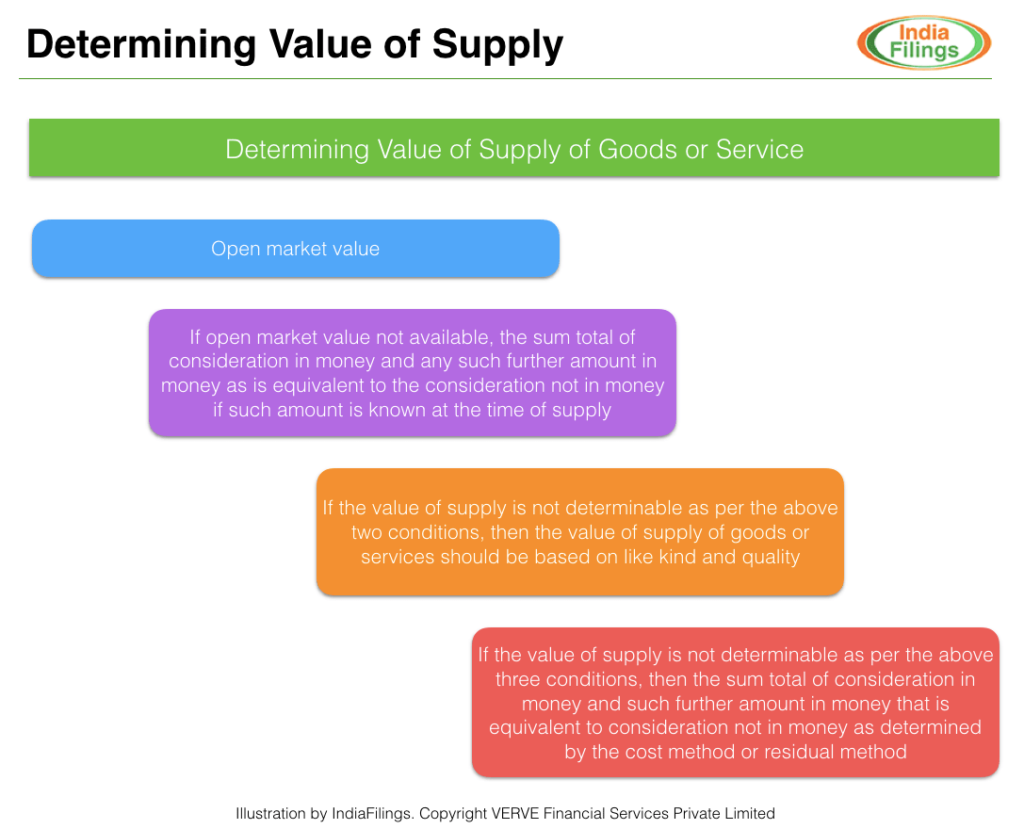 Determining Value of Supply under GST
Read the guide for related party transactions under GST.
GST Valuation Rules 2017
Adhering to the GST Valuation Rules, 2017, is essential for compliant goods and/or service valuation under the GST Act. The detailed rules are available for review:
For assistance with filing and understanding due dates, you can always visit our section on GST filing due dates.
For more comprehensive guidance on GST registration or filing, get in touch with an IndiaFilings CA-assisted service.