IndiaFilings

Published on: Jun 24, 2026

Adangal - Tamil Nadu

In a property transaction, adangal document plays an important role in establishing a clear property title to the seller. Adangal is maintained by the concerned Village Administrative Officer (VAO) and can be obtained by making an application. In this article, we look at the procedure for obtaining adangal in detail.

What is Adangal?

Adangal is a type of land record that is maintained by the Village Administrate Officer. Adangal is also known as Village account No.2. and is written each year by the Village Administrative Officer. The documents contain the following details:

  • Patta lands
    • Wet
    • Dry
    • Manavari
  • Assessed wastelands
    • Wet
    • Dry
  • Poramboke land

It is the primary duty of the Village Administrative Officer to register in the adangal the details of crops raised in the land, trees standing on all government lands (whether under tree tax system or not) cases of unauthorized occupation of Government lands, cases of Fasli Jasthi and Theervai Jasthi, etc. The Village Administrative Officer (VAO) should do the recording of crops every month. Hence, the adangal provides a timeline of ownership and use of property making it invaluable in establishing a property title.

Details in Adangal

Adangal contains various important details like the Survey Number of the property, extent, assessment and land classification which is taken from A register. Further, the name of the landowner is also mentioned in the adangal with reference to the Chitta document. Finally, the document contains details of trees, wells, lands reserved for Scheduled Castes or Scheduled Tribes, assignments made with or without conditions. However, the details in adangal should be drawn up every year and the figures (extent and assessment) classification wise should tally with those noted in 'A' Register.

Sample:

A sample document is below for reference:
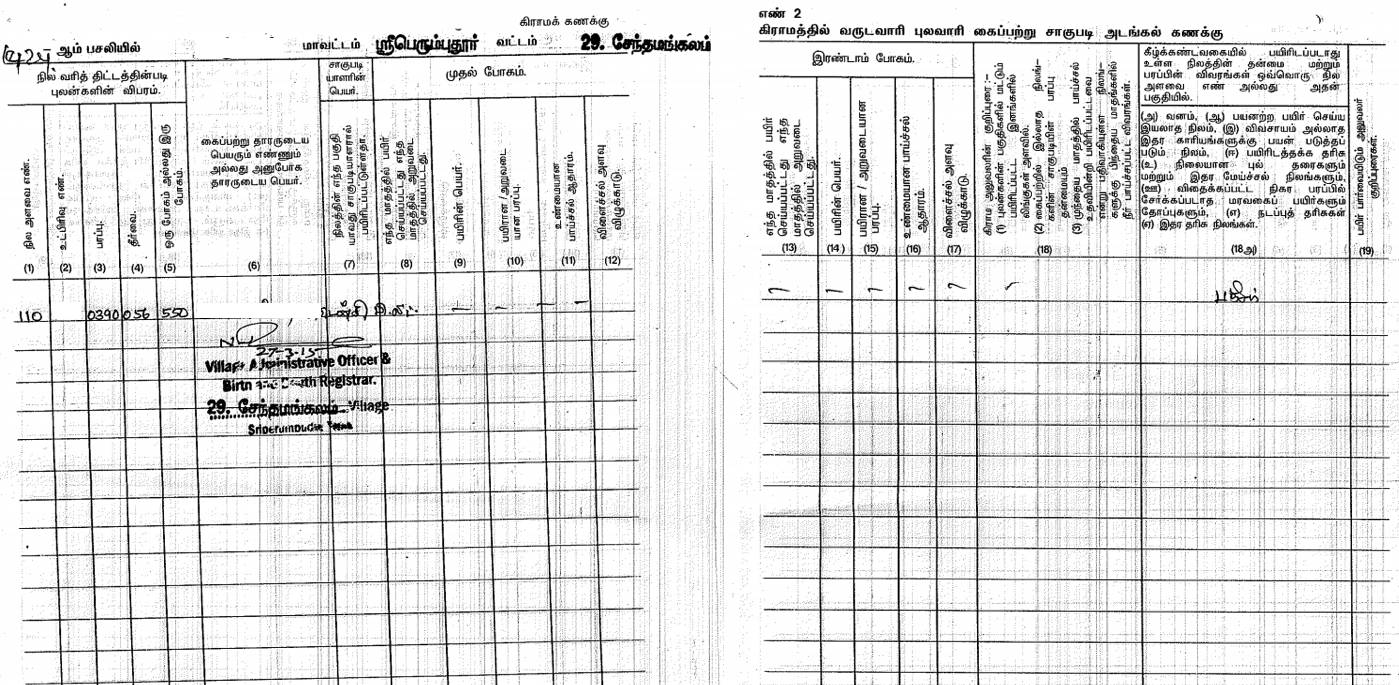
Adangal

Adangal

How to Obtain Adangal ?

A property can receive adangal by contacting the concerned Village Administrative Officer (VAO). In case you need to obtain adangal for a property, get in touch with an IndiaFilings Advisor at

sales@indiafilings.com

or get

online Patta Chitta from IndiaFilings.
Back to Learn

Frequently Asked Questions

Common questions about Adangal Land Records Tamil Nadu.

An adangal document is a type of land record maintained by the Village Administrative Officer (VAO) in Tamil Nadu. It contains details about patta lands, wastelands, poramboke land, crops raised, trees standing on government lands, and any unauthorized occupation of government lands in the village.
The adangal document plays a crucial role in establishing clear property title to the seller. It provides a timeline of ownership and usage details of the property, making it invaluable in verifying the seller's claim over the property during transactions.
An adangal document typically records the survey number of the property, extent, assessment, land classification, name of the landowner (with reference to the Chitta document), details of trees, wells, lands reserved for Scheduled Castes or Scheduled Tribes, and any assignments made with or without conditions.
The Village Administrative Officer (VAO) is required to update the adangal document every year by recording the crops raised on the land each month. This ensures that the document remains current and reflects any changes in ownership or usage of the property.
Yes, an adangal document can be obtained for any property in Tamil Nadu by contacting the concerned Village Administrative Officer (VAO) responsible for maintaining the records for that particular village or area.
To obtain an adangal document for a property, you need to get in touch with the Village Administrative Officer (VAO) of the respective village where the property is located and submit an application requesting the document.
The details in the adangal document, such as the extent, assessment, and land classification, should tally with the figures noted in the 'A' Register, which is the primary land record maintained by the revenue authorities.
The sections in the adangal document that are particularly useful in property transactions include the survey number, extent, land classification, and the name of the landowner recorded with reference to the Chitta document. These details help establish the ownership and legal status of the property.
While the adangal document is maintained by the Village Administrative Officer (VAO) of the respective village, it should be possible to obtain the document for a property located in a different village or district by contacting the appropriate VAO and submitting an application.