

RENU SURESH
Expert
Published on: Mar 28, 2026
Udyog Aadhar for MSME Registration
Udyog Aadhar was a simplified registration system introduced by the Ministry of Micro, Small & Medium Enterprises (MSME), Government of India, to make it easier for MSMEs to register and access various government benefits. Launched in 2015, the Udyog Aadhar initiative allowed business owners to self-declare their enterprise details using a simple online form, requiring only basic documents like Aadhaar and PAN. It replaced the earlier complex filing systems such as EM-I and EM-II.
However, from July 1, 2020, the Udyog Aadhar system was officially replaced by Udyam Registration—a more streamlined and digitally integrated process. While Udyog Aadhar registrations are no longer accepted, many entrepreneurs still search for information under this legacy term. This article explores the Udyog Aadhar system, its evolution into Udyam Registration, and how MSMEs can benefit from registering under the current framework.
Udyog Aadhar for MSME
As mentioned, the Ministry of MSME notified a one-page Udyog Aadhar Memorandum (UAM) through the Gazette of India on 18.09.2015 as part of an initiative to ease the Registration of MSMEs. The process for obtaining MSME registration has been simplified by introducing the Udyog Aadhar for MSMEs in India. Before the Udyog Aadhaar, two filings, namely the Entrepreneur Memorandum-I (EM-I) and the Entrepreneur Memorandum-II (EM-II), had to be filed to obtain MSME or SSI Registration. With Udyog Aadhaar, obtaining SSI or MSME registration has been drastically simplified. In addition to simplifying the registration process, the MSME registration form has also been simplified.
Udyog Aadhaar registration form was made in a self-declaration format under which the MSME self-certifies its existence, bank account details, promoter/owners' Aadhar, and other essential information required. Based on the simple form submitted, the business would be issued online, at a minimum, a unique identifier or Udyog Aadhaar, making the unit formally registered as an SSI Registrationor MSME.
Udyam Registration
Udyam registration is the new process for registering MSMEs launched by the Ministry of Micro, Small & Medium Enterprises on July 1, 2020. The government of India initiated Udyam registration as a substitute for the earlier method of Udyog Aadhaar to make it easier for MSMEs to register with the government portal.
Earlier, the process of Udyog Aadhaar registration was lengthy and confusing. The person registering for the same had to go through many categories and documents, requiring a lot of paperwork. With this new process, any person can register easily in a single window without needing extensive documents or paperwork for the same.
Click here to learn more about the MSME – Udyam Registration.
MSME Registration Prior to Udyog Aadhaar
Prior to the introduction of Udyog Aadhaar, businesses seeking MSME or SSI Registration were required to complete two separate filings: Entrepreneur Memorandum-I (EM-I) / Entrepreneur Memorandum-II (EM-II) and SSI Registration.
Entrepreneurs Memorandum (Part-II) / [EM-II]
After the implementation of the Micro, Small, and Medium Enterprises Development Act, 2006, with effect from October 2006, the filing of the Entrepreneurs Memorandum Part-I and Part-II came into vogue.
According to MSME Act, MSMEs file Entrepreneurs Memorandum (Part-I) at District Industries Centers (DICs) before setting up an enterprise, applicants used to file applications for obtaining utilities, building plan approval from local bodies, consent to establish from the State Pollution Control Board or applying for a term loan from the bank or a financial institution to set up the enterprise along with a copy of EM-I.
After the commencement of the project, the entrepreneur concerned files the Entrepreneur's Memorandum (Part-II) / [EM-II]. Before the MSMED Act 2006, there was a system of registration for small-scale industrial units by the DICs. Filing of EM-II is discretionary. To ameliorate the ease of doing business, the MSME department has developed a web portal for online filing of Entrepreneurship Memorandum I and II - required for obtaining MSME registration. The objective of introducing such a feature was to make the SSI or MSME registration process simple and available from anywhere. UAM registration/Udyam registration is given after an enterprise starts commercial operations.
Earlier MSME or SSI Registration
Before introducing Entrepreneurship Memorandum I and II, the State's District Industry Centers, managed the MSME Registration in each state. The procedure for obtaining SSI or MSME registration was through manual filing, and entrepreneurs found it difficult to obtain SSI or MSME registration as the process was ridden with challenges.
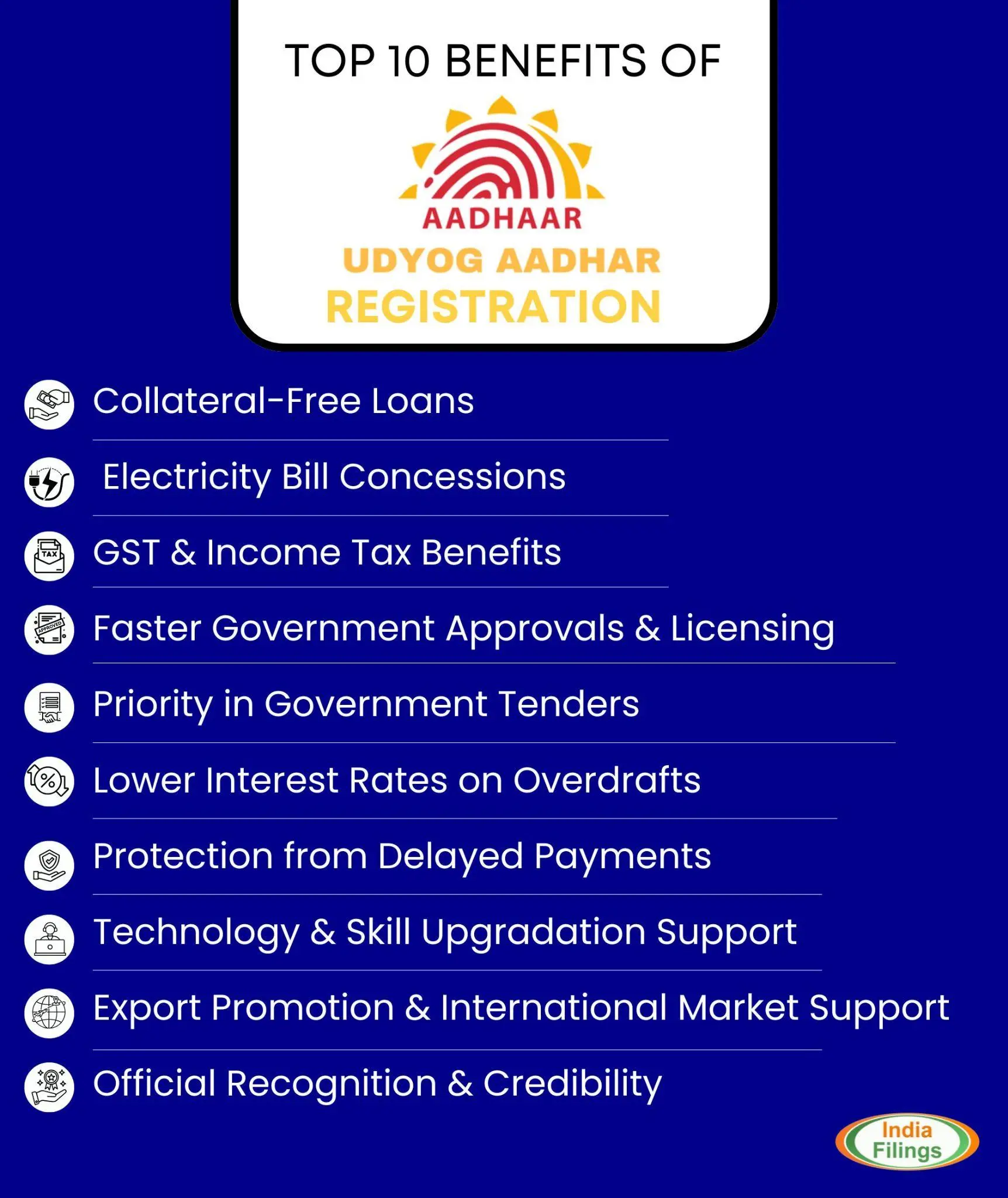
Key Benefits of Udyog Aadhaar Registration
While Udyog Aadhaar is now discontinued, it played a pivotal role in bringing micro, small, and medium enterprises into the formal economy. Here are the expanded key benefits that made Udyog Aadhaar valuable:
1. Easy Access to Collateral-Free Loans
Registered MSMEs were eligible for credit guarantee schemes offered by banks and NBFCs under the Credit Guarantee Fund Scheme (CGTMSE). These loans were often collateral-free, making it easier for small businesses to secure capital.
2. Preference in Government Tenders
Businesses with Udyog Aadhaar registration received special reservation in government procurement tenders under the Public Procurement Policy. This meant more business opportunities, especially for micro and small units.
3. Subsidies and Incentives
Udyog Aadhaar holders could avail:
- Capital and technology subsidies
- Subsidised patent/trademark registration fees
- Reimbursement of ISO certification expenses
- 50% subsidy on trademark registration fees
4. Lower Interest Rates on Overdrafts
Banks extended 1% interest rate exemptions on overdrafts to registered MSMEs, reducing the cost of working capital.
5. Concession on Electricity Bills
Many state governments offered concessions or subsidies on electricity tariffs for Udyog Aadhaar-registered enterprises, significantly reducing operational costs.
6. Easier Licensing and Approvals
With Udyog Aadhaar, businesses found it easier to obtain licenses, approvals, and registrations from government bodies, thanks to recognised MSME status.
7. Protection Against Delayed Payments
The MSMED Act provided legal safeguards against delayed payments from buyers. Udyog Aadhaar holders were allowed to:
- File complaints with MSME Samadhan
- Receive interest on delayed payments
8. Easier Access to Export Promotion Benefits
Udyog Aadhaar registration enabled access to various export promotion council incentives, subsidies, and training programs, helping MSMEs reach global markets.
9. Income Tax and GST-Related Benefits
Many registered MSMEs enjoyed exemptions or relaxations under Direct and Indirect Taxes, subject to prevailing policies. This included schemes under Section 80-IB and presumptive taxation schemes for eligible businesses.
10. Business Recognition and Credibility
Having a Udyog Aadhaar gave businesses official recognition as an MSME, enhancing trust with banks, customers, and suppliers.
How to Get Udyog Aadhaar Registration
Note: The Udyog Aadhaar Memorandum (UAM) has been discontinued. New MSMEs must register under Udyam.
Here is a clear step-by-step guide for obtaining Udyog Aadhaar (now largely replaced by Udyam Registration) and the current Udyam Registration:
- Visit the Official Udyam Registration Portal
- Go to the official website
- Start New Registration
- Click on the option for new entrepreneurs or those not yet registered as MSMEs or with EM-II.
- Enter Aadhaar Details
- Enter your Aadhaar number and the name as per your Aadhaar card.
- Click on "Validate & Generate OTP".
- Verify OTP
- Enter the OTP sent to your mobile number linked to your Aadhaar.
- Click on "Validate".
- PAN Verification
- Enter your PAN number (if applicable) and validate it.
- Indicate if you have filed the previous year’s ITR and if you have a GSTIN.
- Fill in Business Details
- Provide enterprise details: name, address, bank account, activity, NIC code, number of employees, investment, and turnover267.
- Review all information carefully.
- Submit and Final OTP
- Click "Submit" and enter the final OTP received on your mobile.
- Confirm submission.
- Receive Udyam Registration Certificate
- You will instantly receive your Udyam Registration Certificate via email26.
- The certificate includes a dynamic QR code for easy verification.
Differences between Udyog Aadhaar and Udyam registration
Udyam and Udyog Aadhaar are the same processes used to register MSMEs in India. The earlier Udyog Aadhaar registration has been transformed to the new Udyam registration since July 2020.
Registration Method
For the registration process, Udyog Aadhaar only requires the applicant's Aadhaar card and PAN number, and it provides instant self-certification as per the old MSME criteria. In contrast, Udyam Registration only requires the applicant's Aadhaar card and provides verified certification per the new MSME criteria.
Integration of Other Portals
Udyam registration is fully integrated with other MSME portals, while Udyog Aadhaar is not integrated with other government portals, such as Gem.
Form for Registration
Compared to Udyog Aadhaar, the Udyam Portal features a longer form requiring details from the Income Tax portal and the GST departments for the registration procedure. Udyam registration requires an Aadhaar card linked to a mobile number.
Number of Registration
Udyog Aadhaar can be registered several times with different corporate names, but Udyam registration can be obtained by a single person with a single Aadhaar card.
Here is a clear table comparison highlighting the key differences between Udyog Aadhaar and Udyam Registration:
Feature | Udyog Aadhaar | Udyam Registration |
Year Introduced | September 2015 | July 2020 |
Registration Method | Online or offline, self-certification | Completely online, paperless, self-declaration |
Documents Required | Aadhaar, PAN (not always mandatory) | Aadhaar, PAN, GSTIN (mandatory, except exemptions) |
Verification | No backend verification | Automated verification via PAN & GSTIN databases |
Integration | Not integrated with other government portals | Fully integrated with income tax, GST, GeM portals |
Registration Form | Shorter form, less detail required | Longer form, more details from IT and GST systems |
Number of Registrations | Multiple registrations per person are possible | Only one registration per Aadhaar (linked to PAN) |
Validity | Required re-registration | Permanent, no renewal needed |
Certificate | Issued as a soft copy, no QR code | Issued as a soft copy with a QR code for verification |
Process Clarity | Simpler, but less secure and prone to errors | More streamlined, secure, and user-friendly |
Government Benefits | Eligible for most schemes | Mandatory for all government schemes post-2020 |
Get your Udyog Aadhaar/Udyam Registration through IndiaFilings!
The registration process involves filing various forms and documents, which can be time-consuming and tedious. IndiaFilings offers a hassle-free Udyog Aadhar/Udyam Registration service to help businesses get their registration done quickly and easily. With our team of experts, we provide end-to-end assistance for registration, including helping clients understand the fees associated with it. This helps businesses save time, money, and effort in getting their registration done.
Frequently asked questions (FAQs)
1. What is the difference between Udyam Registration and Udyog Aadhaar?
Udyam Registration is the latest MSME registration system introduced in July 2020, replacing the older Udyog Aadhaar system. It features a more secure, integrated, and automated registration process using PAN and GST data, while Udyog Aadhaar was simpler but less secure.
2. Is Udyog Aadhaar still valid after the introduction of Udyam Registration?
No, Udyog Aadhaar has been discontinued. Existing Udyog Aadhaar holders must migrate to Udyam Registration to continue availing MSME benefits.
3. Can one person register multiple MSMEs under Udyam Registration?
No, under Udyam Registration, a single Aadhaar card (linked to PAN) can only be used for one MSME registration, unlike Udyog Aadhaar, where multiple registrations were allowed.
4. Is it mandatory to obtain Udyam Registration for MSMEs?
While not legally mandatory, Udyam Registration is essential for accessing various government benefits, schemes, subsidies, and tenders for MSMEs.
5. What documents are required for Udyog Aadhaar Registration?
The primary documents needed are Aadhaar number, PAN card, and GSTIN (if applicable). No physical documents need to be uploaded as the system is self-declared and auto-verified.
6. How is Udyam Registration more advanced than Udyog Aadhaar?
Udyam Registration is integrated with Income Tax, GST, and GeM portals, uses auto-verification, provides a QR-coded certificate, and is paperless. Udyog Aadhaar lacked such integrations and was more prone to manual errors.
7. Can I still register through Udyog Aadhaar?
No, Udyog Aadhaar (UAM) registration has been officially discontinued. All new MSME registrations must be done through the Udyam portal.
8. What are the benefits of registering under Udyog Aadhaar/Udyam?
Benefits include collateral-free loans, tax exemptions, concession on electricity bills, access to government tenders, 1% interest rebate on overdrafts, protection against delayed payments, and fee discounts for trademarks and patents.
9. Is the Udyog Aadhaar Registration certificate issued instantly?
Yes, once the application is completed and validated, the certificate is issued immediately via email and includes a dynamic QR code for authenticity verification.
10. Where can I apply for Udyog Aadhaar/Udyam Registration?
You can apply directly on the official Udyam Registration portal, or seek professional help from services like IndiaFilings for guided assistance.
11. How to download old Udyog Aadhaar certificate?
You can still download your old Udyog Aadhaar Memorandum (UAM) certificate if you had registered before the system was discontinued in 2020. Here’s how:
Steps to Download Udyog Aadhaar Certificate:
- Visit the official Udyog Aadhaar portal (archived version).
- Enter your UAM number and mobile number used during registration.
- Generate and verify OTP sent to your mobile.
- Download or print the certificate.This option is for already registered users only. New registrations are no longer allowed under Udyog Aadhaar.
12. Can I renew Udyog Aadhaar in 2025?
No, you cannot renew Udyog Aadhaar in 2025. The Udyog Aadhaar system has been officially discontinued since July 1, 2020, and replaced by Udyam Registration.
If you still have a valid Udyog Aadhaar and wish to continue receiving MSME benefits, you must migrate to Udyam Registration.
Migration Steps:
- Visit:Udyam Registration Portal
- Click on “For those already having registration as UAM”
- Enter your UAM number and mobile number
- Validate with OTP and complete the form
Important: Udyam Registration is permanent and doesn't require renewal like Udyog Aadhaar.
13. Is the Udyog Aadhaar number still valid for banks?
Technically, yes, but with limitations.
As of 2025, some banks may still accept Udyog Aadhaar numbers for reference, especially for loans granted before 2020. However, most financial institutions now require Udyam Registration for:
- New MSME loan applications
- Access to government schemes like CGTMSE, PMEGP, and interest subvention
Migrate your Udyog Aadhaar to Udyam Registration to ensure eligibility for financial and government benefits.
Related Article
What is Udyog Aadhar Benefits?
Who is eligible for Udyog Aadhar?